


The Taipei Folk Dance Theatre (台北民族舞團) happily celebrated its 20th anniversary last year with a program that reflected the company’s history of interpreting Taiwanese culture while giving new meaning to tradition. Founder and artistic director Tsai Li-hua (蔡麗華), who has built both an academic and a creative career on research and recording the music and movements of ethnic dances, had every reason to feel proud of her achievements.
Health concerns, however, forced her to take a background role in the company’s new production, Dancing Portrait of Taiwan (舞語台灣), as she was recovering from a stroke last year. Luckily, she has a dedicated administrative team, a strong group of dancers and a talented son, Lin Wen-chung (林文中), who has inherited his mother’s capacity for hard work.
In addition to running his own small modern dance company, WCdance, the 35-year old Lin also pitched in at his mother’s troupe and created one of the works on this weekend’s program.
Tsai and Lin then turned to two men who have often worked with the company, Hu Min-shan (胡民山) and Guo Ruei-ling’s (郭瑞林), to fill out the program.
Hu’s Tales of Marvels About Po Jieh (婆姐傳奇), or the “great aunts legend” takes its inspiration from a folk tale about the 12 pojieh, the masked female attendants of deities at Taoist temples who help women during pregnancy and childbirth.
Guo’s Community Bulletin (社區公告) examines traditional movements, but from a more modern perspective — the popularity of qigong, tai chi and yoga classes at community centers nationwide — all set to a classic Taiwanese ballad.
Lin said his 23-minute-long piece, Reflections in a Lake (湖映), proved to be a huge challenge for him. While he had collaborated with his mother last year on her Wild Taiwan (狂想台灣), he had never tried to create a folk dance before.
“It’s unlike any other piece I’ve done ... I didn’t want to
use any ‘traditional’ gestures
or dance movements. The
feeling of ‘Eastern-ness’ is rooted in our minds, not the movements. I wanted to find something different from the big, senior Taiwanese choreographers like Lin Hwai-min (林懷民) or my mother,” he said in a telephone interview.
The work conveys a very “Eastern” image, he said, about seeing the world indirectly through the reflections on the surface of a lake. The second image he drew upon was leaves falling in autumn and winter, “falling and circling in the air.”
When asked why he chose to work with just five dancers instead of the entire troupe, Lin Wen-chung laughed and said it was based on simple economics — and his own work ethic.
“I demand high quality from the dancers, but we have limited rehearsal time because of everyone’s schedules,” he said. “The rehearsal fee system here means that with five dancers I could have four months rehearsal time. So it was a choice — we could have 10 dancers for two months or five dancers for four months.”
It wasn’t a tough decision, he said, because he’s perfectionist.

Last week Joseph Nye, the well-known China scholar, wrote on the Australian Strategic Policy Institute’s website about how war over Taiwan might be averted. He noted that years ago he was on a team that met with then-president Chen Shui-bian (陳水扁), “whose previous ‘unofficial’ visit to the US had caused a crisis in which China fired missiles into the sea and the US deployed carriers off the coast of Taiwan.” Yes, that’s right, mighty Chen caused that crisis all by himself. Neither the US nor the People’s Republic of China (PRC) exercised any agency. Nye then nostalgically invoked the comical specter
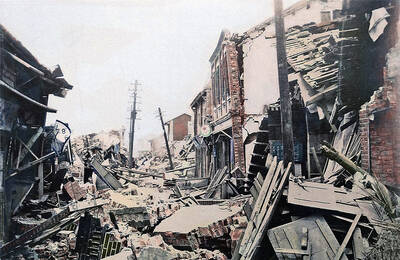
April 15 to April 21 Yang Kui (楊逵) was horrified as he drove past trucks, oxcarts and trolleys loaded with coffins on his way to Tuntzechiao (屯子腳), which he heard had been completely destroyed. The friend he came to check on was safe, but most residents were suffering in the town hit the hardest by the 7.1-magnitude Hsinchu-Taichung Earthquake on April 21, 1935. It remains the deadliest in Taiwan’s recorded history, claiming around 3,300 lives and injuring nearly 12,000. The disaster completely flattened roughly 18,000 houses and damaged countless more. The social activist and

Over the course of former President Ma Ying-jeou’s (馬英九) 11-day trip to China that included a meeting with Chinese Communist Party (CCP) leader Xi Jinping (習近平) a surprising number of people commented that the former president was now “irrelevant.” Upon reflection, it became apparent that these comments were coming from pro-Taiwan, pan-green supporters and they were expressing what they hoped was the case, rather than the reality. Ma’s ideology is so pro-China (read: deep blue) and controversial that many in his own Chinese Nationalist Party (KMT) hope he retires quickly, or at least refrains from speaking on some subjects. Regardless

Approaching her mid-30s, Xiong Yidan reckons that most of her friends are on to their second or even third babies. But Xiong has more than a dozen. There is Lucky, the street dog from Bangkok who jumped into a taxi with her and never left. There is Sophie and Ben, sibling geese, who honk from morning to night. Boop and Pan, both goats, are romantically involved. Dumpling the hedgehog enjoys a belly rub from time to time. The list goes on. Xiong nurtures her brood from her 8,000 square meter farm in Chiang Dao, a mountainous district in northern Thailand’s


 RSS
RSS