


Wen Qiang (文強) had a fondness for Louis Vuitton belts, fossilized dinosaur eggs and B-list pop stars. For a public employee in charge of the local judiciary, he also had a lot of money: nearly US$3 million that investigators found buried beneath a fish pond.
But Wen’s lavish tastes were nothing compared with the carnal appetites of his sister-in-law, Xie Caiping (謝才萍), known as “the godmother of the Chongqing underworld.” Prosecutors say she ran 30 illegal casinos, including one across the street from the courthouse. She also employed 16 young men who, according to the state-run press, were exceedingly handsome and obliging.
In recent weeks, Xie, Wen and a cavalcade of ranking officials and lowbrow thugs have been players in a mass public trial that has exposed the unseemly relationship between gangsters, police officers and the sticky-fingered bureaucrats.
The spectacle involves more than 9,000 suspects, 50 public officials, a petulant billionaire and criminal organizations that dabbled in drug trafficking, illegal mining, and random acts of savagery, most notably the killing of a man for his unbearably loud karaoke voice.
But like all big corruption cases in China, this one is as much about politics as graft. The political machine in Chongqing, a province-size megacity of 31 million people in the southwest, has been broken up by a new Communist Party boss, Bo Xilai (薄熙來), who is the son of a revolutionary party veteran and has his eye on higher office.
Bo, a former trade minister sent to Chongqing to burnish his managerial credentials, has conducted the crackdown in a way that appears devised to maximize national attention. The drawn-out nature of the trial and the release of lurid details of the criminal syndicate have given Bo a new reputation as a leading corruption fighter, though the inquiry has yet to implicate any really high-ranking party officials.
So far six people have been sentenced to death. Xie got off relatively lightly, receiving an 18-year prison term on Tuesday.
How Bo’s performance is regarded by the party elite is a matter of speculation. There are some suggestions that his swagger, including boastful comments to the news media,
strikes some fellow officials as excessive.
Anti-corruption campaigns by China’s one-party state are generally calibrated to show resolution in tackling venality, but also to reassure the public that whatever problems are uncovered are localized and effectively contained.
“These guys are all for fighting corruption, but they are a little alarmed by the way Bo Xilai has been going about it and building up his personality,” said Sidney Rittenberg, one of the few American citizens to join the Communist Party here and a confidant of Chinese leaders since 1944. “People I talk to say he’s getting too big for his britches.”
A so-called princeling whose father, Bo Yibo (薄一波), was an economic planner and a onetime ally of the paramount leader Deng Xiaoping (鄧小平), Bo, 60, is already a member of the Communist Party’s powerful Politburo. He is often talked about as a future top leader in Beijing, although in the party’s rigid hierarchy the No. 1 posts in the party and the government have already been assigned to other younger officials.
Recent statements by Bo suggest he understands the perils of drawing too much attention. Two weeks ago, he defended the crackdown, saying he was forced to act by the rampant violence and brazen criminality that had given this perpetually foggy city a reputation for lawlessness.
“The public gathered outside government offices and held up pictures of bloodshed,” he said. “The gangsters slashed people with knives just like butchers killing animals.”
In the three weeks since trials began, the crowds have continued to come, and their stories of bloodshed are indeed horrifying. They press outside the gates of the 5th Intermediate Court, hoping to glimpse the orange-vested defendants who are paraded through the hearings.
Others desperately seek out reporters willing to hear tales of crimes unpunished. “The bandits used to live in the mountains; now they live in the Public Security Bureau,” said Zheng Yi, a vegetable wholesaler.
Unlike past sweeps that brought down crime bosses and their henchmen, the crackdown in Chongqing has yielded a number of wealthy businessmen and Communist Party officials, exposing the depth of corruption that has resulted from the mixing of state control and free-market economics in China.
Ko-lin Chin, who studies the intermingling of organized crime and government in China, said the line between legitimate business and illegal conduct had become increasingly blurred, although most official corruption involved bribery, not violence.
“As these gangs have become more powerful, their existence depends entirely on the cooperation and tolerance of the Communist Party,” said Chin, a professor of criminal justice at Rutgers. “But when things get out of hand, as they did in Chongqing, the party can really go after these groups with a vengeance.”
Among those on trial this week is Li Qiang (黎強), a local legislator and billionaire who the authorities say owned a fleet of 1,000 cabs and 100 bus routes. So great was his power, they say, that he orchestrated a taxi strike last year that brought the city to a standstill. On trial with him are three government officials suspected of acting as his “protection umbrellas” in exchange for payments of about US$100,000 each.
While Li stood in the dock, more than 200 people gathered outside in the rain, including women who said they were roughed up in October last year when they refused to vacate their homes for a redevelopment project. One of them, Wu Pinghui, 67, said 40 people were herded into a government-owned bus and dumped in the countryside. By the time they made it back, their homes were gone.
“We called 110,” she said, referring to the Chinese emergency number, “but the police said they couldn’t get involved in a government affair.”
Hong Guibi also came to the courthouse. She said the Communist Party chief of her village, enraged when she and her husband refused to give him part of their orchard, watched as thugs attacked the couple with cleavers. Hong, 47, was critically wounded, and her husband was killed. “The neighbors heard our screams, but they were afraid to do anything,” she said.
Although heartened that so many are being prosecuted, Hong is still waiting for someone to prosecute the village chief. “If I could just kneel down in front of Bo Xilai,” she said, “I’m sure he would solve my problem.”
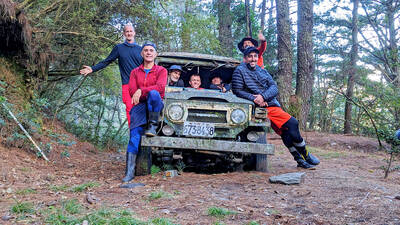
The year was 1991. A Toyota Land Cruiser set out on a 67km journey up the Junda Forest Road (郡大林道) toward an old loggers’ camp, at which point the hikers inside would get out and begin their ascent of Jade Mountain (玉山). Little did they know, they would be the last group of hikers to ever enjoy this shortcut into the mountains. An approaching typhoon soon wiped out the road behind them, trapping the vehicle on the mountain and forever changing the approach to Jade Mountain. THE CONTEMPORARY ROUTE Nowadays, the approach to Jade Mountain from the north side takes an

Last week Joseph Nye, the well-known China scholar, wrote on the Australian Strategic Policy Institute’s website about how war over Taiwan might be averted. He noted that years ago he was on a team that met with then-president Chen Shui-bian (陳水扁), “whose previous ‘unofficial’ visit to the US had caused a crisis in which China fired missiles into the sea and the US deployed carriers off the coast of Taiwan.” Yes, that’s right, mighty Chen caused that crisis all by himself. Neither the US nor the People’s Republic of China (PRC) exercised any agency. Nye then nostalgically invoked the comical specter

Relations between Taiwan and the Czech Republic have flourished in recent years. However, not everyone is pleased about the growing friendship between the two countries. Last month, an incident involving a Chinese diplomat tailing the car of vice president-elect Hsiao Bi-khim (蕭美琴) in Prague, drew public attention to the People’s Republic of China’s (PRC) operations to undermine Taiwan overseas. The trip was not Hsiao’s first visit to the Central European country. It was meant to be low-key, a chance to meet with local academics and politicians, until her police escort noticed a car was tailing her through the Czech capital. The
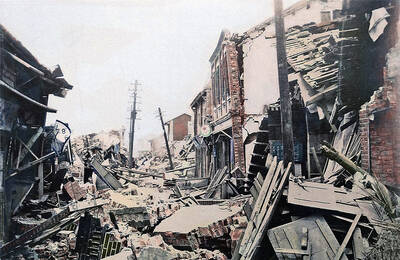
April 15 to April 21 Yang Kui (楊逵) was horrified as he drove past trucks, oxcarts and trolleys loaded with coffins on his way to Tuntzechiao (屯子腳), which he heard had been completely destroyed. The friend he came to check on was safe, but most residents were suffering in the town hit the hardest by the 7.1-magnitude Hsinchu-Taichung Earthquake on April 21, 1935. It remains the deadliest in Taiwan’s recorded history, claiming around 3,300 lives and injuring nearly 12,000. The disaster completely flattened roughly 18,000 houses and damaged countless more. The social activist and


 RSS
RSS