


Try telling Brother Jerry Smith that the recession in the US has ended. As scores of people queued up last week at the soup kitchen that the Capuchin friar helps run in Detroit, the celebrations on Wall Street in New York seemed from another world.
The hungry and needy come from miles around to get a free healthy meal. Though the East Detroit neighborhood the soup kitchen serves has had it tough for decades, the recession has seen almost any hope for anyone getting a job evaporate. Neither is there any sign that jobs might come back soon.
“Some in the past have had jobs here, but now there is nothing available to people. Nothing at all,” Smith said as he sat behind a desk with a computer but dressed in the simple brown friar’s robes of his order.
Outside his office the hungry, the homeless and the poor crowded around tables. Many were by themselves, but some were families with young children. None had jobs. Indeed, the soup kitchen itself is now starting to dip into its savings to cope with a drying up of desperately needed donations. This is an area where times are so tough that the soup kitchen is a major employer for the neighborhood, keeping its own staff out of poverty. But now Smith fears he may also have to start laying people off.
Officially, the US is on the up. The economy grew by 3.5 percent in the past quarter. On Wall Street, stocks are rising again. The banks — rescued wholesale by taxpayers’ money last year — are posting billions of US dollars of profits. Thousands of bankers and financiers are wetting their lips at the prospect of enormous bonuses, often matching or exceeding those of pre-crash times. The financial sector is lobbying successfully to fight government attempts to regulate it. The wealthy are beginning to snap up property again, pushing prices up. In New York’s fashionable West Village a senior banker recently splurged US$10 million on a single apartment, sending shivers of delight through the city’s property brokers.
But for tens of millions of Americans such things seem irrelevant. Across the country lay-offs are continuing. Indeed, jobless rates are expected to rise for the rest of this year and perhaps beyond. Unemployment in the US stands at 9.8 percent. But that headline figure, massaged by bureaucrats, does not include many categories of the jobless. Another, broader official measure, which includes those such as the long-term jobless who have given up job-seeking and workers who can only find piecemeal part-time work, tells another story. That figure stands at 17 percent.
Added to that shocking statistic are the millions of Americans who remain at risk of foreclosure. In many parts of the country repossessions are still rising or spreading to areas that have escaped so far. In the months to come, no matter what happens on the booming stock market, hundreds of thousands of Americans are likely to lose their homes.
For them the recession is far from over. It rages on like a forest fire, burning through jobs, savings and homes. It will serve to exacerbate a long-term trend towards deepening inequality in the US. Real wages in the US stagnated in the 1970s and have barely risen since, despite rising living costs. The gap between the average American worker and high-paid chief executives has widened and widened. The richest 1 percent of Americans have more financial wealth than the bottom 95 percent. It seems the American hope of a steady job, producing rising income and a home in the suburbs, has evaporated for many. A generation of aspiring middle-class homeowners have been wiped out by the recession. “Poor people just don’t have the political clout to lobby and get what they need in the way Wall Street does,” said Smith.
There is little doubt that Detroit is ground zero for the parts of the US that are still suffering. The city that was once one of the wealthiest in America is a decrepit, often surreal landscape of urban decline. It was once one of the greatest cities in the world. The birthplace of the American car industry, it boasted factories that at one time produced cars shipped over the globe. Its downtown was studded with architectural gems, and by the 1950s it boasted the highest median income and highest rate of home ownership of any major American city. Culturally it gave birth to Motown Records, named in homage to Detroit’s status as “Motor City.”
Decades of white flight, coupled with the collapse of its manufacturing base, especially in its world-famous auto industry, have brought the city to its knees. Half a century ago it was still dubbed the “arsenal of democracy” and boasted almost two million citizens, making it the fourth-largest in America. Now that number has shrunk to 900,000.
Its once proud suburbs now contain row after row of burnt-out houses. Empty factories and apartment buildings haunt the landscape, stripped bare by scavengers. Now almost a third of Detroit — covering a swath of land the size of San Francisco — has been abandoned. Tall grasses, shrubs and urban farms have sprung up in what were once stalwart working-class suburbs. Even downtown, one ruined skyscraper sprouts a pair of trees growing from the rubble.
The city has a shocking jobless rate of 29 percent. The average house price in Detroit is only US$7,500, with many homes available for only a few hundred dollars. Not that anyone is buying. At a recent auction of 9,000 confiscated city houses, only a fifth found buyers.
The city has become such a byword for decline that Time magazine recently bought a house and set up a reporting team there to cover the city’s struggles for a year. There has been no shortage of grim news for Time’s new “Assignment Detroit” bureau to get their teeth into. Recently a semi-riot broke out when the city government offered help in paying utility bills. Need was so great that thousands of people turned up for a few application forms. In the end police had to control the crowd, which included the sick and the elderly, some in wheelchairs. At the same time national headlines were created after bodies began piling up at the city’s mortuary. Family members, suffering under the recession, could no longer afford to pay for funerals.
Incredibly, despite such need, things are getting worse as the impact of the recession has bitten deeply into the city’s already catastrophic finances. Detroit is now US$300 million in debt and is cutting many of its beleaguered services, such as transport and street lighting.
As the number of bus routes shrivels and street lights are cut off, it is the poorest who suffer. People like TJ Taylor. He is disabled and cannot work. He relies on public transport. It has been cut, so now he must walk. But the lights are literally going out in some places, making already dangerous streets even more threatening. “I just avoid those areas that are not lit. I pity for the poor people who live in them,” he said.
The brutal truth, some experts say, is that Detroit is being left behind — and it is not alone. In cities across the US a collapsed manufacturing base has been further damaged by the recession and has led to conditions of dire unemployment and the creation of an underclass. Richard Feldman, a former Detroit car-worker and union official turned social activist, sees disaster across the country. Sitting in a downtown Detroit bar, he lists a grim roll call of cities across America where decline is hitting hard and where the official end of the recession will make little difference.
Names such as Flint, Youngstown, Buffalo, Binghamton, Newton. Feldman sees a relentless decline for working-class Americans all the way from Iowa to New York. He sees the impact in his own family, as his retired parents-in-law have difficulties with their gutted pension fund and his disabled son stares at cuts to his benefits. The economic changes going on, he believes, are a profound de-industrialization with which the US is failing to come to terms.
“We are going to have to face the end of the industrial age,” he said. “This didn’t just happen last October either. It’s been happening here in Detroit since the 1980s. Detroit just got it first, but it could happen anywhere now.”
The busy highway of Eight Mile Road marks the border between the city of Detroit and its suburbs. On one side stretches the city proper with its mainly black population; on the other stretches the progressively more wealthy and more white suburbs of Oakland County. But this recession has reached out to those suburbs, too. Repossessions have spread like a rash down the streets of Oakland’s communities. Joblessness has climbed, spurred by yet another round of mass lay-offs in the auto industry. Feldman recently took a tour down Eight Mile Road and was shocked by what he saw: “I went door-to-door north and south of Eight Mile and I could not tell the difference any more. I did not believe it until I saw it.”
Robin Boyle, an urban planning expert at Detroit’s Wayne State University, believes the real impact of the recession will continue to be felt in those suburbs for years to come. For decades they stood as a bulwark against the poverty of the city, ringing it like a doughnut of prosperity, with decrepit inner Detroit as the hole at its center.
Now home losses and job cuts are hitting the middle classes hard. “Recovery is going to take a generation,” he said. “The doughnut itself is sick now. But what do you think that means for the poor people who live in the hole?”
That picture is borne out by the recent actions of Gleaners Community Food Bank. The venerable Detroit institution has long sent out parcels of food, clothing and furniture all over the city. But now it is doing so to the suburbs as well, sometimes to people who only a year or so ago had been donors to the charity but now face food shortage themselves.
Gleaners has delivered a staggering 14,000 tonnes of food in the past 12 months alone. Standing in a huge warehouse full of pallets of potatoes, cereals, tinned fruit and other vitals, Gleaners’ president, DeWayne Wells, summed up the situation bluntly: “People who used to support this program now need it themselves. The recession hit them so quickly they just became overwhelmed.”
In Detroit many people see the only signs of recovery as coming from themselves. As city government retreats and as cuts bite deep, some of those left in the city have not waited for help. Take the case of Mark Covington. He was born and raised in Detroit and still lives only a few meters from the house where he grew up in one of the city’s toughest neighborhoods. Laid off from his job as an environmental engineer, Covington found himself with nothing to do. So he set about cleaning up his long-suffering Georgia Street neighborhood.
He cleared the rubble where a bakery had once stood and planted a garden. He grew broccoli, strawberries, garlic and other vegetables. Soon he had planted two other gardens on other ruined lots. He invited his neighbors to pick the crops for free, to help put food on their plates. Friends then built an outdoor screen of white-painted boards to show local children a movie each Saturday night and keep them off the streets. He helped organize local patrols so that abandoned homes would not be burnt down. He did all this for free. All the while he still looked desperately for a job and found nothing.
Yet Georgia Street improved. Local youths, practiced in vandalism and the destruction of abandoned buildings, have not touched his gardens. People flock to the movie nights, harvest dinners and street parties Covington holds. Inspired, he scraped together enough cash to buy a derelict shop and an abandoned house opposite his first garden. He wants to reopen the shop and turn the house into a community center for children. To do it, he needs a grant. Or a cheap bank loan. Or a job. But for people like Covington the grants have dried up, the banks are not lending, and no one is hiring. There is no help for him.
It is hard not to compare Covington’s struggle for cash to the vast bailout of the country’s financial industry. “We just can’t get a loan to help us out. The banks are not lending,” he said. On an unseasonable warm day last week, he stood in his urban garden, tending his crops, and gazed wistfully at the abandoned buildings that he now owns but cannot yet turn into something good for his neighborhood. He does not seem bitter. But he does wonder why it seems so easy in modern America for those who already have a lot to get much more, while those who have least are forgotten.
“It makes me wonder how they do it. And where is that money coming from?” he asked.

Last week Joseph Nye, the well-known China scholar, wrote on the Australian Strategic Policy Institute’s website about how war over Taiwan might be averted. He noted that years ago he was on a team that met with then-president Chen Shui-bian (陳水扁), “whose previous ‘unofficial’ visit to the US had caused a crisis in which China fired missiles into the sea and the US deployed carriers off the coast of Taiwan.” Yes, that’s right, mighty Chen caused that crisis all by himself. Neither the US nor the People’s Republic of China (PRC) exercised any agency. Nye then nostalgically invoked the comical specter
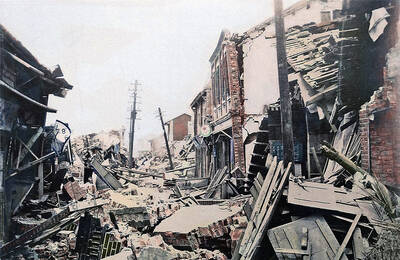
April 15 to April 21 Yang Kui (楊逵) was horrified as he drove past trucks, oxcarts and trolleys loaded with coffins on his way to Tuntzechiao (屯子腳), which he heard had been completely destroyed. The friend he came to check on was safe, but most residents were suffering in the town hit the hardest by the 7.1-magnitude Hsinchu-Taichung Earthquake on April 21, 1935. It remains the deadliest in Taiwan’s recorded history, claiming around 3,300 lives and injuring nearly 12,000. The disaster completely flattened roughly 18,000 houses and damaged countless more. The social activist and

Over the course of former President Ma Ying-jeou’s (馬英九) 11-day trip to China that included a meeting with Chinese Communist Party (CCP) leader Xi Jinping (習近平) a surprising number of people commented that the former president was now “irrelevant.” Upon reflection, it became apparent that these comments were coming from pro-Taiwan, pan-green supporters and they were expressing what they hoped was the case, rather than the reality. Ma’s ideology is so pro-China (read: deep blue) and controversial that many in his own Chinese Nationalist Party (KMT) hope he retires quickly, or at least refrains from speaking on some subjects. Regardless

Approaching her mid-30s, Xiong Yidan reckons that most of her friends are on to their second or even third babies. But Xiong has more than a dozen. There is Lucky, the street dog from Bangkok who jumped into a taxi with her and never left. There is Sophie and Ben, sibling geese, who honk from morning to night. Boop and Pan, both goats, are romantically involved. Dumpling the hedgehog enjoys a belly rub from time to time. The list goes on. Xiong nurtures her brood from her 8,000 square meter farm in Chiang Dao, a mountainous district in northern Thailand’s


 RSS
RSS