


For nearly half a century, a 7-hectare piece of forested property in the mountains of Taoyuan County was off-limits and hidden from the public. But this May, Back Cihu (後慈湖) — which was built in the 1960s to serve as former president Chiang Kai-shek’s (蔣介石) secret command center in case of a Chinese Communist invasion — was opened to tourists for the first time.
The park-like environs, located in Dasi Township (大溪鎮) (not to be confused with
the township of the same name in Ilan County) behind the already well-known Cihu (慈湖), site of Chiang’s mausoleum, are definitely worth a visit, whether or not you are a fan of the dictator.
Scenically, Back Cihu is unique. Its dense forest cover and secluded location, both of which ensured it remained hidden from enemy eyes, make the park one of the most beautiful and calming places you can find just an hour outside of Taipei. Historically, it’s a treasure trove, especially for those interested in Chiang-era intrigue.
The Taoyuan County Government officially acquired the property from the Ministry of Defense in 2007. When Back Cihu opened to the public in May, only 400 tourists were allowed each day. That number rose to 600 in August.
“Since cross-strait relations have been good, we feel it’s a good time to open this place up to the public as a tourist attraction,” said Hsieh Shyang-ling (謝祥齡), a spokeswoman for the county’s Tourism Promotion Department (桃園縣政府觀光行銷處).
To ensure visitors have a worthwhile experience, the tourism department has transformed the buildings into historical or ecological exhibition halls.
One of the most interesting of these halls houses copies of documents that reveal, for the first time, details of Chiang’s secret 1960s plan to take back China from the Communists.
Chiang did not want to go down in history as the man who lost China to communism. In the wake of the humiliation of 1949, when his defeated Chinese Nationalist Party (KMT) fled to Taiwan, Chiang schemed to launch a counterattack against Mao Zedong (毛澤東).
In the mid-1960s, Chiang thought the time was right. Mao’s Great Leap Forward had led to widespread famine in China and the Communists were on the verge of obtaining a nuclear weapon.
Chiang, however, needed US military support. The US was then embroiled in the Vietnam War, and Chiang offered to aid US war efforts in exchange for American assistance in fighting the Chinese Communists.
Though Washington rejected Chiang’s proposal, he nonetheless continued to plan a counteroffensive against China — nicknamed the Guoguang Project (國光計劃).
Recently revealed documents displayed at Back Cihu indicate that the plan involved 26 operations, including military exercises, amphibious landings, raids, and special operations behind enemy lines. Chiang also instructed his son Chiang Ching-kuo (蔣經國) to devise a plan to launch an airborne attack on southern China’s Fujian and Guangdong provinces.
Information about Guoguang (National Glory) was highly classified during this period. Soldiers, who could not tell their families what mission they were training for, drew up their wills. In the meantime, Chiang Kai-shek and the generals struggled to determine the most suitable day to deploy their troops.
But unbeknownst to Chiang Kai-shek, China was prepared. On Aug. 6, 1965, in the waters off Dongshan Island near Fujian Province, Chinese forces sunk two Taiwanese naval vessels assigned to transport troops on a reconnaissance mission. Almost all of the approximately 200 servicemen on board were killed.
In November of the same year, another vessel sent to drop off supplies for soldiers stationed on Taiwan’s outlying islands, including Wuqiu Island, was hit by Communists torpedoes, killing some 90 personnel.
These setbacks shocked Chiang Kai-shek, who had not realized the extent to which the Communists’ naval capabilities had strengthened. As a result of these military failures and continuing US objections, both of which prevented him from acquiring sophisticated weaponry, Chiang was forced to drastically reduce the scale of his scheme. His eventual decision to abandon the plan in 1972 led him and his son to focus on developing Taiwan’s economy instead of on retaking China.
“It’s because of Guo Guang’s failure that Taiwan’s defense strategy changed ... Chiang’s son [later] focused on modernizing Taiwan and building peace across the Taiwan Strait,” said Andrew Yang (楊念祖), a political scientist who specializes in Taiwan-China relations and defense issues at the Taipei-based Chinese Council of Advanced Policy Studies.
However, this consequential chapter in history might have forever remained a secret if not for the tenacity of the Taoyuan tourism department’s supervisors and staffers, who spent years persuading Ministry of Defense, Academia Historica, the KMT’s history museum and the president’s office to give them access to the documents.
“We got in touch with any government office that knew about this history. The discussions encountered many difficulties,” Hsieh said. “It was especially difficult at the time of Chen Shui-bian (陳水扁), because the DPP [Democratic Progressive Party] didn’t want us to promote the legacy of the Chiangs.”
But, Hsieh added, “We just feel that since this history existed, we shouldn’t hide it. We want to tell people there was this part of history ... But we don’t comment on it. We are not involved with politics.”
Though documents originally existed for all 26 operations, files for 10 of them have been destroyed, Hsieh said.
“What we can see is what’s opened to the public,” she said.
The tourism department expects that, in addition to Taiwanese tourists, many Chinese tourists will also want to visit Back Cihu.
“They never learned this history, either. To them, this place is mysterious. When we go to the mainland, we want to know what Mao was like, so when they come here, they’d like to know what Chiang Kai-shek was like.”
Besides tourists, old veterans also frequently visit the site — and are greatly appreciative of the fact that details not even found in Taiwan’s history books are finally being revealed.
Andrew Yang of the Chinese Council of Advanced Policy Studies said this newly uncovered information possesses the potential to positively impact cross-strait relations.
“In the early days, Taiwan still wanted to take over mainland China ... Both sides were focused on using force against each other,” Yang said. “Perhaps it will teach both sides [China and Taiwan] some lessons — that it’s better to abandon the use of force.”
HISTORY
Cihu (慈湖) and Back Cihu (後慈湖) were part of a mining area in the early 20th century. Many of the mines collapsed because of natural disasters.
Chiang Kai-shek (蔣介石) accidentally stumbled upon Back Cihu when he was traveling through the area. He immediately took a liking to the place because it reminded him of his hometown in China’s Zhejiang Province.
After a local property owner donated 19 hectares of land in Cihu and Back Cihu to the government, Chiang instructed his staff to build a residence there for him and his family. It subsequently served as a vacation getaway for the Chiangs.
The five military offices in Back Cihu were completed in 1964.
HIGHLIGHTS
Chiang’s bunker
The 150m-long bomb shelter tunnel in Back Cihu was equipped with all the necessities in the event of a Communist invasion, including a kitchen, offices, telecommunications facilities, power-generating facilities and emergency medical supplies.
The front and back of the tunnel were outfitted with three layers of doors: one to withstand bomb blasts, one to protect against chemical weapons, and one that operates as a typical door for entry and exit.
Nowadays the F-shaped tunnel has been taken over by Formosan leaf-nosed bats.
ECOLOGICAL TREASURES
A wide variety of trees grow in Back Cihu, including a tree (small-leaf eucalyptus citriodora) locally nicknamed the “Beauty’s Legs” (美人腿) due to its smooth, bark-less trunks. The place is also dotted with tiny purple flowers, supposedly capable of relieving itches, and small leaves that ward off mosquitoes.
In addition to its rich flora, the area is home to more than 100 species of butterflies and many types of worms and insects. Visitors can hear the sonorous sounds of these small creatures and also see the twinkle of fireflies on summer nights.
A camera system has been installed inside the bomb shelter tunnel to provide the park with Asia’s only real-time observatory of bats. Infrared technology is used to film the bats; the images are shown on a screen in one of the halls. During park opening hours, the nocturnal animals are normally asleep. A female bat, clearly pregnant but still hanging upside down while she slept, was a highlight of a recent screening.
The same hall has a question-and-answer game on a display board that tests people’s knowledge of Taiwan’s butterflies.
THE FIVE HALLS
Chiang Kai-shek ordered five offices built to house the five branches of government. Some of them now serve as cafes, photo galleries and exhibit halls.
The No. 3 Hall is a remake of Madame Chiang’s (Song Mei-ling, 宋美齡) bedroom. She and Chiang slept apart in their later years. A desk is adorned with paper and brushes, as Madame Chiang began studying painting at age 50 and enjoyed Chinese landscape painting. The pieces on display feature words written by Chiang. The hall also contains a remake of Chiang Kai-shek’s bedroom, complete with a Bible on his desk, a nod to Chiang’s penchant for reading the Bible and writing in his diary.
One of the halls holds the aforementioned Guoguang Project exhibit, which includes photos that show Chiang Kai-shek inspecting military exercises for the project, documents that detail planned military maneuvers and US opposition to the plan, and a model of one of the naval vessels sunk by the Chinese Communists.
Several of the halls display photos of the Chiangs that differ from the serious images usually presented to the public. Many of the photos are of the Chiangs’ family life, including the time they spent in Cihu and Back Cihu.
CIHU SCULPTURE MEMORIAL PARK (慈湖雕塑紀念公園)
This outdoor exhibit is located in Cihu, not Back Cihu. With a total of 152 bronze sculptures placed on a large lawn, it is one of the most distinctive areas of the park. All of the sculptures are of Chiang Kai-shek, except one, which depicts Chiang Ching-kuo (蔣經國).
Many of the sculptures were created in honor of Chiang Kai-shek after his death in 1975 and were placed in schools and government offices. During former president Chen Shui-bian’s (陳水扁) years in power, however, efforts to diminish the legacy and adulation of Chiang led many local offices to get rid of the statues.
Given that Chiang’s mausoleum is in the park, the Taoyuan County Government, which also operates Cihu, began collecting all of these “reject” statues in 2000, with the goal of providing a save haven for them.
“Back then, the DPP encouraged people to knock down the statues. We encouraged people to give them to us. We weren’t thinking about politics, just preserving history and culture,” said Hsieh Shyang-ling (謝祥齡), a spokeswoman for the county’s Tourism Promotion Department (桃園縣政府觀光行銷處).
The tallest statue is 7m high and was donated by the Kaohsiung City Government. All of the statues are at least 170cm tall, as it was standard practice to make all full-body statues of Chiang Kai-shek, who was 169.7cm, at least as tall as he was.
Some show the Generalissimo wearing his military uniform, while others show him seated or riding a horse.

In late October of 1873 the government of Japan decided against sending a military expedition to Korea to force that nation to open trade relations. Across the government supporters of the expedition resigned immediately. The spectacle of revolt by disaffected samurai began to loom over Japanese politics. In January of 1874 disaffected samurai attacked a senior minister in Tokyo. A month later, a group of pro-Korea expedition and anti-foreign elements from Saga prefecture in Kyushu revolted, driven in part by high food prices stemming from poor harvests. Their leader, according to Edward Drea’s classic Japan’s Imperial Army, was a samurai

The following three paragraphs are just some of what the local Chinese-language press is reporting on breathlessly and following every twist and turn with the eagerness of a soap opera fan. For many English-language readers, it probably comes across as incomprehensibly opaque, so bear with me briefly dear reader: To the surprise of many, former pop singer and Democratic Progressive Party (DPP) ex-lawmaker Yu Tien (余天) of the Taiwan Normal Country Promotion Association (TNCPA) at the last minute dropped out of the running for committee chair of the DPP’s New Taipei City chapter, paving the way for DPP legislator Su

Located down a sideroad in old Wanhua District (萬華區), Waley Art (水谷藝術) has an established reputation for curating some of the more provocative indie art exhibitions in Taipei. And this month is no exception. Beyond the innocuous facade of a shophouse, the full three stories of the gallery space (including the basement) have been taken over by photographs, installation videos and abstract images courtesy of two creatives who hail from the opposite ends of the earth, Taiwan’s Hsu Yi-ting (許懿婷) and Germany’s Benjamin Janzen. “In 2019, I had an art residency in Europe,” Hsu says. “I met Benjamin in the lobby
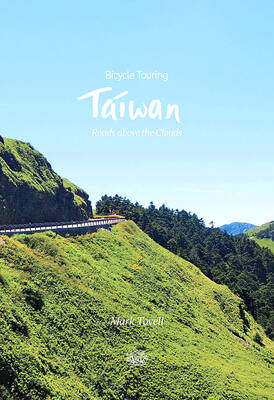
It’s hard to know where to begin with Mark Tovell’s Taiwan: Roads Above the Clouds. Having published a travelogue myself, as well as having contributed to several guidebooks, at first glance Tovell’s book appears to inhabit a middle ground — the kind of hard-to-sell nowheresville publishers detest. Leaf through the pages and you’ll find them suffuse with the purple prose best associated with travel literature: “When the sun is low on a warm, clear morning, and with the heat already rising, we stand at the riverside bike path leading south from Sanxia’s old cobble streets.” Hardly the stuff of your


 RSS
RSS