


Taipei dance audiences got their first look at Japanese choreographer Jo Kanamori and his Noism company this weekend at the National Theater and they liked what they saw.
Noism is a small troupe, just 10 dancers, but perfectly matched in technique and intensity. The 90-minute NINA was a crisply executed examination of control and submission that veered between mesmerizing and plain creepy. Although it dragged a bit towards the end, it was a good introduction to someone who is likely to be a major force in Asia dance for decades to come.
The company says its goal is to avoid any specific “ism” so they are free to draw on any and all possibilities, hence the name “No-ism.” However, there was a clear “ism” in evidence on Saturday — minimalism — from the choreography to the costumes, to the staging and score.
The costumes were basic: The women wore nude leotards that exposed every muscle, every rib, every breath and stripped them of any identity. The men wore simple black suits that gave them an eerily corporate uniformity. The only thing that differed was their heights, although Sawako Iseki, a veteran of Rudra Bejart Lausanne and Netherlands Dans Theater II, did stand out a bit.
The sublimation of individuality reinforced the sexual politics of the piece. The women were nothing more than stiff, inert mannequins to be handled, dragged, lifted and spun by their male handlers. NINA begins with one man sitting in a chair, staring at a standing women, with the other women laying scattered around the stage in a variety of lifeless poses. The men were emotionless as they roughly positioned and then danced with the women in a variety of duets, pas de trios and group pieces, while the women often appeared robotic.
The most animated the women got was when they lay flailing their arms and legs on the floor as their handlers lay on top of them, weighting them down until they were nothing but empty forms. But after that mock rape scene the power dynamics shifted. The men still propelled the women, but you could tell it was becoming hard to push them around. In the end, the roles were completely reversed. The women stripped the men down to flesh-toned briefs and T-shirts and then put on the men’s suits. The show ends with one woman seated in a chair, another standing next to her, looking a standing man, while the rest of the men lay inert around him.
CHILD’S PLAY
Earlier this month, the New Melody From the National Palace Museum (故宮新韻) series of theatrical productions hosted by the museum commenced a new program featuring the Taipei Li-Yuan Peking Opera Theatre (台北新劇團) performing segments from Journey to the West (西遊記). In both format and mood, it is a very different proposition from The Palace of Eternal Youth (長生殿) by Lanting Kun Opera Company (蘭庭崑劇團), which launched the New Melody series in July.
Where Lanting created a highly compressed but complete production of The Palace of Eternal Youth, Li-Yuan has opted for a more direct educational presentation in its 12-week New Journey to the West (新西遊記) program, which will rotate through four separate episodes from the story of the monk Tripitaka’s journey to India and the many dangers he meets on the way.
The episode on Wednesday, the second installment in the program, was that of The Gossamer Cave (盤絲洞), in which Tripitaka very nearly gets eaten by a spider demon.
The program began with an introduction to the various character types that feature in Beijing opera, followed by an introduction to the various instruments used in the orchestra. Children in the audience were warned not to attempt some of the difficult acrobatic maneuvers that they saw on stage.
Then the story began. The material lent itself to a very high degree of physical showmanship, and this dominated at the expense of less showy aspects of performance. There was plenty of tumbling, juggling, acrobatics, fight scenes and comedy, which certainly delighted the audience, but provided a rather unbalanced picture of what Beijing opera is about.
Still, there was much to admire about the New Journey to the West, because it was both entertaining and educational. But it also takes the New Melody series in a direction that could undermine its credibility as an operatic showcase that can be enjoyed by both aficionados and casual visitors. Much will depend on the third installment of New Melody, which should begin in January.
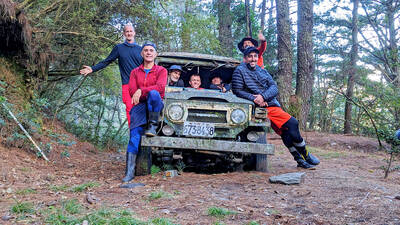
The year was 1991. A Toyota Land Cruiser set out on a 67km journey up the Junda Forest Road (郡大林道) toward an old loggers’ camp, at which point the hikers inside would get out and begin their ascent of Jade Mountain (玉山). Little did they know, they would be the last group of hikers to ever enjoy this shortcut into the mountains. An approaching typhoon soon wiped out the road behind them, trapping the vehicle on the mountain and forever changing the approach to Jade Mountain. THE CONTEMPORARY ROUTE Nowadays, the approach to Jade Mountain from the north side takes an

Last week Joseph Nye, the well-known China scholar, wrote on the Australian Strategic Policy Institute’s website about how war over Taiwan might be averted. He noted that years ago he was on a team that met with then-president Chen Shui-bian (陳水扁), “whose previous ‘unofficial’ visit to the US had caused a crisis in which China fired missiles into the sea and the US deployed carriers off the coast of Taiwan.” Yes, that’s right, mighty Chen caused that crisis all by himself. Neither the US nor the People’s Republic of China (PRC) exercised any agency. Nye then nostalgically invoked the comical specter

Relations between Taiwan and the Czech Republic have flourished in recent years. However, not everyone is pleased about the growing friendship between the two countries. Last month, an incident involving a Chinese diplomat tailing the car of vice president-elect Hsiao Bi-khim (蕭美琴) in Prague, drew public attention to the People’s Republic of China’s (PRC) operations to undermine Taiwan overseas. The trip was not Hsiao’s first visit to the Central European country. It was meant to be low-key, a chance to meet with local academics and politicians, until her police escort noticed a car was tailing her through the Czech capital. The
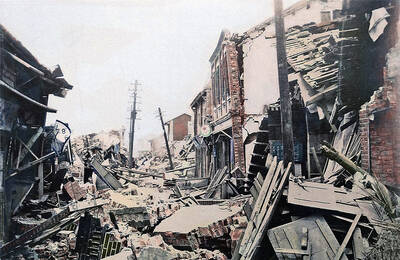
April 15 to April 21 Yang Kui (楊逵) was horrified as he drove past trucks, oxcarts and trolleys loaded with coffins on his way to Tuntzechiao (屯子腳), which he heard had been completely destroyed. The friend he came to check on was safe, but most residents were suffering in the town hit the hardest by the 7.1-magnitude Hsinchu-Taichung Earthquake on April 21, 1935. It remains the deadliest in Taiwan’s recorded history, claiming around 3,300 lives and injuring nearly 12,000. The disaster completely flattened roughly 18,000 houses and damaged countless more. The social activist and


 RSS
RSS