


Highly acclaimed, controversial and openly gay, German director Monika Treut has spent the length of her career exploring hot-button issues such as homosexuality, feminism and marginalized identity.
Her first narrative feature film, Seduction: The Cruel Woman (1985), is a subculture milestone that tackles the subject of sadomasochistic sexual practices. The 1988 classic Virgin Machine explores the issue of homosexual identity through a girl’s coming-of-age story.
In the 1990s, Treut turned her attention to documentary filmmaking. The 1992 work Female Behavior chronicles the lives of four “bad” girls, including American feminist writer Camille Paglia. With 1999’s Gendernauts, Treut examines the lives of a group of San Francisco transsexuals relegated to the margins of society.
Her documentary Tigerwomen Grow Wings (母老虎飛飛飛), shot in 2004 during the presidential election in Taiwan, traces the lives of Taiwanese women from three generations — Taiwanese opera actress Hsieh Yue-hsia (謝月霞), famed novelist Li Ang (李昂) and director D.J. Chen (陳映蓉).
This week, Treut’s Taiwanese connections deepen with the release of Ghosted (曖昧), a supernatural mystery that also functions as a love story. Shot in Germany and Taiwan, the movie tells the tale of the relationship between a Taiwanese reporter, Wang Mei-li (Hu Ting-ting, 胡婷婷) and a German artist, Sophie (Inga Busch), whose former lover Chen Ai-ling died mysteriously.
Director Treut spoke with the Taipei Times via e-mail about Ghosted, her ties to Taiwan and who she thinks is the hottest screen actress.
Taipei Times: What was your inspiration for making the movie Ghosted?
Monika Treut: Before starting to work on Ghosted I had a personal loss: a close friend of mine died. I dedicated the film to her memory, and I was thinking that the Taiwanese way of dealing with loss is more human than our Western way. This influenced the writing of the script. We have a “ghost-like character” in the film. This character is kind of open to different readings. Taiwanese see it differently than people from Western cultures. In Germany we have the motif of the doppelganger: when somebody dies, Westerners might have guilty feelings for not having cared enough for the person so we might feel haunted and see the person incorporated everywhere — a very popular element of Romantic literature in Germany and England in the 18th century, which is still alive in popular mythology. In Taiwan, during the Ghost Month of the lunar calendar, the gates between life and death open and the living give offerings to the dead, which gives us the sense that the two worlds are not so far apart and we can communicate with our deceased loved ones.
TT: After a decade doing documentary work, what prompted you to come back to narrative film?
MT: To me, documentaries and narrative features are not very far apart. I like combining the elements of both. I try to give documentaries a narrative structure and in fiction I’m open and flexible for the unforeseen, the surprises.
TT: You are known for films that explore risque themes such as sexuality, gender identity and subculture sexual practices. Why did you decide to go for a conventional love story this time?
MT: Times are changing. I’d say in Western cultures exploring sexual practices like S&M in film or dealing with the concept of a variety of genders beyond just female and male like in Gendernauts has become more accepted and is almost mainstream by now. So the artist’s fun of attacking taboos is gone. With Ghosted I was interested in exploring the clashing of cultures via a love story between a German and a Taiwanese person.
TT: What was the biggest challenge you faced during the making of this film?
MT: It was quite tough especially for the main actresses (with the exception of Hu Ting-ting (胡婷婷), who is a true citizen of the world) to adjust to working in a foreign culture, including to speak in a foreign language, to adjust to different working styles and foremost to do all this on a tight shooting schedule with only a few days of rehearsal.
TT: You have made two films featuring Taiwan. How did you become so enchanted with Taiwan that you wanted to explore this land in two films?
MT: My infatuation with Taiwan was an instant one: on my first visit back in 2002 when the film festival Women Make Waves invited me for a retrospective of my work, I was smitten with the Taiwanese people’s kindness to strangers, their genuine interest in film, culture and fun, and, of course by Taiwanese food. Since then I’ve been back not only for researching and shooting but for more film festivals, each time learning a bit more about Taiwanese culture and seeing more of the island. I’ve also been fortunate enough to develop a professional friendship with PTS-TV which has supported all — actually three films — from the start. We’ve also made a 30-minute documentary: Made In Taiwan (2005), for a ZDF-series on 17-year-old girls all over the world. We portrayed Fan Yi-chun, a high-school student from Taipei. We have a project we hope to realize on how to further explore Taiwanese culture through aspects of food.
TT: What was your experience of filming this movie
in Taiwan?
MT: Before my Taiwanese filming experience I had shooting experience in the US, Mexico, Brazil and in Europe. Compared to these experiences the Taiwanese one was very hospitable, after we — my Taiwanese co-producers and I — had mounted the bureaucratic obstacles of being the first official co-production between Germany and Taiwan. Both sides did learn a lot from each other since the ways of making movies in both countries are quite different. For me it was an enriching experience. The Germans tend to map out everything perfectly well before they start shooting and are then unable to change the plan, so the German way lacks spontaneity and flexibility. Whereas the Taiwanese way is more improvised and floating, which might lead to longer shooting days but has the potential of quickly reacting to new situations, which I personally quite like.
TT: What do you think about actress Hu Ting-ting’s performance in this film?
MT: Hu Ting-ting is a dream for a director: she’s very fast, very smart and professional and always offering a lot of choices. For me she’s the ideal fearless Mei-li character.
TT: What do you think of the state of gay cinema in today’s world? What obstacles have been overcome and what new milestones are there?
MT: Regarding gay cinema, we can basically only talk about North America, Europe, some parts of South America and a few spots in Asia, like Hong Kong and Taiwan, Thailand and to a lesser degree Japan. We have practically no gay cinema in the Muslim countries, most of Asia and most of Africa. So obviously there is a long way ahead, especially for Muslim countries where gay people get prosecuted and have to fear for their lives. Gay cinema can help to instigate hope and a sense of a world community to fight repression. In North America and Europe, gay cinema has come a long way and is by now almost accepted into the mainstream. But we do have to fight for the rights of our people in other parts of the world.
TT: Have you watched any of the gay-themed films from Taiwan? What do you think about them?
MT: I very much like, for example, Formula 17 (十七歲的天空) by D.J. Chen, the fun comedy about a gang of gay boys, and Spider Lilies (刺青), the beautifully shot romance of two girls by Zero Chou (周美玲), among others. Most of the gay-themed movies coming from Taiwan express a poetic quality which is lacking in European or American gay-themed films.
TT: Which sexy screen actress, dead or alive, would you fancy going to bed with (or kiss, or just hug)?
MT: I’m no spring chicken any more and as a filmmaker I’m not so easy to fall for actresses. So a long time ago, before being a filmmaker, I fell for Susan Sarandon in The Hunger and the young Suzanne Pleshette, (RIP) in The Birds, both warm, sensual women with a husky voice.
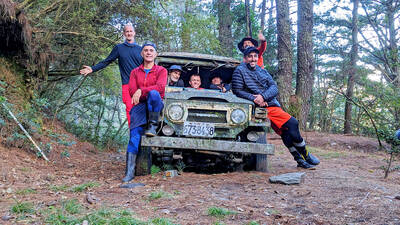
The year was 1991. A Toyota Land Cruiser set out on a 67km journey up the Junda Forest Road (郡大林道) toward an old loggers’ camp, at which point the hikers inside would get out and begin their ascent of Jade Mountain (玉山). Little did they know, they would be the last group of hikers to ever enjoy this shortcut into the mountains. An approaching typhoon soon wiped out the road behind them, trapping the vehicle on the mountain and forever changing the approach to Jade Mountain. THE CONTEMPORARY ROUTE Nowadays, the approach to Jade Mountain from the north side takes an

Last week Joseph Nye, the well-known China scholar, wrote on the Australian Strategic Policy Institute’s website about how war over Taiwan might be averted. He noted that years ago he was on a team that met with then-president Chen Shui-bian (陳水扁), “whose previous ‘unofficial’ visit to the US had caused a crisis in which China fired missiles into the sea and the US deployed carriers off the coast of Taiwan.” Yes, that’s right, mighty Chen caused that crisis all by himself. Neither the US nor the People’s Republic of China (PRC) exercised any agency. Nye then nostalgically invoked the comical specter

Relations between Taiwan and the Czech Republic have flourished in recent years. However, not everyone is pleased about the growing friendship between the two countries. Last month, an incident involving a Chinese diplomat tailing the car of vice president-elect Hsiao Bi-khim (蕭美琴) in Prague, drew public attention to the People’s Republic of China’s (PRC) operations to undermine Taiwan overseas. The trip was not Hsiao’s first visit to the Central European country. It was meant to be low-key, a chance to meet with local academics and politicians, until her police escort noticed a car was tailing her through the Czech capital. The
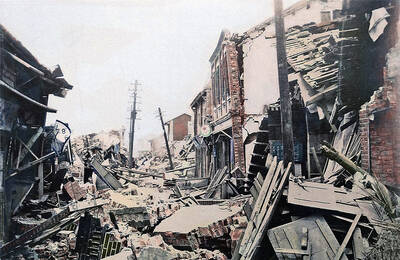
April 15 to April 21 Yang Kui (楊逵) was horrified as he drove past trucks, oxcarts and trolleys loaded with coffins on his way to Tuntzechiao (屯子腳), which he heard had been completely destroyed. The friend he came to check on was safe, but most residents were suffering in the town hit the hardest by the 7.1-magnitude Hsinchu-Taichung Earthquake on April 21, 1935. It remains the deadliest in Taiwan’s recorded history, claiming around 3,300 lives and injuring nearly 12,000. The disaster completely flattened roughly 18,000 houses and damaged countless more. The social activist and


 RSS
RSS