


AS far back as she can remember, Arianna Huffington says, she has liked to “bring people together.” Around the table in her mother’s one-room apartment in Athens, on hikes near her home in Los Angeles, at the ritziest election parties in Washington. When she was a student at Cambridge, she was fined for having surplus men in her room after hours. “They fined me a shilling per man.” They were talking about politics.
At 55, she discovered the ideal venue for her brand of networking and launched the Huffington Post, an online newspaper. The impressive success of the Post means that, four years on, Huffington is often cited in Top 100 Most Influential Media People lists. But as the site keeps growing, the question of what, exactly, Huffington does and how she does it remains mysterious.
She is by background a biographer, a political analyst, a socialite — supposedly “the most upwardly mobile Greek since Icarus” — a Republican turned Democrat and, above all, perhaps, although it sounds pejorative, a PR genius, more capable of selling the value of her position than bigger and more established figures. This is partly a question of skill and partly one of style; she is a commanding presence, frequently impersonated on US comedy shows for her deceptively frilly air and hammy Greek accent, a person who stands out amidst the dry, dull voices debating the future of the Internet. In the tearoom of the St Regis hotel in Manhattan, it is hard not to notice that she matches the fittings: all fishpaste and gold, tinkly and expensive, with a vague air of indestructibility. In the early days of the Huffington Post, she had the advantage of being underestimated, but no one makes that mistake now.
Huffington’s approach to her career has always been premised on moving on when something no longer suits her. She grew up Arianna Stassinopoulos outside Athens and was encouraged by her mother to try as many different things as she wanted to. “If I failed, it wouldn’t matter. That was her main ethos about everything. So when I saw a picture of Cambridge in a magazine and said I want to go there and everybody else said you’re crazy, you’ll never get in, my mother said let’s go visit it. And I remember she borrowed the money and we took a plane from Athens to London, took the train and just walked around. We didn’t see anybody.”
Defying expectations, Huffington did go to Cambridge and became president of the Union. She now refers to those years as the most informative of her life, largely due to the “endless discussions about everything” they entailed, although not, perhaps, as endless as the discussions that the Huffington Post would one day facilitate. After Huffington left, she moved to London and met and moved in with the critic Bernard Levin, who became her mentor. He taught her about cliche, she says, and gave her a plaque for her desk that reads, “You can break every grammatical and syntactical rule consciously when, and only when, you have rendered yourself incapable of breaking them unconsciously.” Huffington, of course, has long since moved on from writing; in 1981 she wrote a biography of Maria Callas, followed by one of Picasso, followed by a series of polemical books arguing one political position or another, but the striking thing is that for the last 10 years she has dictated everything — blogs, columns, books — into a voice recorder, transcribing her thoughts and ideas, like a 1990s parody of busy people on the move. It better suits the way her mind works, Huffington says. It might explain the confusion over why, when a collection of George Clooney’s remarks to journalists were cobbled together by the Huffington Post and run under the actor’s byline, he was obliged to point out that speaking and writing aren’t always the same thing.
Eventually, she left Levin and moved to the US, where, thanks to introductions from her publisher George Weidenfeld, she became one of the best-connected women in New York.
The above is the outline. It doesn’t explain how Huffington completed these huge journeys, or how, from a position of relative obscurity, she managed to build up such forceful momentum. She was boosted in 1986 by her marriage to Michael Huffington, an oil millionaire, friend of the Bushes and a Republican congressman, with whom she has two children. Huffington herself was still a Republican then, in favor of Newt Gingrich and small government. The couple divorced in 1997 and she has not remarried, although she has since adopted different politics.
A result of Huffington’s numerous transformations and adaptations was that, serendipitously, when the Internet came along, she was perfectly placed to understand its value. Her first Web site was called Arianna Online and she got her elderly mother to write an agony column under the heading Ask Ya-Ya. “She was incredibly wise and earthy. She would scrawl her answers on a yellow pad.” The column generated a lot of publicity and was an early version of Huffington’s guiding online philosophy: to involve people “who wouldn’t otherwise be in the debate,” either because “they are barely on computers, or they don’t have the time to maintain their own blog. That is one of the motivations. To provide a platform where people could just deposit a thought and move on.”
These words reflect Huffington’s brilliant anticipation both of the capacity of the new medium and the endless gas-bagging to come, the stampede to Join The Debate, whatever it was, and to promote it as a form of disinterested progress. When she founded the Huffington Post in 2005, it was as a modest liberal politics blog. Huffington had no idea, she says, that the Post would grow to be so influential, eventually becoming a model that has threatened or seduced existing media organizations into going into partnership with it. If you have never read the Huffington Post, it encompasses regular politics and arts coverage, new media forms like citizen journalism and viral comedy and old standbys like pieces you’ve already read in your daily newspaper, which Huffington reproduces on her site, free of charge, in return for driving traffic back towards the newspaper. Whether “aggregation,” as it’s known, is a fair exchange is the subject of intense debate, particularly in the US at the moment, a discussion that Huffington cleverly presents as a fait accompli. When she describes her site as “aggregated and curated news with our own point of view,” she implies not only that the train has left the station, but also that her Web site, in large part, constitutes the train.
On the day of our interview, the splash on the Huffington Post illustrates what the site does best — it pulls a small detail from an overlooked story and runs it in insanely large type; in this case a US Department of Labor statistic showing that unemployment among young people in the US is at 52.5 percent. “Stunning,” says Huffington. “That’s a national emergency. It’s not a big story everywhere, but it deserves to be.” Further down the home page, readers learn that “Mary Louise Parker Has A New Boyfriend” and are invited to ponder “Who Has the Biggest Chest in Hollywood?”, emergencies of a different kind that confirm Huffington’s lack of squeamishness when it comes to drumming up traffic.
Unsurprisingly, she calls the Wall Street Journal’s recent decision to charge for all of its online content wholly misguided. “I think this is trying to go back to an era that has passed. Consumer habits have changed, technology has changed. We’re living in a linked economy and trying to pretend that we’re not ...” It can be a problem, she thinks, among the very successful, that success renders them inflexible. (This has never been Huffington’s problem.) “I was reading a book by Clayton Christensen, The Innovator’s Dilemma, which explains how hard a time very successful people in various industries are having with disruptive innovation — because they’ve succeeded with one particular set of technologies in the broad sense, and so the gap in innovation is difficult for many people to adapt to.”
The same goes for the established pundits, the supposedly superior newspaper voices annoyed at yappy new competition from the Huffington Post: esteemed arbiters who were exposed and undermined by their failure to anticipate the economic meltdown or challenge the US government in the run-up to the Iraq war. “It’s not exactly as if we have this amazing font of wisdom and we’re drowning it out.”
Of course, like the Body Shop and Craigslist, the Huffington Post’s conception of itself as the noble outsider grows more problematic as its value increases and the public interest rationale — particularly on days when the site has more breasts on it than the Sun, which is most days — can sound a little hollow. As Malcolm Gladwell pointed out in the New Yorker recently, in reference to wrangles in the publishing industry, “Why are the self-interested motives of powerful companies being elevated to a philosophical principle?”
In the unlikely event that other newspapers follow the Wall Street Journal and start charging, does she have a business plan to respond to such a development?
Huffington looks unimpressed. “Right now we pay for AP. They would continue to be available. We pay for pictures, from Getty. Even if every single other paper charged, you’d still have your bread and butter stories and you’d have your value added, with reporters and bloggers and citizen journalists.”
The value-added is Huffington’s point of view, which has veered radically over the years; it is always exciting to see where it will go next. After years campaigning for the Republicans, she stood against Arnold Schwarzenegger as an independent in the California governor race, but dropped out before the election. She backed John Kerry in 2004 and, with the Huffington Post, became a figurehead of liberal opinion. These days she writes editorials criticizing Obama’s failure to adequately reform Wall Street. Huffington is, she says, never a contrarian for the sake of it, but “there’s so much wrong with conventional wisdom.”
The initial switch from right to left was situated “around my understanding of the role of government. It wasn’t around social issues — like I’ve always been pro-choice, pro-gay rights, pro-gun control. So what changed for me was the role of government. When I was a Republican, I thought that the private sector would step up to the plate and address all the major social problems, and then I saw first hand this wasn’t happening. And it’s so long ago — 1995.”
Did it feel like a major event, this shift to the other side? “No, because it wasn’t like I left one party and became a Democrat. It was more about the ideas; when I was married to Michael, obviously he was a Republican congressman and then in the Senate, so I was more engaged in the Republican party. But in terms of me not being married ... It is more about ideas than party membership.”
Her inconsistencies are what give Huffington a “maverick” air that, in an age when nobody knows what’s going on or how things will turn out, can appear more authoritative, with its sense of conviction, than received wisdom. She is an environmentalist but orders Fiji water in the restaurant, which, greens will tell you, is so bad it means somewhere a fairy dies. She is very serious about politics and debate, but possesses enough of a sense of fun, or PR savvy, to list among her proudest achievements the Huffington Post’s backstage chill-out area at the Democratic convention last summer. “It became a place that so many journalists and delegates hung out. I remember David Carr [of the New York Times] getting a private yoga class and coming out looking translucent.”
She is an arch networker, complete with the slightly creepy, bright-eyed interest that her position entails — at her election party, Sting, Sheryl Crow, Ron Howard and Don King appeared, like homeopathic drops in a sea of bloggers — but at the same time has championed the voices of the uncelebrated as much, or more, than those of the powerful. The main thing about her site, Huffington says, is “community.” But she understands the weariness that the words “2,000 contributors” can generate in a person and hopes she is sensitive to managing this ennui. “That’s a huge thing we’re dealing with, as a culture, individually. We call it ‘How To Learn To Disconnect’ in order to recharge. And connect with ourselves. Otherwise you can really lose yourself on the surface. We want to uni-task — if we are in love or reading a great book or absorbed in a creative project, multitasking is an enemy of that.” Earlier this year, Huffington fainted from exhaustion; she now makes it a point to turn her BlackBerry off and have an early night.
A few days after the interview, I visit the Huffington Post’s New York offices, which, although well established, still have the look of a start-up, a loft-type space full of light and air and young men with beards. It is quiet and orderly, with people working on traditional journalism pieces as well as “Digital Watercoolers” and other wheezes for driving up numbers. In the middle of it all is Huffington, surveying her work with unblinking satisfaction.

In late October of 1873 the government of Japan decided against sending a military expedition to Korea to force that nation to open trade relations. Across the government supporters of the expedition resigned immediately. The spectacle of revolt by disaffected samurai began to loom over Japanese politics. In January of 1874 disaffected samurai attacked a senior minister in Tokyo. A month later, a group of pro-Korea expedition and anti-foreign elements from Saga prefecture in Kyushu revolted, driven in part by high food prices stemming from poor harvests. Their leader, according to Edward Drea’s classic Japan’s Imperial Army, was a samurai

Approaching her mid-30s, Xiong Yidan reckons that most of her friends are on to their second or even third babies. But Xiong has more than a dozen. There is Lucky, the street dog from Bangkok who jumped into a taxi with her and never left. There is Sophie and Ben, sibling geese, who honk from morning to night. Boop and Pan, both goats, are romantically involved. Dumpling the hedgehog enjoys a belly rub from time to time. The list goes on. Xiong nurtures her brood from her 8,000 square meter farm in Chiang Dao, a mountainous district in northern Thailand’s
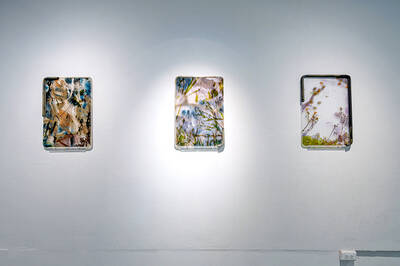
Located down a sideroad in old Wanhua District (萬華區), Waley Art (水谷藝術) has an established reputation for curating some of the more provocative indie art exhibitions in Taipei. And this month is no exception. Beyond the innocuous facade of a shophouse, the full three stories of the gallery space (including the basement) have been taken over by photographs, installation videos and abstract images courtesy of two creatives who hail from the opposite ends of the earth, Taiwan’s Hsu Yi-ting (許懿婷) and Germany’s Benjamin Janzen. “In 2019, I had an art residency in Europe,” Hsu says. “I met Benjamin in the lobby
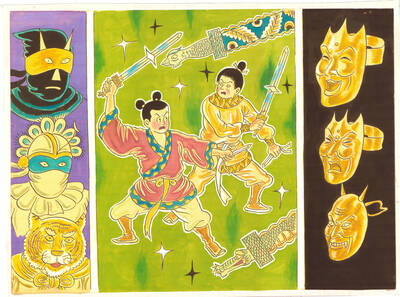
April 22 to April 28 The true identity of the mastermind behind the Demon Gang (魔鬼黨) was undoubtedly on the minds of countless schoolchildren in late 1958. In the days leading up to the big reveal, more than 10,000 guesses were sent to Ta Hwa Publishing Co (大華文化社) for a chance to win prizes. The smash success of the comic series Great Battle Against the Demon Gang (大戰魔鬼黨) came as a surprise to author Yeh Hung-chia (葉宏甲), who had long given up on his dream after being jailed for 10 months in 1947 over political cartoons. Protagonist


 RSS
RSS