


Honore de Balzac’s multivolume The Human Comedy vividly dissects the manners, customs and people of the tumultuous age in which he lived — from the French Revolution to the Bourbon Restoration. Taking the French writer’s corpus as inspiration, the National Taipei University of the Arts has put together a group exhibit titled Comedies, part of its Kuandu Arts Festival, which purports to follow Balzac’s project by presenting portraits of contemporary society.
“Two centuries ago, a remarkable French playwright, Balzac, described the human nature of [his country] in the 19th century in detail. We hope that, with visual codes, we can convey, shape, construct and deconstruct the spirit of comedy in contemporary times,” the exhibition blurb states.
The festival, held at the Kuandu Museum of Fine Arts (關渡美術館) and Aigrette Down (鷺鷥草原), includes two solo shows — one by Australian installation artist Jayne Dyer and the other by Taiwanese sculptor Chang Tzu-lung (張子隆). But the festival’s main emphasis is the group exhibit.
Citing one of the 19th century’s most insightful novelists as the foundation of an art exhibit is a risky venture because it creates powerful and far-reaching expectations.
Aspiring to emulate Balzac’s approach is an achievable goal, as for example, dozens of local artists have created multi-layered characterizations of Taiwanese society.
Huang Chin-ho’s (黃進河) paintings from the 1990s blend religious and folk symbols with the kitschy glitz of Taipei to critically portray the conspicuous consumption of contemporary society, while Hou Chun-ming’s (侯俊明) woodcut prints from the same period parody the power of folk beliefs. Both artists created tapestries of Taiwanese culture by employing symbols culled from the past and present.
Comedies, however, fails to formulate any nuanced depictions of, or comments on, society — whether humorous or not. This probably has something to do with the exhibit’s setup. Four established artists curated the show and chose a “team” of younger artists to exhibit
their paintings, installations and sculptures within the confines of one of four subthemes: Real Comedy, Innovative Hybrid, Multiple Characters and Non-Academic Artists.
Although the categories were intended to focus the artist’s (and the viewer’s) attention, they are so vague that the works within one could easily be transferred to another without any loss of thematic coherence because there wasn’t any in the first place.
Hung Yi’s (洪易) sculpture of a dog emblazoned with a variety of red patterns taken from various cultures, for example, could have easily been placed in the Innovative Hybrid section rather than the Multiple Characters grouping where it is found.
In Chen Ching-yao’s (陳擎耀) display of figures (also located in the Multiple Characters section), characters are dressed in costumes right out of an American Western movie and posing in what appears to be a New York diner. How it “represents Taiwan at its foundation,” as the exhibition literature says, is beyond this reviewer — unless the point is to show that Taiwan is made up of posses of cowboys hanging out in greasy spoons. Had it been placed in the Innovative Hybrid section, Cheng’s point that Taiwan is a mixture of cultural identities and styles might have been more apparent.
Some of the works, however, successfully illustrate their section’s theme. Chung Kun-i’s (張崑逸) documentary, set in South Africa, intimately charts a social movement’s struggle to turn tragedy into comedy. Ji Hyun Ahn’s animated shorts, which picture a group of relatives gorging themselves on food, comically reflect on the human desire to consume. Both are displayed in the Real Comedy section.
For the most part, Comedies is baffling because it isn’t thematically cohesive and doesn’t construct an incisive Balzacesque panorama.
Australian-born, Beijing-based artist Jayne Dyer, on the other hand, is in full control of her medium and the themes she wants to convey. Her installation, The Book Project, examines our changing relationship with knowledge and information as illustrated through the written word.
Dyer instructed the museum to collect discarded books over the past year for her installation. She then pieced the work together and suspended it from the museum’s ceiling.
I asked Dyer if the installation was meant to evoke the tree of knowledge. “Pillars of knowledge, actually,” she said. “The nature of a pillar of knowledge is that it is valued at a certain place and certain time and in another place and another time it might not have meaning. So there is that shifting notion of what is fact and what is fiction.”
Novels, works of philosophy, music texts and scores and children’s books are among the 2,500 volumes that went into constructing the 8m-tall structure. Dyer said that she was fascinated by the fact that the majority of the discarded books were computer manuals — a sign perhaps of local preoccupations.
“This is Taiwan’s history,” Dyer said. “But it could be another history in another place.”
Like Dyer, Taiwanese sculptor Chang Tzu-lung uses recycled material to fashion monumental and abstract works,.eight of which are on display at Aigrette Down.
The Spirit of Organicism (有機之靈) is indicative of what Chang is trying to accomplish. The 3m-high structure resembles an aviary. The door, however, is open and formed to look like a bird’s wing — it’s as though the whole sculpture could take flight at any moment.
By slightly altering the appearance of the “birdcage,” Chang completely changes our expectations of what its function could be. No longer a receptacle for animals, the cage itself becomes a metaphor for freedom.

In late October of 1873 the government of Japan decided against sending a military expedition to Korea to force that nation to open trade relations. Across the government supporters of the expedition resigned immediately. The spectacle of revolt by disaffected samurai began to loom over Japanese politics. In January of 1874 disaffected samurai attacked a senior minister in Tokyo. A month later, a group of pro-Korea expedition and anti-foreign elements from Saga prefecture in Kyushu revolted, driven in part by high food prices stemming from poor harvests. Their leader, according to Edward Drea’s classic Japan’s Imperial Army, was a samurai
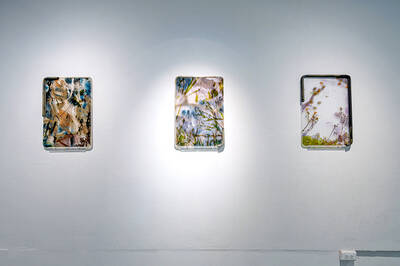
Located down a sideroad in old Wanhua District (萬華區), Waley Art (水谷藝術) has an established reputation for curating some of the more provocative indie art exhibitions in Taipei. And this month is no exception. Beyond the innocuous facade of a shophouse, the full three stories of the gallery space (including the basement) have been taken over by photographs, installation videos and abstract images courtesy of two creatives who hail from the opposite ends of the earth, Taiwan’s Hsu Yi-ting (許懿婷) and Germany’s Benjamin Janzen. “In 2019, I had an art residency in Europe,” Hsu says. “I met Benjamin in the lobby
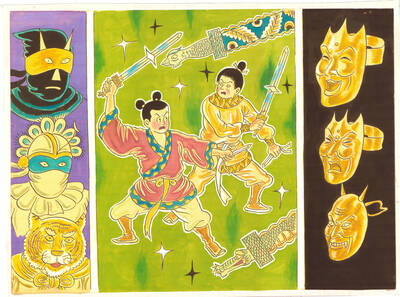
April 22 to April 28 The true identity of the mastermind behind the Demon Gang (魔鬼黨) was undoubtedly on the minds of countless schoolchildren in late 1958. In the days leading up to the big reveal, more than 10,000 guesses were sent to Ta Hwa Publishing Co (大華文化社) for a chance to win prizes. The smash success of the comic series Great Battle Against the Demon Gang (大戰魔鬼黨) came as a surprise to author Yeh Hung-chia (葉宏甲), who had long given up on his dream after being jailed for 10 months in 1947 over political cartoons. Protagonist

Peter Brighton was amazed when he found the giant jackfruit. He had been watching it grow on his farm in far north Queensland, and when it came time to pick it from the tree, it was so heavy it needed two people to do the job. “I was surprised when we cut it off and felt how heavy it was,” he says. “I grabbed it and my wife cut it — couldn’t do it by myself, it took two of us.” Weighing in at 45 kilograms, it is the heaviest jackfruit that Brighton has ever grown on his tropical fruit farm, located


 RSS
RSS