


Like millions of other men, women and children who each day pass through the dizzying maze called the airport passenger screening system, Jim Adams, an executive at a natural gas company in Dallas, has gotten the drill down pat: taking off his shoes, stripping himself of jacket, belt, watch, cellphone and loose change, making sure his 96g tubes of toothpaste and shaving gel are safely sealed in a plastic bag, unpacking his laptop, discarding that half-finished bottle of water — all while glancing nervously at the clock, wondering if he is going to miss his flight.
But several weeks ago, a new step was added to that routine: trying to prove to suddenly skeptical security agents that he actually was the person his boarding pass and photo ID said he was.
A rule that is being phased in this year requires that the names on IDs and tickets match perfectly; it’s not permissible to have an ID that reads “John Smith,” your legal name, and a ticket as “Jack Smith,” the name you use in everyday life.
Adams, 63, says he has routinely had to wait 30 minutes or more for a Transportation Security Administration official to check his ID and enter his name in a logbook. It’s happened more than a dozen times, and he has never been told exactly why he is being singled out.
“In the early days it was anything sharp or pointed,” he said. “Now it’s gotten really personal. It’s me. It’s not my fingernail clippers or pen knife.”
Adams said, however, that he was able to avoid additional security screening and subsequent delays on two flights last month for which he used his full name, James L. Adams Jr. He said he still hadn’t received a response from the Transportation Security Administration about his problems on earlier flights.
Even for people who pass through security with less difficulty than Adams, the airport security system has made flying increasingly miserable in the eight years since 9/11. Many of the measures instituted the last few years, like the limitations on liquids and the requirement that you take off your shoes, were almost knee-jerk reactions to specific scares and were left in place as a matter of course.
As rule upon rule has been added, passengers have learned to cope with the long lines, bag checks, physical pat-downs and carry-on restrictions that border on the absurd. But now there is a fresh opportunity for change. Last month, the White House said that US President Barack Obama planned to nominate Erroll Southers, a former FBI special agent, to head up the Transportation Security Administration, which has been without a permanent head for eight months.
Southers, who is now the assistant chief for Homeland Security at the agency that operates Los Angeles International and several other airports in that region, will, if approved, face the formidable challenge of balancing the yin and yang of airport security — passenger convenience and safety.
Of course, if we look back at the state of security before 9/11, it’s clear that we have made progress. People without a ticket can no longer waltz through the airport and up to the gate. Technology, including explosive-detection devices, has gotten better and is more consistently applied to checked and carry-on bags alike. Passengers are more consistently screened by a more stable security work force with less employment turnover. And at times, even the lines seem to be moving a hair faster.
A case could also be made that because there have been no successful attacks against a US commercial flight since 9/11, the system is indeed working. But inconsistencies, contradictory rules and flat out screening failures continue to provoke skepticism among passengers and security experts alike.
“My wife was recently shocked to discover that she had accidentally taken a large pair of scissors in her knitting bag on a recent trip, and they were not discovered in either the outgoing or returning trips,” said Walt Ciciora, an electrical engineer from Southport, Conn. “That concerned us.”
Echoing the opinions of many security experts interviewed, Andrew Thomas, editor in chief of the Journal of Transportation Security, said that since 9/11 two things have made aviation safer: reinforced cockpit doors and the conviction of passengers to bring down terrorists, as evidenced by the action taken on United Flight 93. “Any substantive measures put in place by TSA since 9/11 are effectively window dressing and have done little to reduce the overall risk to the system,” he said in an e-mail message.
“I think we do a lot of things that are foolish and silly,” he said in a separate telephone conservation, “and there doesn’t seem to be a mechanism in place to pull back and evaluate what’s working and what’s not.”
The Transportation Security Administration disagrees.
“We are constantly looking at the risks that we see and the procedures we have in place and ensuring the resources we have available to us,” said the acting administrator, Gale Rossides. “The dollars we are investing, the people we’re employing, are focused on the highest priorities.”
And there are multiple layers of security in place so that if one area fails and, say, someone sneaks a knife onboard a plane, there are also locked cockpit doors to thwart hijackers.
Each week, as evidence that it is getting the job done, the agency posts on its Web site (www.tsa.gov) a tally of passenger arrests and banned items, including firearms, found at checkpoints. For the week beginning Sept. 7, for example, 11 passengers were arrested “after investigations of suspicious behavior or fraudulent travel documents,” 40 firearms were found at checkpoints, six “artfully concealed prohibited items” were discovered, and there were 30 incidents that involved a “checkpoint closure, terminal evacuation or sterile area breach.”
“It would be terrific,” Rossides said, if passengers could one day walk through a checkpoint without having to open their bags or take off their shoes and jackets. But she made it clear that those wishes were hers and not necessarily on the government’s agenda.
“That’s my vision,” she said, “not TSA’s or DHS’ vision, but my vision — where the industry can create the kind of technology where it is much easier on the traveler and still provides TSA with the detection capability. The innovation in the labs and the industry will get us there.”
Removing any of the security measures, even the most criticized and ineffective, would be a risky political decision for the Obama administration, opening up the White House to second-guessing. Undoing a long-established rule will inevitably provoke skepticism about the reasoning behind the decision. Therefore, if any of the procedures are to be changed, they must be proved to be ineffective or replaced and improved — not merely eliminated.
All this takes time and testing, whether it is to demonstrate what little gains in safety come from collecting lip gloss and moisturizers at checkpoints or to develop technologies that make screening safer and more efficient. That means passengers are likely to be stuck with the current airport screening process for several years.
Is any relief at hand? Well, you may one day be able to walk through security without having to relinquish your water bottle or your jar of moisturizer, but that day may be at least two years away, at best.
Advanced X-ray machines now being rolled out to airports could be programmed to distinguish between hazardous and benign liquids, enabling passengers to carry full-size tubes of hair gel and to keep their Gatorade bottles in their bags. Currently, 78 of the more than 450 airports in the US where the Transportation Security Administration maintains security have the new X-ray machines, which offer multiple views of carry-on luggage as opposed to one top-down look. The agency expects to have contracts in place by the end of fiscal 2010 to buy enough machines to cover the rest.
But beyond the rollout of the machines, there is another integral step that must also be completed: Software must be developed and installed to differentiate between liquids. And neither the agency nor the software manufacturers will even hint at a timeline.
Kip Hawley, a former head of the Transportation Security Administration, said Washington needed to make this happen sooner rather than later. “I don’t think they need to make massive changes,” he said. “They just need to hit the accelerator.”
But speeding things up isn’t an easy task, he acknowledged, partly because of resistance from passengers themselves. Take those full-body screening machines, the kind that provide a stark image of the naked body, and which Hawley said could be the answer to the current jacket, belt and jewelry strip down. Yet, while they might eliminate much of the annoyance of going through security, many passengers have objected to them because they found the machines personally invasive.
Earlier this year, in fact, the House of Representatives approved an amendment, still making its way through Congress, to limit the use of the machines to secondary screening and to require that passengers be offered a pat-down search in lieu of such screening.
If the increasingly cumbersome screening process has proved anything, however, it’s that travelers are a highly adaptable species. And when the facts show that the benefits of a particular security method outweigh the privacy issues, many are willing accept it.
“I equate this to E-ZPass for vehicles,” said Chris Grniet, a vice president at the Kroll Security Group. “Everyone said this will be an invasion of privacy,” and certain people still will not do it, he said. But those who embraced the system no longer have to slow down for tolls.
Another factor that cannot be ignored is that passenger numbers and, consequently, security checkpoint volume are down because of the economy. But as a recovery and passenger traffic pick up, the system will be under enormous pressure. Lines will grow, waiting times will rise, and screeners will face added pressure to speed things along.
“The procedures are not being reduced; if anything they’re being added,” said Brian Michael Jenkins, an international expert on terrorism at the Mineta Transportation Institute. “The number of TSA screeners are not going up, so either the line gets longer or we get smarter. Or we invent the X-ray for a man’s soul.”

Last week Joseph Nye, the well-known China scholar, wrote on the Australian Strategic Policy Institute’s website about how war over Taiwan might be averted. He noted that years ago he was on a team that met with then-president Chen Shui-bian (陳水扁), “whose previous ‘unofficial’ visit to the US had caused a crisis in which China fired missiles into the sea and the US deployed carriers off the coast of Taiwan.” Yes, that’s right, mighty Chen caused that crisis all by himself. Neither the US nor the People’s Republic of China (PRC) exercised any agency. Nye then nostalgically invoked the comical specter
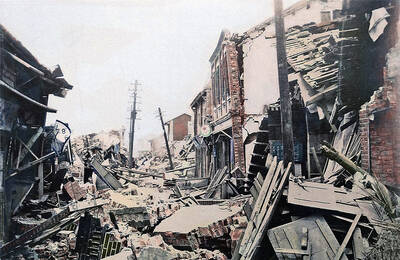
April 15 to April 21 Yang Kui (楊逵) was horrified as he drove past trucks, oxcarts and trolleys loaded with coffins on his way to Tuntzechiao (屯子腳), which he heard had been completely destroyed. The friend he came to check on was safe, but most residents were suffering in the town hit the hardest by the 7.1-magnitude Hsinchu-Taichung Earthquake on April 21, 1935. It remains the deadliest in Taiwan’s recorded history, claiming around 3,300 lives and injuring nearly 12,000. The disaster completely flattened roughly 18,000 houses and damaged countless more. The social activist and

Over the course of former President Ma Ying-jeou’s (馬英九) 11-day trip to China that included a meeting with Chinese Communist Party (CCP) leader Xi Jinping (習近平) a surprising number of people commented that the former president was now “irrelevant.” Upon reflection, it became apparent that these comments were coming from pro-Taiwan, pan-green supporters and they were expressing what they hoped was the case, rather than the reality. Ma’s ideology is so pro-China (read: deep blue) and controversial that many in his own Chinese Nationalist Party (KMT) hope he retires quickly, or at least refrains from speaking on some subjects. Regardless

Approaching her mid-30s, Xiong Yidan reckons that most of her friends are on to their second or even third babies. But Xiong has more than a dozen. There is Lucky, the street dog from Bangkok who jumped into a taxi with her and never left. There is Sophie and Ben, sibling geese, who honk from morning to night. Boop and Pan, both goats, are romantically involved. Dumpling the hedgehog enjoys a belly rub from time to time. The list goes on. Xiong nurtures her brood from her 8,000 square meter farm in Chiang Dao, a mountainous district in northern Thailand’s


 RSS
RSS