


As one of the seminal figures of modern Japanese theater, it is fitting that Tadashi Suzuki’s production of Cyrano de Bergerac should open the National CKS Cultural Foundation’s (國立中正文化中心) Window on Japan (世界之窗日本系列) program next Friday.
The series of performances provides a sampling of Japan’s varied artistic developments, including representative dance, multimedia, musical and dramatic works, that is designed to provide a deeper insight into some of country’s cultural currents.
Japan has proved remarkably successful in creating a dialogue between its traditional culture and the avant-garde, and Suzuki played a key role in that process.
Drawing heavily on Noh and Kabuki techniques, Suzuki developed a training program that places great emphasis on actors’ physical discipline.
In an article titled Culture and the Body, published in 2002, Suzuki summarized his approach as consisting “of training … to speak powerfully and with clear articulation, and also … learn[ing] to make the whole body speak, even when one keeps silent.”
The Suzuki method is famed for requiring a level of control more akin to that of a dancer than a stage actor.
Lin Yu-beng (林于立立), an assistant professor of drama at the Taipei National University of the Arts (國立臺北藝術大學), says Suzuki’s achievement was to distill physical movements from Asian theatrical traditions.
“Similar in some respects to the forms used in Beijing opera and other Chinese opera styles, it is a physical expression that does not require words,” Lin said. “The presence of each actor is sufficient to command the audience’s attention.”
While inspired by traditional Japanese performance styles, Suzuki ranges freely
through the cannons of drama to find his
material. In 2007 he brought his production of Dionysus to Taiwan, a work based on Euripides’ play The Bacchae.
His reworking of Edmond Rostand’s Cyrano de Bergerac, written in 1897, has seen many successful modern versions, and was popularized in the 1990 French movie adaptation starring Gerard Depardieu.
Suzuki’s Cyrano bears little resemblance to those redactions. Not only do the actors don traditional Japanese dress, but Suzuki has also incorporated whole sections of Verdi’s La Traviata into the score.
Suzuki also frames Cyrano’s story within another story whose central figure is an author, and compares the latter’s position, hidden behind his words, with the former’s, who is forced by circumstance to declare his love by proxy.
Suzuki’s Cyrano, with its strange, even absurd hybridity, transcends specific styles and is universally expressive, Lin says.
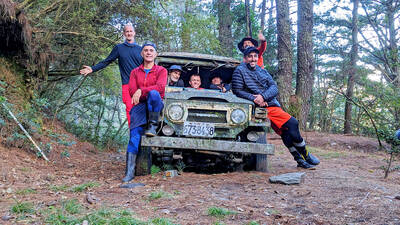
The year was 1991. A Toyota Land Cruiser set out on a 67km journey up the Junda Forest Road (郡大林道) toward an old loggers’ camp, at which point the hikers inside would get out and begin their ascent of Jade Mountain (玉山). Little did they know, they would be the last group of hikers to ever enjoy this shortcut into the mountains. An approaching typhoon soon wiped out the road behind them, trapping the vehicle on the mountain and forever changing the approach to Jade Mountain. THE CONTEMPORARY ROUTE Nowadays, the approach to Jade Mountain from the north side takes an

Relations between Taiwan and the Czech Republic have flourished in recent years. However, not everyone is pleased about the growing friendship between the two countries. Last month, an incident involving a Chinese diplomat tailing the car of vice president-elect Hsiao Bi-khim (蕭美琴) in Prague, drew public attention to the People’s Republic of China’s (PRC) operations to undermine Taiwan overseas. The trip was not Hsiao’s first visit to the Central European country. It was meant to be low-key, a chance to meet with local academics and politicians, until her police escort noticed a car was tailing her through the Czech capital. The

Last week Joseph Nye, the well-known China scholar, wrote on the Australian Strategic Policy Institute’s website about how war over Taiwan might be averted. He noted that years ago he was on a team that met with then-president Chen Shui-bian (陳水扁), “whose previous ‘unofficial’ visit to the US had caused a crisis in which China fired missiles into the sea and the US deployed carriers off the coast of Taiwan.” Yes, that’s right, mighty Chen caused that crisis all by himself. Neither the US nor the People’s Republic of China (PRC) exercised any agency. Nye then nostalgically invoked the comical specter
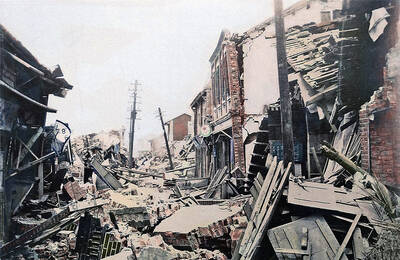
April 15 to April 21 Yang Kui (楊逵) was horrified as he drove past trucks, oxcarts and trolleys loaded with coffins on his way to Tuntzechiao (屯子腳), which he heard had been completely destroyed. The friend he came to check on was safe, but most residents were suffering in the town hit the hardest by the 7.1-magnitude Hsinchu-Taichung Earthquake on April 21, 1935. It remains the deadliest in Taiwan’s recorded history, claiming around 3,300 lives and injuring nearly 12,000. The disaster completely flattened roughly 18,000 houses and damaged countless more. The social activist and


 RSS
RSS