


Dancer/choreographer Sun Chuo-tai (孫梲泰) has delivered another well thought-out, polished and humorous commentary on modern-day society — a meditation our growing dependence on all forms of electronics, with Electron (電子).
His 8213 Physical Dance Theater (8213肢體舞蹈劇場) performed at the tiny Guling Street Theater (牯嶺街小劇場). The space may be small, but it is perfect for the company’s very intimate pieces. You need to be close to see the performers’ expressions, the small twitches of the fingers, the vibrations of the body.
Sun’s caution last week not to sit in the front row because of the sweat that would fly was a good one. He and his two colleagues, American dancer/choreographer Casey Advaunt and Taiwanese dancer Yogi (Chan Tien-chen, 詹天甄), wore white, short-sleeved neo-prene scuba-diving suits that must have felt like saunas under the stage lights, but worked very well during the black-light segments that reduced the dancers to just their white shells.
Electron began with the three hooked up to white cords that connected them at the neck to a hook-up in the ceiling — very Matrix. From spasmodic heaves while lying prone on the elevated flooring, the dancers progressed to robotic mannequin moves until they were able to break free of the umbilical cords and explore their new world.
While the topic may have been weighty, Sun, as usual, used a combination of sight gags and verbal interplay to keep the audience smiling while making them think.
Near the end of the show, Sun sits on a stool, scuba suit pulled half-way down, wearing some kind of electronic headpiece and what turned out to be a vibrating belt around his waist (the kind that is supposed to help the wearer lose weight without actually exercising) and a remote control in each hand. He looks as majestic and stern as any mandarin in one of those old ancestor portrait scrolls, at least until he turned on the remotes and started to vibrate.
One last clever touch was that the show’s program was given out in the form of a DVD — so you needed an electronic device to read it.
Sun has frequently said that he will continue dancing and choreography until he feels that he has nothing more to say. Let’s hope he doesn’t run out of ideas anytime soon.
Just a few blocks away physically, but kilometers in terms of scale, Cloud Gate Dance Theatre performed their next-to-the-last show of their current run at the National Theater on Saturday night. Wild Cursive (狂草) was a fast-paced rendition of the final segment of company founder and artistic director Lin Hwai-min’s (林懷民) Cursive trilogy.
Like watching a calligraphy master at work, Wild Cursive may appear spontaneous, but it is tightly controlled and well thought-out. The 70 minutes just flew by, almost in silence, so quiet was the audience. The score by Jim Shum (沈聖得) and Liang Chun-mei (粱春美) is a seamless mix of chirping crickets, waves, foghorns and temple bells, each perfectly complementing its particular segment without drawing attention away from the dancers or overshadowing their breathing, which is so essential to the piece.
Despite the solos and duets, at heart Wild Cursive remains an ensemble piece. Nevertheless, it was wonderful to see to see principal dancer Lee Ching-chun (李靜君), albeit in an all-too-brief solo. With the exception of her short piece in last week’s Cursive II (行草貳), she has been seen far too rarely on the National Theater stage in recent years.
The graphic black-and-white simplicity of the staging — from the scrolls of translucent rice paper that descend from the rafters with lines of ink slowly trickling down them, to the simple black costumes — provide the perfect setting for the dance. Kudos go to lighting designer Chang Tsan-tao (張贊桃), while credit for the staging goes to Lin Hwai-min.
Though some reviewers have called the piece “arid,” I relish its starkness, and it was wonderful to be able to see the full trilogy in one place.

In late October of 1873 the government of Japan decided against sending a military expedition to Korea to force that nation to open trade relations. Across the government supporters of the expedition resigned immediately. The spectacle of revolt by disaffected samurai began to loom over Japanese politics. In January of 1874 disaffected samurai attacked a senior minister in Tokyo. A month later, a group of pro-Korea expedition and anti-foreign elements from Saga prefecture in Kyushu revolted, driven in part by high food prices stemming from poor harvests. Their leader, according to Edward Drea’s classic Japan’s Imperial Army, was a samurai
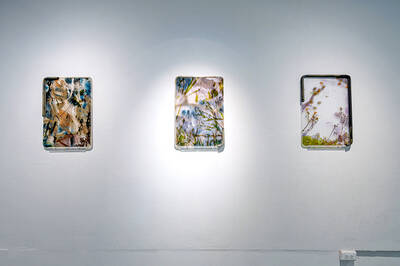
Located down a sideroad in old Wanhua District (萬華區), Waley Art (水谷藝術) has an established reputation for curating some of the more provocative indie art exhibitions in Taipei. And this month is no exception. Beyond the innocuous facade of a shophouse, the full three stories of the gallery space (including the basement) have been taken over by photographs, installation videos and abstract images courtesy of two creatives who hail from the opposite ends of the earth, Taiwan’s Hsu Yi-ting (許懿婷) and Germany’s Benjamin Janzen. “In 2019, I had an art residency in Europe,” Hsu says. “I met Benjamin in the lobby
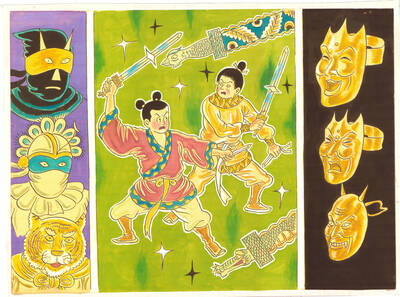
April 22 to April 28 The true identity of the mastermind behind the Demon Gang (魔鬼黨) was undoubtedly on the minds of countless schoolchildren in late 1958. In the days leading up to the big reveal, more than 10,000 guesses were sent to Ta Hwa Publishing Co (大華文化社) for a chance to win prizes. The smash success of the comic series Great Battle Against the Demon Gang (大戰魔鬼黨) came as a surprise to author Yeh Hung-chia (葉宏甲), who had long given up on his dream after being jailed for 10 months in 1947 over political cartoons. Protagonist

Peter Brighton was amazed when he found the giant jackfruit. He had been watching it grow on his farm in far north Queensland, and when it came time to pick it from the tree, it was so heavy it needed two people to do the job. “I was surprised when we cut it off and felt how heavy it was,” he says. “I grabbed it and my wife cut it — couldn’t do it by myself, it took two of us.” Weighing in at 45 kilograms, it is the heaviest jackfruit that Brighton has ever grown on his tropical fruit farm, located


 RSS
RSS