


Even in Colombia, a country known for its paramilitary death squads, this hunting party stood out: more than a dozen soldiers from a Colombian army battalion, two Porsche salesmen armed with rifles, their assistant, and a taxidermist.
They stalked Pepe through the backlands of Colombia for three days in June before executing him in a clearing about 96km from here with shots to his head and heart. But after a snapshot emerged of soldiers posing over his carcass, the group suddenly found itself on the defensive.
As it turned out, Pepe — a hippopotamus who escaped from his birthplace near the pleasure palace built here by the slain drug lord Pablo Escobar — had a following of his own.
The meticulously organized operation to hunt down Pepe, carried out with the help of environmentalists, has become the focus of an unusually fierce debate over animal rights and the containment of invasive species in a country still struggling to address a broad range of human rights violations during four decades of protracted war with guerrillas.
“In Colombia, there is no documented case of an attack against people or that they damaged any crops,” said Anibal Vallejo, president of the Society for the Protection of Animals in Medellin, referring to the hippos. “No sufficient motive to sacrifice one of these animals has emerged in the 28 years since Pablo Escobar brought them to his hacienda.”
Sixteen years after the infamous Escobar was gunned down on a Medellin rooftop in a manhunt, Colombia is still wrestling with the mess he made.
Wildlife experts from Africa brought here to study Colombia’s growing numbers of hippos, a legacy of Escobar’s excesses, have in recent days bolstered the government’s plan to prevent them — by force, if necessary — from spreading into areas along the nation’s principal river. But some animal-rights activists are so opposed to the idea of killing them that they have called for the firing of President Alvaro Uribe’s environment minister.
Peter Morkel, a consultant for the Frankfurt Zoological Society in Tanzania, compared the potential for the hippos to disrupt Colombian ecosystems to the agitation caused by alien species elsewhere, like goats on the Galapagos Islands, cats on Marion Island between Antarctica and South Africa, or pythons in Florida.
“Colombia is absolute paradise for hippos, with its climate, vegetation and no natural predators,” Morkel said.
“But as much as I love hippos, they are an alien species and extremely dangerous to people who disrupt them,” he continued. “Since castration of the males is very difficult, the only realistic option is to shoot those found off the hacienda.”
The uproar has its roots in 1981, when Escobar was busy assembling a luxurious retreat here called Hacienda Napoles that included a Mediterranean-style mansion, swimming pools, a 1,000-seat bull ring and an airstrip.
“He needed a tranquil place to unwind with his family,” said Fernando Montoya, 57, a sculptor from Medellin who built giant statues here of Tyrannosaurus Rex and other dinosaurs for Escobar.
Hired by private administrators of the seized estate, part of which is now a theme park (imagine mixing Jurassic Park and Scarface into a theme), Montoya rebuilt the statues after looters tore them apart searching for hidden booty.
But Escobar was not content with just fake dinosaurs and bullfights. In what ecologists describe as possibly the continent’s most ambitious effort to assemble a collection of species foreign to South America, he imported animals like zebras, giraffes, kangaroos, rhinoceroses and, of course, hippopotamuses.
Some of the animals died or were transferred to zoos around the time Escobar was killed. But the hippos largely stayed put, flourishing in the artificial lakes dug at Escobar’s behest.
Carlos Palacio, 54, head of animal husbandry at Napoles, said Escobar started in 1981 with four hippos. Now, he said, at least 28 live on the estate. “With our current level of six births a year set to climb, we could easily have more than 100 hippos on this hacienda in a decade,” Palacio said.
“Some experts see this herd as a treasure of the natural world in case Africa’s hippo population suffers a sharp decline,” Palacio said. “Others view our growth as a kind of time bomb.”
The number of hippos on the hacienda could have reached 31 had Pepe, the slain hippo, not clashed about three years ago with the herd’s dominant hippo, then left with a mate for other pastures. Once established near Puerto Berrio, the mate gave birth to a calf.
Faced with the possibility of a nascent colony away from Napoles, Colombian authorities decided to act. After all, hippos, despite their docile appearance, are thought to kill more people in Africa than any other large animal.
Unable to find a zoo that would accept the three hippos in Puerto Berrio, officials in the department, or province, of Antioquia considered their options.
Capturing them was expensive, costing as much as US$40,000 for each hippo, in a country where malnourishment among the poor remains a major problem, said Luis Alfonso Escobar — not related to Pablo Escobar — head of Corantioquia, a state environmental organization. Taking them to Africa was dangerous, in addition to being expensive, because of the new diseases they might introduce there.
So the officials opted for a hunt and hired a nonprofit conservation group, the Neotropical Wildlife Foundation, to help manage the operation.
The foundation brought in two experienced hunters, Federico Pfeil-Schneider and Christian Pfeil-Schneider, both of whom also represent the car manufacturer Porsche in Colombia. To ensure the hunting party’s safety, the environmentalists also secured an escort
of soldiers.
All went as planned until the hunt’s details and the photo of the soldiers appeared in the news media. Outrage ensued. Newspapers speculated on the fate of Pepe’s severed head. (Luis Alfonso Escobar, of Corantioquia, rejected rumors that it went to the hunters.) A judge in Medellin issued a ruling suspending the hunt for Pepe’s mate and their offspring.
Meanwhile, other hippos may be on the loose. Palacio, the hippo caretaker here, said at least one was lurking in the waters of a neighboring ranch. Morkel, the veterinarian, said one or two others could have wandered off, according to local reports.
On the grounds of Hacienda Napoles, a sign warns visitors to the theme park. “Stay in your vehicle after 6pm,” it reads. “Hippopotamuses on the road.”
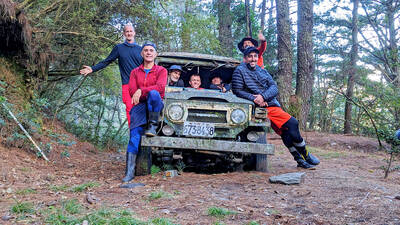
The year was 1991. A Toyota Land Cruiser set out on a 67km journey up the Junda Forest Road (郡大林道) toward an old loggers’ camp, at which point the hikers inside would get out and begin their ascent of Jade Mountain (玉山). Little did they know, they would be the last group of hikers to ever enjoy this shortcut into the mountains. An approaching typhoon soon wiped out the road behind them, trapping the vehicle on the mountain and forever changing the approach to Jade Mountain. THE CONTEMPORARY ROUTE Nowadays, the approach to Jade Mountain from the north side takes an

Relations between Taiwan and the Czech Republic have flourished in recent years. However, not everyone is pleased about the growing friendship between the two countries. Last month, an incident involving a Chinese diplomat tailing the car of vice president-elect Hsiao Bi-khim (蕭美琴) in Prague, drew public attention to the People’s Republic of China’s (PRC) operations to undermine Taiwan overseas. The trip was not Hsiao’s first visit to the Central European country. It was meant to be low-key, a chance to meet with local academics and politicians, until her police escort noticed a car was tailing her through the Czech capital. The

Last week Joseph Nye, the well-known China scholar, wrote on the Australian Strategic Policy Institute’s website about how war over Taiwan might be averted. He noted that years ago he was on a team that met with then-president Chen Shui-bian (陳水扁), “whose previous ‘unofficial’ visit to the US had caused a crisis in which China fired missiles into the sea and the US deployed carriers off the coast of Taiwan.” Yes, that’s right, mighty Chen caused that crisis all by himself. Neither the US nor the People’s Republic of China (PRC) exercised any agency. Nye then nostalgically invoked the comical specter

April 15 to April 21 Yang Kui (楊逵) was horrified as he drove past trucks, oxcarts and trolleys loaded with coffins on his way to Tuntzechiao (屯子腳), which he heard had been completely destroyed. The friend he came to check on was safe, but most residents were suffering in the town hit the hardest by the 7.1-magnitude Hsinchu-Taichung Earthquake on April 21, 1935. It remains the deadliest in Taiwan’s recorded history, claiming around 3,300 lives and injuring nearly 12,000. The disaster completely flattened roughly 18,000 houses and damaged countless more. The social activist and


 RSS
RSS