


Tsai Ken’s (蔡根) sculptures are difficult to comprehend. Engaging the intellect to decipher the 24 sculptures in his exhibit at Main Trend Gallery (大趨勢畫廊), titled The Great Form Without Shape (大象無形), misses the point.
“I just want people to experience their own feelings through my art,” Tsai said.
Rather than appealing to reason, Tsai’s works are meant to express an emotion or create an ambiance. This necessitates an attitude that gallerygoers used to taking an academic approach to art may find arduous.
The exhibit’s title is taken from a line found in Chapter 41 of Lao Tzu’s (老子) Tao Te Ching (道德經), which suggests that most of what we consciously perceive is an illusion. Tsai employs this idea by generating a space between our perception of an object and the object itself.
“Take painting for example,” Tsai said. “When you look at a painting, you think it is beautiful, but really the painting isn’t that important. For me, what is important is the feeling experienced when looking at it.”
Some of the sculptures in The Great Form Without Shape hark back — both formally and thematically — to Tsai’s 2006 exhibit Still Life, which was composed of a series of sculptures made from readymade and natural objects that wouldn’t look out of place in an IKEA catalogue.
One featured a twig placed over a ball made from iron wire set atop a wooden pedestal; another consisted of long bamboo poles tightly arranged in and sticking out of a
Chinese pot emblazoned with colorful flowers.
These sculptures emphasized a spontaneity of design that evoked feelings
of freedom.
Interior Design 3 (室內陳設(三)) follows a similar modus operandi. Balls of wound iron wire, wooden and iron tables topped with objects and a stone lion are arranged on a large wooden matrix. Placed within the walls of the gallery, the work is a serene and simple space within a space.
Tsai’s other work plays tricks on viewers. Great Form Without Shape 2 (大象無形(二)), for example, appears from a distance to be a large mural of colorful flowers. On drawing closer, however, a large sculpture of an elephant adorned with the same floral pattern as the background comes into view. The space between the illusion and what becomes apparent brings us closer to the philosophical ideas underlying Tsai’s aesthetic creations and we begin to question the truthfulness of our own perceptions.
From far away, Buddha Without Form 1 (佛無象(一)) appears to be a dark ball resting on a stone tablet placed on top of a wooden pedestal.
Closer scrutiny reveals the outline of a head with long earlobes — turning the work into the severed head of a Buddhist statue. The sculpture makes an interesting point about worship.
“When people enter a temple they are not concerned too much with Buddhist sculptures,” Tsai said. “They are more interested in the feeling that the space generates.”
Tsai’s sculptures, whether fashioned to free our intellect or prompt us to question the limits of perception, offer augmented ways of experiencing art.
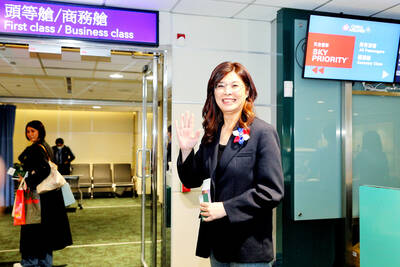
“Taiwan’s Opposition Leader Comes to US With a Message Straight Out of Beijing” read a May 31 headline in the Wall Street Journal. Top US administration officials and members of Congress almost certainly read the WSJ, and if there was a bullet point takeaway that people in Washington should absorb ahead of Chinese Nationalist Party (KMT) Chair Cheng Li-wun’s (鄭麗文) arrival in DC on June 9, that headline is it. The last few columns have discussed this very topic, and the timing is not coincidental. While those top officials likely do not read the Taipei Times, judging by the number
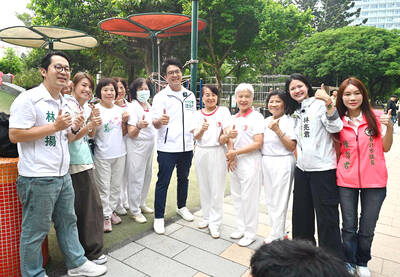
With weighty, anxiety-inducing geopolitical topics dominating the headlines, checking in on the wild and weird state of local politics can take some of the edge off. This November’s elections will determine who will be in charge of fixing potholes in your neighborhood, not the potholes in Taiwan’s complicated geopolitical space. Recently, after an online interview with a Taipei-based journalist, I commented that Taipei journalists never go further than the MRT can take them. He laughed and agreed. Naturally, the Taipei mayoral race is eating up much of the press attention. TAIPEI CITY Democratic Progressive Party (DPP) candidate Puma Shen (沈伯洋) has
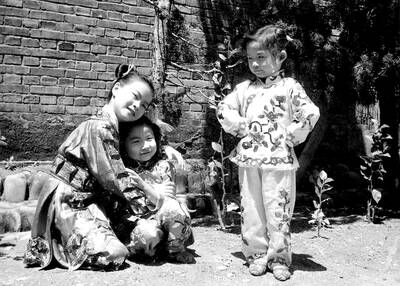
Audiences in Leicester, Cardiff, London and Sheffield will this month gather to watch a series of black-and-white Taiwanese-language films made more than 70 years ago. On the surface, these screenings commemorate the seventieth anniversary of taiyupian (台語片) — Taiwanese-language cinema. Yet the significance of these events extends far beyond nostalgia or film history. They represent a remarkable chapter in Taiwan’s ongoing effort to recover, preserve and reinterpret a cultural heritage that was once thought to have largely disappeared. The centerpiece of the program is the Ho Chi-ming (何基明) directed Xue Pinggui and Wang Baochuan (薛平貴與王寶釧), a film produced in 1955 and
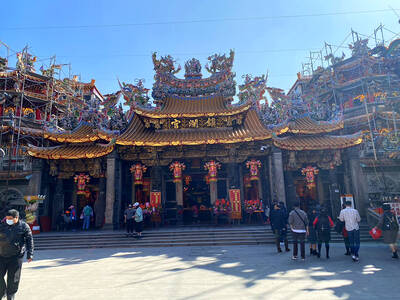
In December of 2008 Lee E-tin (李乙廷), a Miaoli county legislative hopeful, was convicted of vote-buying. Rather than buy votes retail, voter by voter, in the usual manner, Lee had done it wholesale, in a commendably efficient manner: he had visited local temples and made donations to gain their support. Because he did not normally make donations to temples, the court ruled he was attempting to improperly influence voter behavior. The case indicates how important temples are in influencing political life. Both judge and politician appeared to see them in the same way. Beijing sees them that way as well. Democratic Progressive


 RSS
RSS