


Here’s something I’ve not done before: climbed a dune and got into bed. My bedroom is called the NamibRand nature reserve, and it’s about the size of a biggish English county. I’m sharing it with a few creatures that are frightened of me (like leopards and cheetahs) and a few that aren’t (like weaver birds, which are now eating out of my hand). With me, spread out along the dune, are my wife, a few very engaging Italians, a cook, a guide, and the “housekeeper” Hans, who has a special talent: finding golden moles.
Of the guests, none of us had ever experienced anything like this before. After all, this is something of a unique, Namibian specialty; the Room with an Extra View. It also happens to be something the Namibians excel at; wild adventures without wild prices. If you’re prepared to do the driving, they’ll come up with the new ideas. Of course, in central and northern Namibia, they’ve been doing this for years. But we wanted to see what’s been happening down here. So, here we are, on a
12-day road trip, touring the sandy south.
Up on the dune, we know it won’t rain — this is hyper-arid desert — but it will get chilly. The temperature here doesn’t drop, it swoops. One minute, it’s a luxurious 25°C, the next it’s cool-box cold. That’s when we all zip ourselves up inside “swags,” or huge industrial duvets. To passing owls, we must be a startling sight: nine fat, green pupae, just too big to eat.
I wake once, partly from excitement. The sky is so clear it looks like a city at night. There’s Orion’s Belt, and Mars, followed more shyly by Saturn. I strain to listen but all I can do is see moonlight. Everything’s turned silver — the mountains, the thorn trees and the sea of sand. I half expect to see something Jurassic tottering over the plain, but — if it does — I’ve long since gone back to sleep.
Not so our wilder room-mates. Sunrise brings footprints, and news of another busy night. Almost everyone’s called by: beetles who gather dew on their backs; lizards that can plunge through the sand as if it were surf; prehistoric crickets, small harmless snakes, and tiny armored “sand lions” (insects that make booby traps for ants). But busiest of all are the moles. They’ve been swimming around under the sand, and — even though they’ve got no eyes and look like miniature orange tennis balls — they can cover up to 4.5km a night.
To me, all this is astonishing. But in Namibia, desiccation is a way of life. Some bits of the country get less than 2.5cm of rain a year. You either love the sand, or you shrivel up and die.
As one of our guides said, modern Namibia began about 300 million years ago. It’s been an extraordinary process. Imagine a country — about the size of Italy and France together — which has been buried in mud, baked, broken up, turned over, superheated, blasted with volcanoes and bombed with lava. As if that wasn’t enough, it’s now under attack by sand. Starting somewhere in South Africa, the bright orange grit is washed first into the Atlantic, and then up on to the Namibian coast. From there, it whips its way inland, sand-blasting everything it finds. After five million years, there’s no sign it’s over yet. Dunes many many square kilometers in size still roll around at the rate of 6m a year, and, everywhere you go, there are old houses flayed of paintwork and cars stripped back to the steel.
But however intimidating its elements may sound, getting around Namibia needn’t involve a paramilitary operation: a good car will do. All you need to remember is that this land is vast. We thought that a tour of just the south of the country would probably be enough. Even then, we circled an area the size of Britain.
Naturally, here, in the world’s second most sparsely-populated country (after Mongolia), we’d often be alone. During one five-hour journey, the only people we saw (other than truck drivers) were a goatherd, a man with a large pink suitcase and a hunter selling skins on the roadside. That’s not to say we were alone. Out in the sand, there was always something peering at us — a chorus of ostriches perhaps, or a kudu, a zebra, or a goshawk in bright red tights.
In the country’s capital, Windhoek, it was easy to forget the vastness beyond. It’s a city so intimate that, when anyone loses their wallet, it gets a mention in the local paper. I loved it. There was a clutch of Swabian churches and a tiny pastel-colored parliament about the size of Joe’s Beerhouse (which, incidentally, is famous for its garlicky cowboy steaks). This is what the Wild West would have looked like, if it had been German — in other words not very wild at all. Windhoek has been an oasis of order since the colonial days of Deutsch Sudwestafrika (1884-1915). It also felt like a meeting point, for all the disparate elements of Namibian society. Downtown, I spotted Himba tribeswomen — dressed only in butterfat and ochre — German farmers, Boers, and the Herero ladies, who still wore the long Victorian bustles of the missionary mentors.
It was here, too, that we first encountered the Namibian guesthouse. Forget cowboys: the Olive Grove was desert chic. Even the most unruly textures had been ingeniously coaxed into service; sand-blasted driftwood, rawhide, scarlet gravel, and polished rock. It was so serene that we sprawled around until check-out time, and then made a dash for our little car, worried we might never want to leave.
Would things go downhill from here? Not a bit. Even on our limited budget, there was plenty of style, and always something new. At the Bagatelle Kalahari Game Ranch, it was semi-pet cheetahs and a roll top bath overlooking the Kalahari desert; in Luderitz, at the Nest Hotel, it was the sea, so close it almost came into our room. And at the Corona Guest Farm, it was the food; miraculous confections of game, fresh herbs and flambed fruit. The cooks were local cousins, trained by a Swiss chef. They waited on us as if we were at The Ritz, which felt odd on an old farm 970m up a mountain, adrift in sand and rock.
Between all these treats, we were out, churning up the dirt. But the road south was merely a gentle introduction. It was asphalt, and swooped through old volcanoes and a desert of corrugated reds. There were even little towns (three shops, an undertaker and a petrol pump), and a river with a trickle of green. Then things got really interesting. At the southernmost limit of our journey, the road turned to gravel, and then boulders. Just when we thought we could go no further, there was the new Fish River Lodge. We got out, walked through the hall and then had to stop, as the desert vanished altogether. In front of us was a hole, 27km wide, and 550m deep.
The Fish River Canyon — the second largest in the world — looks like a slice through the crust of our planet. I could see every variant of orange, sandwiched together, and a tangle of long-dead rivers. Later, a guide drove us down there. Everything was so dry the stones seemed to clink, and the bushes were like clumps of barbed wire, or petrified broccoli, armed with spears. Surely nothing lives here, I thought. Then, during our picnic, some zebra appeared. Perhaps there’s a scientific term for the way they looked at us, but gobsmacked will do.
As for the lodge, it was almost new and looked as if Bauhaus had come to the desert — a fabulous aerie of rock and steel. But, as much as it was grand, it was also modest; polished concrete, pure linen and giant braziers for heat. The color scheme, it seems, had been left to God. That night, the great hole turned ochre, then purple, before quietly howling itself to sleep.
As we drove west, a slightly feral journey became even wilder. From now on, the horizon was dog-toothed in blue, and silvery grass swept off in all directions, occasionally rippled with red. This was the beginning of the Namib desert. Near Aus, we came across a herd of wild horses. They were all that was left of a vast World War I army. Now their descendants ran free, a living memorial to war.
One of the defeated Schutztruppe — the German colonial force — had stayed on, and built a ranch. Set among some vast orange boulders, it was now the Desert Horse Inn. Here, we met some friendly ostriches, and clambered up through the Germans’ trenches. Most of them were buried nearby. They’d survived three blistering years of desert captivity, before dying of Spanish flu.
The old German railway still curled off down to the coast. In places, it vanished beneath the sand. As we drove alongside, we sometimes found ourselves among wisps of fog, or coils of glossy black rock. It was a forbidding place, and also forbidden. This was the diamond belt, and the only place we were allowed to stop was Kolmanskop. In 1908, this was the richest town in Namibia, but then it was abandoned. Now its mansions sit eerily empty, wallpaper flapping in the breeze, dunes spewing through the door.
The port of Luderitz had fared better, but only just. It was like something from a Baltic fairy tale, except without trees, or grass or anything green. There was an art nouveau castle, a Bismarckstrasse and an old whaling station. Now the wind was trying to prize it all apart. But the sea was irresistible, and so we hired a boatman to take us out among the dolphins. Out there, each island had its own smell: from the resident penguins to enormous slobbery seals. Weren’t these supposed to be polar creatures? Even the wind here had a sprightly Antarctic nip. “Down here,” said the skipper, “it’s always one extreme or another.”
From here, we began our extraordinary return journey, north through the Namib. It was an unforgettable finale. Along the way, we found ancient cave paintings (Corona), a vintage car dump (Solitaire), and a gorge of shifty baboons (Gaub Pass). But best of all was the vast nothingness. It was as if the world had been reduced to bands of scarlet and silver as far as the eye could see.
I was glad of a last chance to camp in this sumptuous void. For three days, we pottered through the dunes and climbed a purple cone. There was kudu casserole for dinner and almond cake for tea. For a moment, this seemed almost idyllic. Quite something considering that this is one of the harshest environments in the world, where the oryx we saw can only survive because he lives on two liters of water a year, and his pee is like glue.
Alright, so not idyllic for everyone, perhaps, but perfect for us. After all, where else do you meet golden moles? Or climb a sand dune to get to bed?

Last week Joseph Nye, the well-known China scholar, wrote on the Australian Strategic Policy Institute’s website about how war over Taiwan might be averted. He noted that years ago he was on a team that met with then-president Chen Shui-bian (陳水扁), “whose previous ‘unofficial’ visit to the US had caused a crisis in which China fired missiles into the sea and the US deployed carriers off the coast of Taiwan.” Yes, that’s right, mighty Chen caused that crisis all by himself. Neither the US nor the People’s Republic of China (PRC) exercised any agency. Nye then nostalgically invoked the comical specter

Relations between Taiwan and the Czech Republic have flourished in recent years. However, not everyone is pleased about the growing friendship between the two countries. Last month, an incident involving a Chinese diplomat tailing the car of vice president-elect Hsiao Bi-khim (蕭美琴) in Prague, drew public attention to the People’s Republic of China’s (PRC) operations to undermine Taiwan overseas. The trip was not Hsiao’s first visit to the Central European country. It was meant to be low-key, a chance to meet with local academics and politicians, until her police escort noticed a car was tailing her through the Czech capital. The
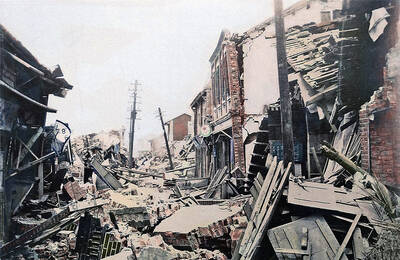
April 15 to April 21 Yang Kui (楊逵) was horrified as he drove past trucks, oxcarts and trolleys loaded with coffins on his way to Tuntzechiao (屯子腳), which he heard had been completely destroyed. The friend he came to check on was safe, but most residents were suffering in the town hit the hardest by the 7.1-magnitude Hsinchu-Taichung Earthquake on April 21, 1935. It remains the deadliest in Taiwan’s recorded history, claiming around 3,300 lives and injuring nearly 12,000. The disaster completely flattened roughly 18,000 houses and damaged countless more. The social activist and

Over the course of former President Ma Ying-jeou’s (馬英九) 11-day trip to China that included a meeting with Chinese Communist Party (CCP) leader Xi Jinping (習近平) a surprising number of people commented that the former president was now “irrelevant.” Upon reflection, it became apparent that these comments were coming from pro-Taiwan, pan-green supporters and they were expressing what they hoped was the case, rather than the reality. Ma’s ideology is so pro-China (read: deep blue) and controversial that many in his own Chinese Nationalist Party (KMT) hope he retires quickly, or at least refrains from speaking on some subjects. Regardless


 RSS
RSS