


Are you saving enough for retirement? Do you know how to your reduce your carbon footprint? Have you ever wondered how to stop men from urinating on the bathroom floor?
Behavioral economist Richard H. Thaler presents solutions to these problems in his new book Nudge: Improving Decisions About Health, Wealth and Happiness, a self-help guide to show people how to make more informed, and therefore better, financial and life decisions.
The 63-year-old Thaler, a professor at the University of Chicago, will give a free lecture about his book tomorrow at Taipei 101.
Thaler’s area of expertise merges psychology and economics, hence the term behavioral economics.
Co-written by Cass Sunstein, the current head of the Obama Administration’s Office of Information and Regulatory Affairs, Nudge uses examples drawn from popular culture — cartoon icon Homer Simpson and cult leader James Jones both make appearances — in a book that is largely free of the economic jargon that would put the average reader to sleep.
The book’s central premise is that through sensible “choice architecture” decision-makers can “nudge” people in the right direction without impinging on their freedom of choice. Thaler spoke about his book last week by e-mail.
Taipei Times: What is a nudge?
Richard Thaler: A nudge is any small feature of the environment that attracts our attention and alters our behavior.
A good example is default options. A default option is what happens if you do nothing. For example, when watching TV the default option is for the next show on the same channel to come on when one show ends. Since we don’t have to do anything to keep watching the same channel we often continue watching even if we don’t really like the next show.
TT: Did you invent “nudging?”
RT: We invented the “term” nudging but people have been nudging for thousands of years. Religions nudge as do people trying to sell us a product.
TT: What are choice architects and how do these people influence our lives or make our lives better/worse?
RT: A choice architect is anyone who has influence over the environment in which we make a choice. Consider a restaurant. The chef may decide what he will cook but someone is in charge of writing the choices on a menu. This person has decisions to make about how to group options (are soups in a special category?), how to describe the options, and in what order to arrange them. These small details can have powerful influences on what people decide to eat.
(Thaler’s most famous anecdote of choice architecture is the men’s bathrooms at Schiphol Airport in Amsterdam. Images of small black flies were etched into each urinal, a measure that, according to Aad Kieboom, an economist consulting on building expansion at the airport who came up with the idea, reduced spillage by 80 percent. “It improves the aim,” Kieboom was quoted as saying in the Wall Street Journal. “If a man sees a fly, he aims at it.”)
TT: Please explain the “yeah, whatever” heuristic and how it relates to default options.
RT: When in doubt, we often just take the easiest course of action. This is why default options are so important. They create a strong “status quo bias” meaning that whatever has been chosen in the past continues to be chosen even if a better option now exists. This can be a powerful impediment to progress.
TT: Why do we make poor decisions?
RT: Humans try to make good decisions but are limited in several ways. First of all we are busy. There are only 24 hours in a day. We cannot afford to carefully weigh every decision — what to wear today, which articles to read in the newspaper — because if so we would never finish breakfast!
Second, although we are the smartest animals, our brains are still limited in their information processing capabilities. We are not computers! We are absentminded and get easily distracted. Finally, we suffer from self-control problems. We sometimes eat or drink too much, or have trouble getting up in the morning. In short, we are human!
TT: What are the differences between rational or traditional economics and your field behavioral economics?
RT: Behavioral economists study how real people, humans, interact in markets. Traditional economics studied how highly rational, unemotional, exceptionally smart people behave. We [Thaler and Sunstein] call these imaginary creatures “econs.” Since real people are not econs, we need models that incorporate a more realistic description of behavior in order to make better predictions.
TT: So why has traditional economic theory held sway for so long?
RT: Traditional economics was not always so wedded to rational models. Early writers such as John Maynard Keynes had an approach closer to what we now call behavioral economics. But after World War II economics started to become much more mathematical, and it turned out that the easiest mathematical models to create were those that characterized rational choice. Behavioral economics has been going on for over 30 years. Nudge is simply helping that progress reach a more general audience and use the ideas for important public policy issues.
TT: What are the goals of Nudge?
RT: Our goals were first to show how behavioral economics can be applied to important social and economic problems, and to put forward a new framework for thinking about public policy, a framework we call “libertarian paternalism.”
Although this phrase sounds like an oxymoron, it is not. Our approach is libertarian because we try to create policies that do not restrict options. It is paternalistic because we try to help people make better choices, as judged by themselves.
TT: Although you mention that the book is geared towards liberals and conservatives in the US, the left seems more sympathetic to the ideas found in the book than the right. How do you address the concerns of the conservatives?
RT: I agree that so far there has been more support for our ideas from the left in the US, but in the UK our ideas have been adopted by David Cameron, the leader of the Conservative Party. I still believe that our policies can be equally attractive to the left and the right.
(Some political commentators, however, suggest that the Tories have more in common with America’s Democratic Party than the Republican Party.)
TT: After the global financial crisis, what is the next crisis that our world has to address?
RT: Well, one big problem we all face is climate change and here nudges can play a very important role. There are many small nudges that can add up to big changes. For example, just telling people how much energy they are using compared to their neighbors can reduce energy usage by 4 percent, and this is free!
TT: How would you characterize the difference between how former US president George W. Bush nudged and how President Barack Obama has nudged or will nudge.
RT: This is too long of a question, but I will say that Obama is a big believer in transparency, which is an important component of nudging.
TT: You’ve been on the lecture circuit for roughly the past two years promoting the ideas in Nudge. How does that differ from your university work as a hard-core economist?
RT: It has been fun to get out of the Ivory tower and meet people all around the world. I am looking forward to my forthcoming trip to Asia.
This interview has been condensed and edited.

In late October of 1873 the government of Japan decided against sending a military expedition to Korea to force that nation to open trade relations. Across the government supporters of the expedition resigned immediately. The spectacle of revolt by disaffected samurai began to loom over Japanese politics. In January of 1874 disaffected samurai attacked a senior minister in Tokyo. A month later, a group of pro-Korea expedition and anti-foreign elements from Saga prefecture in Kyushu revolted, driven in part by high food prices stemming from poor harvests. Their leader, according to Edward Drea’s classic Japan’s Imperial Army, was a samurai
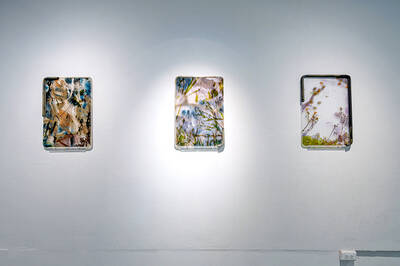
Located down a sideroad in old Wanhua District (萬華區), Waley Art (水谷藝術) has an established reputation for curating some of the more provocative indie art exhibitions in Taipei. And this month is no exception. Beyond the innocuous facade of a shophouse, the full three stories of the gallery space (including the basement) have been taken over by photographs, installation videos and abstract images courtesy of two creatives who hail from the opposite ends of the earth, Taiwan’s Hsu Yi-ting (許懿婷) and Germany’s Benjamin Janzen. “In 2019, I had an art residency in Europe,” Hsu says. “I met Benjamin in the lobby

April 22 to April 28 The true identity of the mastermind behind the Demon Gang (魔鬼黨) was undoubtedly on the minds of countless schoolchildren in late 1958. In the days leading up to the big reveal, more than 10,000 guesses were sent to Ta Hwa Publishing Co (大華文化社) for a chance to win prizes. The smash success of the comic series Great Battle Against the Demon Gang (大戰魔鬼黨) came as a surprise to author Yeh Hung-chia (葉宏甲), who had long given up on his dream after being jailed for 10 months in 1947 over political cartoons. Protagonist

A fossil jawbone found by a British girl and her father on a beach in Somerset, England belongs to a gigantic marine reptile dating to 202 million years ago that appears to have been among the largest animals ever on Earth. Researchers said on Wednesday the bone, called a surangular, was from a type of ocean-going reptile called an ichthyosaur. Based on its dimensions compared to the same bone in closely related ichthyosaurs, the researchers estimated that the Triassic Period creature, which they named Ichthyotitan severnensis, was between 22-26 meters long. That would make it perhaps the largest-known marine reptile and would


 RSS
RSS