


What brought a bright young man who sweated through electrical and nuclear engineering classes at MIT to this, a month on a frozen rock in the Arctic, with a fish bowl on his head, a Buzz Lightyear space suit, a shotgun to scare off polar bears and a busted “incinerator toilet”?
That’s how bad Joe Palaia wants to get to Mars.
Joe is almost 30. His mission in life is Mars, but his Martian clock is ticking. Bailout-happy, cash-for-clunkering politicians are making it very difficult for the space program. Since graduating from MIT three years ago, Palaia has done all he can to keep hope alive.
To advance the cause of manned Mars missions, he left wife and home in Holiday, Florida, to spend last month with five other volunteers in a can-shaped shelter on top of the world just 1,448km from the Earth’s North Pole. The place was Canada’s Devon Island, which hasn’t made much news outside musk oxen circles since a meteor fell on it 20 million years ago.
Their assignment: Pretend they’re on Mars.
Palaia and mates wore fake space suits. They endured snow, rain and fog. They slept through hurricane-force winds and blazing sunshine at midnight. They were armed for bear but saw one mosquito and one rabbit.
They did accomplish something astronauts may one day attempt on the Red Planet. They drew water from rock.
By now in the story, your eyebrow may be up to your hairline. North Pole. Fake space suits. Polar bears vs polar bunnies. Incinerator toilets. Fourth rock from the sun. The fair question is: “Is Palaia nuts or what?”
He seems to be an intelligent, adventurous, focused young man. He just happens to be in a hurry to leave Earth. Draw your own conclusions.
The Mars Society has been sending volunteers on shoestring expeditions to the Arctic since 2000. It’s as close to a Mars environment as you can find on Earth. Everything is like Mars except the polar bears, oxygen and Twitter.
Back in 2000, the Mars Society set up a tall fiberglass tube on the rock and furnished it with generators, stove, showers and cubby holes each just big enough for a bunk and a shelf.
Palaia’s crew was the 12th to occupy the tube. He answered an open call for volunteers because going to Mars has been all he’s thought about. After MIT, he helped start a company called 4Frontiers in New Port Richey, Florida, aimed at getting on the ground floor of Mars commercial opportunities. When he married, he told his wife, Melissa, he’d eventually have to leave for three years or so for a round trip.
The Mars Society made him chief engineer of the Devon Island expedition, meaning he had to keep the tube heated and the balky incinerator toilet working.
When they got to the island by bush plane it was snowing sideways.
The team was three men, three women. Besides engineer Palaia, it included a geologist, two NASA workers, a seismologist and a fifth-grade teacher. Each was encouraged to bring a personal research project. The geologist mined and cooked the mineral gypsum, which was all over the island, and also happens to exist in the polar regions of Mars. When heated to 149°C, it releases water.
Palaia brought an aircraft. He’d persuaded a Gainesville company called Prioria Robotics to loan him a small robotic plane rigged with surveillance cameras. Palaia’s project was to show that he could fly the thing while encumbered in a spacesuit. He flew it six times.
For every outdoor mission, the crew was required to wear the space suits. They’d been sewn by a Denver costumemaker. Each was canvas, badly frayed, and had a button-up fly. The uniform included a backpack that was basically a Tupperware container. It contained a fan that blew air into the stifling bubble helmet.
The purpose of the suits was to test astronaut mobility. Besides, the canvas kept Palaia warm. They enjoyed only three or four sunny days. When they got there, the temperature was minus 15°C. It got up to about 7°C.
Ask Palaia how six people got along for a month in a tube, and he’ll tell you that gypsum is hydrated calcium sulfate. He’s scientific, not one for idle gossip. Mostly, it seems, he and his mates worked. It took two weeks to make the tube livable. They generally kept at it every day from 9:30am to midnight, working around bad weather.
They also had to practice a polar bear drill. It consisted of gathering behind the guy with the shotgun, stripping off space suits, and running as fast as possible. That may or may not be necessary on Mars.
As soon as Palaia’s tired crew returned from Devon Island, a study committee appointed by US President Barack Obama issued a gloomy report on NASA’s manned spaceflight program. Basically, it said, the money isn’t there, even to send someone to the moon.
Palaia says private enterprise will do it if the government can’t. “Look what we’re accomplishing with a bunch of volunteers.” One way or another, he’s going where no man has gone before.
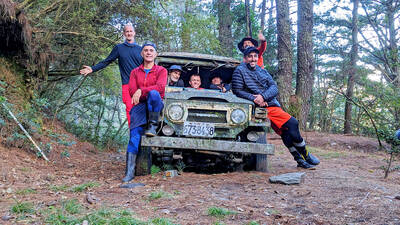
The year was 1991. A Toyota Land Cruiser set out on a 67km journey up the Junda Forest Road (郡大林道) toward an old loggers’ camp, at which point the hikers inside would get out and begin their ascent of Jade Mountain (玉山). Little did they know, they would be the last group of hikers to ever enjoy this shortcut into the mountains. An approaching typhoon soon wiped out the road behind them, trapping the vehicle on the mountain and forever changing the approach to Jade Mountain. THE CONTEMPORARY ROUTE Nowadays, the approach to Jade Mountain from the north side takes an

Last week Joseph Nye, the well-known China scholar, wrote on the Australian Strategic Policy Institute’s website about how war over Taiwan might be averted. He noted that years ago he was on a team that met with then-president Chen Shui-bian (陳水扁), “whose previous ‘unofficial’ visit to the US had caused a crisis in which China fired missiles into the sea and the US deployed carriers off the coast of Taiwan.” Yes, that’s right, mighty Chen caused that crisis all by himself. Neither the US nor the People’s Republic of China (PRC) exercised any agency. Nye then nostalgically invoked the comical specter

Relations between Taiwan and the Czech Republic have flourished in recent years. However, not everyone is pleased about the growing friendship between the two countries. Last month, an incident involving a Chinese diplomat tailing the car of vice president-elect Hsiao Bi-khim (蕭美琴) in Prague, drew public attention to the People’s Republic of China’s (PRC) operations to undermine Taiwan overseas. The trip was not Hsiao’s first visit to the Central European country. It was meant to be low-key, a chance to meet with local academics and politicians, until her police escort noticed a car was tailing her through the Czech capital. The

April 15 to April 21 Yang Kui (楊逵) was horrified as he drove past trucks, oxcarts and trolleys loaded with coffins on his way to Tuntzechiao (屯子腳), which he heard had been completely destroyed. The friend he came to check on was safe, but most residents were suffering in the town hit the hardest by the 7.1-magnitude Hsinchu-Taichung Earthquake on April 21, 1935. It remains the deadliest in Taiwan’s recorded history, claiming around 3,300 lives and injuring nearly 12,000. The disaster completely flattened roughly 18,000 houses and damaged countless more. The social activist and


 RSS
RSS