


Dan Chaon’s strange, stunning new novel, Await Your Reply, is both a ghost story and a valentine. That combination isn’t as peculiar as it sounds. At the end of a book that makes spine-tingling use of shifting, elusive identities, Chaon takes time to applaud some of the authors whose great, spooky stories have haunted his own memories. His list includes not only the usual suspects (Ray Bradbury, Stephen King, J.R.R. Tolkien, Shirley Jackson) but also relatively overlooked popular authors like Ira Levin and Thomas Tryon. Flash back to The Other, by Tryon, for a classic tale of scary twins.
Await Your Reply has scary twins too. But that device is just for starters. In a book that makes wittily exaggerated use of conventional thriller tricks, Chaon is not content to start his story with one reader-grabbing opener; he provides three. The first chapter presents Ryan, a boy whose father is assuring him that he, Ryan, is not going to bleed to death even though Ryan’s hand has just been severed. This is quickly followed by a second piquant setup: “A few days after Lucy graduated from high school, she and George Orson left town in the middle of the night.”
Third up: A twin, Miles Cheshire, en route to find his brother, Hayden, near the Arctic circle. “Welcome to Tsiigehtchic!” says a none-too-welcoming local sign.
Chaon is in no hurry to connect these dots and explain what the three opening scenes have to do with one another. But he is not stalling; he’s not generating arbitrary suspense by withholding information, though thriller writers routinely resort to that lazy method. The pieces of this plot will all fall into place eventually, and there will be shock value as their mysteries unravel. But the real pleasure in reading Chaon is less in finding out where he’s headed than in savoring what he accomplishes along the way.
Suffice it to say that nobody in Await Your Reply is exactly who he or she first appears to be. And nobody is a complete entity, either; perhaps the single most horrific plot motif here is that in a world where identities can be created, hacked into, shed or altered with apparent ease, the full and true self is an endangered species. This book takes its title from a computer spam message that uses Await Your Reply to lure unwitting fraud victims with the promise of a financial windfall from Ivory Coast. The mordant joke here is that the message’s recipient is even more unscrupulous than its sender.
The recipient is Jay Kozelek, the father of teenage Ryan, even though Jay has only lately told Ryan that he is his father and not his uncle. “You trust me, don’t you?” Ryan asks Jay, setting up the kind of ambiguous exchange in which Chaon so evidently delights. “Sure I do,” Jay answers. “You’re my son, right?” Sure.
Jay and Ryan play out an homage of sorts to Patricia Highsmith’s Mr Ripley, busily swindling and creating the fake personae that are clones or avatars of the video-game-savvy Jay. Citing a poem about the road not traveled by that guy “David Frost,” Jay wonders why the poem’s narrator had to make a choice. “How come you can’t travel both?” Jay asks about the divergent roads. “That seemed really unfair to me.”
Meanwhile, the runaway Lucy seems to be on more solid ground. She has escaped a small Ohio town with George Orson, her Maserati-driving history teacher, who never quite seemed to be the person he claimed to be. George would tell his students that American history was full of lies, “and he paused over the word ‘lies’ as if he liked the taste of it.”
George has spirited Lucy off to Nebraska, to the musty motel with a lighthouse motif that he describes as his mother’s home. George also says that the place was once situated lakeside, but all Lucy can see is dust where the lake used to be. There is a body of water in evidence, but it’s on the television set that conveniently plays Rebecca, with Mrs Danvers’ sinister sweet talk about the sea, in a handy Hitchcock-Du Maurier reference. No wonder Lucy’s a little nervous.
Then there’s the Arctic piece of this puzzle: Miles’ search for the lost Hayden, his troubled and alarming twin brother. When Hayden began to refer to “a hodgepodge of crypto-archaeology and numerology, holomorphy and brane cosmology, past-life regression and conspiracy-theory paranoia” as “my work,” Miles realized that he needed to be his brother’s keeper. But Hayden, who is even sneaker than the book’s other secretive characters, which is saying quite a lot, would much rather bait Miles than let Miles find him.
Chaon takes his sweet time — and if you’re lucky, he’ll take some of yours — in aligning the elements of his story so that clarity can begin to emerge. Like Kate Atkinson, who is not officially referenced here but might as well be, he’s particularly good at scrambling timelines in ways that conceal the truth, and in creating quick, occasional deja vu moments that show readers how certain events are connected.
So Chaon succeeds in both creating suspense and making it pay off, but Await Your Reply also does something even better. Like the finest of his storytelling heroes, Chaon manages to bridge the gap between literary and pulp fiction with a clever, insinuating book equally satisfying to fans of either genre. He does travel two roads, even though that guy David Frost said it wasn’t possible.

In late October of 1873 the government of Japan decided against sending a military expedition to Korea to force that nation to open trade relations. Across the government supporters of the expedition resigned immediately. The spectacle of revolt by disaffected samurai began to loom over Japanese politics. In January of 1874 disaffected samurai attacked a senior minister in Tokyo. A month later, a group of pro-Korea expedition and anti-foreign elements from Saga prefecture in Kyushu revolted, driven in part by high food prices stemming from poor harvests. Their leader, according to Edward Drea’s classic Japan’s Imperial Army, was a samurai

The following three paragraphs are just some of what the local Chinese-language press is reporting on breathlessly and following every twist and turn with the eagerness of a soap opera fan. For many English-language readers, it probably comes across as incomprehensibly opaque, so bear with me briefly dear reader: To the surprise of many, former pop singer and Democratic Progressive Party (DPP) ex-lawmaker Yu Tien (余天) of the Taiwan Normal Country Promotion Association (TNCPA) at the last minute dropped out of the running for committee chair of the DPP’s New Taipei City chapter, paving the way for DPP legislator Su
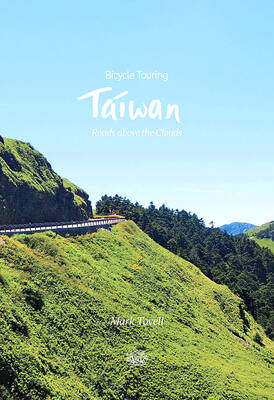
It’s hard to know where to begin with Mark Tovell’s Taiwan: Roads Above the Clouds. Having published a travelogue myself, as well as having contributed to several guidebooks, at first glance Tovell’s book appears to inhabit a middle ground — the kind of hard-to-sell nowheresville publishers detest. Leaf through the pages and you’ll find them suffuse with the purple prose best associated with travel literature: “When the sun is low on a warm, clear morning, and with the heat already rising, we stand at the riverside bike path leading south from Sanxia’s old cobble streets.” Hardly the stuff of your

Located down a sideroad in old Wanhua District (萬華區), Waley Art (水谷藝術) has an established reputation for curating some of the more provocative indie art exhibitions in Taipei. And this month is no exception. Beyond the innocuous facade of a shophouse, the full three stories of the gallery space (including the basement) have been taken over by photographs, installation videos and abstract images courtesy of two creatives who hail from the opposite ends of the earth, Taiwan’s Hsu Yi-ting (許懿婷) and Germany’s Benjamin Janzen. “In 2019, I had an art residency in Europe,” Hsu says. “I met Benjamin in the lobby


 RSS
RSS