


The fashion house Brioni is best known for dressing James Bond in black tie and creating hand-sewn custom suits that start out at US$4,000 and run as high as US$47,000. But this fall it is adding something a lot more humble to its line-up: a T-shirt.
With luxurious touches like hand-stitched Italian embroidery and a price tag of US$250, it won’t be an ordinary T-shirt, of course. Still, while other high-end Italian fashion companies like Armani and Ermenegildo Zegna crossed that threshold years ago, it will be the first offering of its kind for Brioni, whose image — and bottom line — have been built on formal wear and dressing rich Town & Country-style men since its founding in 1945.
As such, it’s a telling sign of how both the financial crisis and changing consumer habits are forcing even the most conservative, family-owned luxury goods makers to adapt to a new world.
Unlike bigger rivals such as Zegna, Brioni has refused to move any of its manufacturing out of Italy to cheaper locales like Mexico.
Nonetheless, the fashion fallout from the global financial crisis has reached even into the rolling hills of the Abruzzo region two-and-half hours east of Rome, where tailors still start their careers as teenage apprentices and pictures of patron saints adorn the walls of the company’s main workshop here.
While the company, which is private, won’t make any specific predictions about its financial performance this year, it concedes the environment is difficult.
“Knock on wood, we will be profitable in 2009,” said the company’s top executive, Andrea Perrone, whose grandfather co-founded Brioni.
Brioni said it managed to make a healthy profit last year. The company said it earned US$45 million before interest, taxes, depreciation and amortization, on revenue of about US$283 million, roughly in line with its results in 2007. The introduction of the T-shirt coincides with the rise of a new generation at Brioni, whose tailors regularly measure the likes of Nelson Mandela, Donald Trump and Britain’s Prince Andrew for suits and tuxedos. “It’s a provocation for the market,” said Perrone, who is 39. “It shows we can do everything from the shoes all the way to the hat.”
The T-shirt is “a sign Brioni is focusing on a younger clientele and a sign that their loyal clients have changed their lifestyle a lot,” said Armando Branchini, a professor of management at Bocconi University in Milan who also serves as the executive director of the Altagamma Foundation, an association of Italian luxury-goods makers.
The new T-shirt is also a departure for Brioni while still reflecting its tradition.
“It should feel different from Hanes,” sniffed Perrone, a soft-spoken, aristocratic heir who became Brioni’s first sole chief executive last month after being one of a triumvirate of top executives who ran the company since 2006.
“Even if you’re committed to your heritage, you have to be aware of where the market is going,” added Perrone, running his hand over the La Dolce Vita-era Brioni labels from the 1950s and 1960s that adorn the new T-shirt.
The top end of the formal wear market is contracting faster than the general men’s wear segment, according to Claudia D’Arpizio, a partner at the consulting firm Bain & Co who tracks the luxury goods industry. “If you have plenty of beautiful suits in your wardrobe, you can postpone a purchase,” she said.
So while Brioni’s T-shirt and its expensive blue jeans with crocodile piping may never end up in the bargain bin, they are much more appealing to the wealthy in these cost-conscious times and should help Brioni reach beyond its traditional clientele.
“Suits are the DNA of the brand but the casual component is the faster-selling part of the business,” said Russ Patrick, a senior vice president with Neiman Marcus. Last spring, the department store chain had to reorder Brioni jeans, which cost more than US$300 a pair, after several popular sizes sold out.
Though the company’s tailors and older executives here still speak reverently of hand-stitched buttonholes and the proper way a suit jacket should slide over the shoulders, the T-shirt caps Perrone’s effort to balance his family’s business.
Three years ago, casual clothes represented just 15 percent to 20 percent of Brioni’s sales. Now the segment equals 30 percent to 40 percent of sales, and Perrone says his goal is for jeans, polo shirts, slacks and T-shirts to eventually provide 50 percent of Brioni’s revenue.
For Brioni, like other luxury brands, casual sales worldwide have been about the only bright spot amid the sharp fall-off in the market, especially in the US. An added blow, as much to its pride as to the bottom line, was the loss of the James Bond account to Tom Ford, who dressed Daniel Craig in the latest 007 film, Quantum of Solace.
Along with the shift to more casual offerings, Brioni has also benefited from what Perrone calls the company’s “Silk Road strategy,” opening new stores in emerging markets like Russia, the Middle East, India and China. That has helped bring down the American share of Brioni’s sales to 30 percent, from 50 percent three years ago.
“Can you imagine our situation if we were still so dependent on the US?” he said.
The two families that control Brioni certainly can. Earlier this year, they flirted with different hedge funds, banks and other potential investors about selling a stake in the company to finance more aggressive expansion plans, much as other Italian luxury houses like Bulgari have done.
But that is all tabled for now. “Even nine months ago, it was how can we manage growth,” Perrone said. “Now it’s a completely different situation.”
Brioni has been forced to reduce the shifts of its 1,400 tailors, seamstresses and cutters in the Abruzzo region, with the Italian government, like several others in Europe, stepping in to make up some of the losses in workers’ paychecks.
Having united the nine family members who control Brioni behind him, Perrone is focused on slowly expanding his Silk Road strategy while also building up the casual line.
“We can afford for the moment to spend from our own pocket,” he said. “I’m talking about expanding the Brioni way, not 20 stores a year but two or three. It’s still a transitional moment, but we are moving step by step.”
T-shirts notwithstanding, that kind of caution, even parochialism, reflects the way most Italian family businesses have evolved over the years.
Workers still offer Perrone homemade ricotta and olive oil, while a priest comes every Christmas and Easter to celebrate Mass in the cafeteria, a few meters from where seamstresses labor on long rows of sewing machines.
“Abruzzo was quite poor, a closed society but people were farmers and had food and being a tailor was a good job,” said Luciano Morelli, who began working at age 10 about 60 years ago and is now a master tailor in charge of teaching teenage apprentices at Brioni’s tailoring school.
“It was a region of tailors because you could trade 50 kilos of flour for a jacket, or a pair of pants for some eggs,” he said.
Bartering may no longer be in style in Abruzzo, but the old-school habits endure, said Angelo Petrucci, 38, who is Brioni’s chief master tailor. “The fabrics have gotten much lighter, but some of the techniques we use are 200 years old,” Petrucci said.
Petrucci, who loves to show pictures of sultans, presidents and princes he has measured for classic suits, is less emotional when it comes to describing the finer points of Brioni’s T-shirts and other casual wear.
But Perrone, who admitted that it is not always easy to explain the realities of the world economic crisis to those whose lives rarely extend beyond Abruzzo, is not so sentimental.
In Penne, they are loyal to formal wear,” he said. “But the market wants casual.”

In late October of 1873 the government of Japan decided against sending a military expedition to Korea to force that nation to open trade relations. Across the government supporters of the expedition resigned immediately. The spectacle of revolt by disaffected samurai began to loom over Japanese politics. In January of 1874 disaffected samurai attacked a senior minister in Tokyo. A month later, a group of pro-Korea expedition and anti-foreign elements from Saga prefecture in Kyushu revolted, driven in part by high food prices stemming from poor harvests. Their leader, according to Edward Drea’s classic Japan’s Imperial Army, was a samurai

Located down a sideroad in old Wanhua District (萬華區), Waley Art (水谷藝術) has an established reputation for curating some of the more provocative indie art exhibitions in Taipei. And this month is no exception. Beyond the innocuous facade of a shophouse, the full three stories of the gallery space (including the basement) have been taken over by photographs, installation videos and abstract images courtesy of two creatives who hail from the opposite ends of the earth, Taiwan’s Hsu Yi-ting (許懿婷) and Germany’s Benjamin Janzen. “In 2019, I had an art residency in Europe,” Hsu says. “I met Benjamin in the lobby
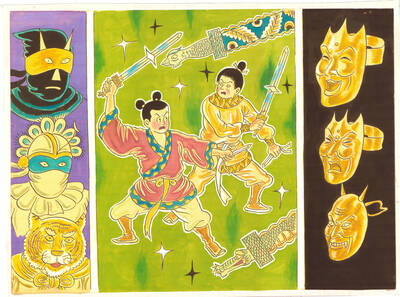
April 22 to April 28 The true identity of the mastermind behind the Demon Gang (魔鬼黨) was undoubtedly on the minds of countless schoolchildren in late 1958. In the days leading up to the big reveal, more than 10,000 guesses were sent to Ta Hwa Publishing Co (大華文化社) for a chance to win prizes. The smash success of the comic series Great Battle Against the Demon Gang (大戰魔鬼黨) came as a surprise to author Yeh Hung-chia (葉宏甲), who had long given up on his dream after being jailed for 10 months in 1947 over political cartoons. Protagonist

A fossil jawbone found by a British girl and her father on a beach in Somerset, England belongs to a gigantic marine reptile dating to 202 million years ago that appears to have been among the largest animals ever on Earth. Researchers said on Wednesday the bone, called a surangular, was from a type of ocean-going reptile called an ichthyosaur. Based on its dimensions compared to the same bone in closely related ichthyosaurs, the researchers estimated that the Triassic Period creature, which they named Ichthyotitan severnensis, was between 22-26 meters long. That would make it perhaps the largest-known marine reptile and would


 RSS
RSS