


A neon city. An urban catwalk of bizarre fashions and manga pixies with eyes like dinner plates. Tokyo: stamping ground of Godzilla, land of flat-pack commuters. A cultural fracture in Ozu’s Tokyo Story; a postmodern glitch in fiction by David Mitchell and William Gibson; a 24-hour high-tech dream-work. But what was Tokyo before it became the future? That question runs through Occupied City, the second part of a projected novel trilogy, and David Peace’s sequence is heading towards an unsettling conclusion: that the dream was built — or rebuilt — on a nightmarish substrate of postwar brutality.
Tokyo Year Zero — set in 1946 — was the Year of the Dog: scavenger, pack animal, beast in the house. A series of young women was sexually assaulted and strangled, while a corrupt police force was caught between an abject population and a thriving organized crime syndicate. Dog ate dog and developed a taste for it, in this shattered city, to which Peace brought the grit-flecked eye he had trained on 1970s Yorkshire. Some things, like the unleavening gallows humor of the Red Riding quartet, didn’t quite translate, but Year Zero was a gripping performance: crime fiction as grime fiction, propelled by a kind of experimentation so unusual in the genre that one sharp critic promptly dubbed it “avant-noir.”
Now, in 1948, the Year of the Rat is about to arrive. Verminous, solitary, a vector of disease, the Rat rules a Tokyo occupied twice over, by the army of US General Douglas MacArthur and by the unquiet ghosts of murder victims. We begin with the facts. Dressed as a government medical officer, a man walks into a downtown branch of the Teikoku bank. Warning against an outbreak of dysentery, he explains that he has been sent to inoculate the bank’s staff, who then willingly drink the poison he pours into their teacups. Sixteen drink. Twelve suffer a wretched, painful death.
With the structure of the book, Peace pays homage to the conflicting narratives of Akutagawa’s short story In a Grove and to Kurosawa’s filmed version, Rashomon. “This city is a seance,” declares one character and so is the novel, split between 12 ghosts in a distribution of narrative that, surprisingly, makes Occupied City a tighter read, with greater momentum, than its predecessor. Toning down the hammering repetitions and bewildering first-person confusions of Tokyo Year Zero has made for a more accommodating book, though at times characters are reduced to mere conduits for hearsay and supposition. In Occupied City, the military scientist and the detective, the killer and the victim are all swept along in the flow of contaminated data through a contaminated polis.
A residue of myth and conspiracy theory still clings to the Teigin incident, as the Japanese call the Teikoku bank murders, and painter Sadamichi Hirasawa spent almost 40 years on death row after recanting a doubtful confession. Some — and David Peace is of this number — proclaim Hirasawa’s innocence, believing that the method of poisoning points to the involvement of Unit 731, Japan’s covert wartime chemical and biological weapons division. Military-industrial conspiracy; police cover-up.
No room here for chance, for the lone wolf, or the rat. That may well be the point, but this apophenia, the hyper-associative thinking that fuels Peace’s imagination, is such that its wilder flights can sound like a paranoid riff on Forster: only connect ... everything.
This means of plotting is an acquired taste, in part because it demands considerable effort to grasp its unity even as it fosters the suspicion that there may be no unity to grasp. Take Occupied City’s most arduous and conspicuously experimental section, where typography alone distinguishes three competing narrative voices: the point at which this offbeat polyphony becomes wearing will depend on your tolerance for the visual contrivance.
One good reason to tolerate it is that the novels Peace produces are uncommonly serious about the nature of the tissues that bind together history, rumor, politics, psychology, community and fiction. At their best, they develop a kind of literary forensics, exhuming histories of violence to probe the necrotized organs of the societies in which that violence erupts. The result is occasionally messy, the evidence often dubious, but Peace wields the scalpel like no one else.
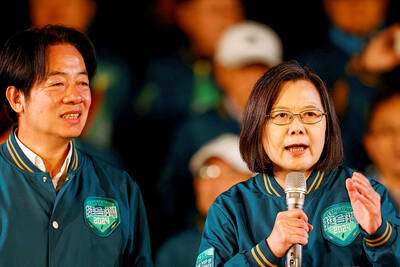
Last week Joseph Nye, the well-known China scholar, wrote on the Australian Strategic Policy Institute’s website about how war over Taiwan might be averted. He noted that years ago he was on a team that met with then-president Chen Shui-bian (陳水扁), “whose previous ‘unofficial’ visit to the US had caused a crisis in which China fired missiles into the sea and the US deployed carriers off the coast of Taiwan.” Yes, that’s right, mighty Chen caused that crisis all by himself. Neither the US nor the People’s Republic of China (PRC) exercised any agency. Nye then nostalgically invoked the comical specter

Over the course of former President Ma Ying-jeou’s (馬英九) 11-day trip to China that included a meeting with Chinese Communist Party (CCP) leader Xi Jinping (習近平) a surprising number of people commented that the former president was now “irrelevant.” Upon reflection, it became apparent that these comments were coming from pro-Taiwan, pan-green supporters and they were expressing what they hoped was the case, rather than the reality. Ma’s ideology is so pro-China (read: deep blue) and controversial that many in his own Chinese Nationalist Party (KMT) hope he retires quickly, or at least refrains from speaking on some subjects. Regardless

Approaching her mid-30s, Xiong Yidan reckons that most of her friends are on to their second or even third babies. But Xiong has more than a dozen. There is Lucky, the street dog from Bangkok who jumped into a taxi with her and never left. There is Sophie and Ben, sibling geese, who honk from morning to night. Boop and Pan, both goats, are romantically involved. Dumpling the hedgehog enjoys a belly rub from time to time. The list goes on. Xiong nurtures her brood from her 8,000 square meter farm in Chiang Dao, a mountainous district in northern Thailand’s

Peter Brighton was amazed when he found the giant jackfruit. He had been watching it grow on his farm in far north Queensland, and when it came time to pick it from the tree, it was so heavy it needed two people to do the job. “I was surprised when we cut it off and felt how heavy it was,” he says. “I grabbed it and my wife cut it — couldn’t do it by myself, it took two of us.” Weighing in at 45 kilograms, it is the heaviest jackfruit that Brighton has ever grown on his tropical fruit farm, located


 RSS
RSS