


Gordon, 3, would not look his parents in the eyes, and refused to call them Mom and Dad. He erupted in tantrums and sometimes cried nonstop for half an hour.
“We did not know why,” said his mother, Winnie Liu, recalling the desperation that sent them to a neurologist to check Gordon for autism, and to a hospital that referred them to Butterflies, a mental health program for very young children on the Lower East Side of Manhattan.
Finally they learned the reason for their child’s distress — and the reason social service agencies that help families from China are facing a sharp rise in such developmental problems.
Like thousands of other Chinese immigrants responding to financial and cultural pressures, Liu and her husband, Tim Fang, had sent Gordon to live with his grandparents, thousands of kilometers away in Fujian Province, a few months after his birth in New York. Working long hours in the restaurant business, they had not brought him back to the US until he was old enough to attend all-day public preschool.
And now he saw them as strangers who had stolen him away to a strange land.
“The children that have that experience come back with tremendous needs,” said Nina Piros, director of early childhood programs at University Settlement, a nonprofit agency that estimates that 400 of the 1,000 children served by its Butterflies program are returnees from China. “They come here and they’re totally traumatized.”
Some act out in frightening and confusing ways, she said, banging their heads on walls, refusing to speak, or wandering aimlessly in the classroom. These signs of extreme trauma have often been misunderstood as symptoms of autism. But they are the marks of the emotional dislocations these young children have endured.
Less severely affected youngsters are helped through supportive workshops for their teachers and parents. But about two dozen in the Butterflies program need the kind of intensive therapy that eventually helped Gordon and his parents bond, said Andrea Bennett, director of Butterflies, which was started three years ago with money from the New York City Council.
The phenomenon of US-born children who spend their infancy in China has been known for years to social workers, who say it is widespread and worrying. About 8,000 Chinese-born women gave birth in New York last year, so the number of children at risk is substantial, according to the Chinese-American Planning Council, a social service agency that hopes to get a grant to educate parents about the pitfalls of the practice and help them find alternatives.
But no one tracks the numbers, and the issue has only recently seized the attention of early-childhood researchers like Yvonne Bohr, a clinical psychologist at York University in Toronto, who calls such children “satellite babies.”
Their repeatedly disrupted attachments to family members “could potentially add up to a mental health crisis for some immigrant communities,” Bohr wrote in an article in May in The Infant Mental Health Journal. She cited classic research like the work of Anna Freud, who found that young children evacuated during the London blitz were so damaged by separation from their parents that they would have been better off at home, in danger of falling bombs.
Bohr, who is undertaking a longitudinal study of families with satellite babies, cautions that the older research was shaped by Western values and expectations. Chinese parents, including university-educated professionals she has studied, are often influenced by cultural traditions: an emphasis on self-sacrifice for the good of the family, a belief that grandparents are the best caretakers, and a desire to ground children in their heritage.
Sending babies back to grandparents is also done in some South Asian communities, she said.
But Amanda Peck, a spokeswoman for University Settlement, which has been serving newcomers to the Lower East Side since 1886, said that while family separations are a feature of migration in many ethnic groups, the satellite-baby phenomenon seems rare outside the Chinese community.
Some children are better able to adapt, whether because of natural resilience, more supportive parenting or the age at which disruptions occurred. Even in severe cases like Gordon’s, the Butterflies program has had success in overcoming the worst consequences of separation with therapeutic play and support for parent and child, said Victoria Chiu, its bilingual therapist.
But for many children, new separations are in store even after they return to the US. In one typical case, parents migrated to work in a Chinese restaurant in South Carolina, taking a school-age child along, but leaving a baby in China and a three-year-old with grandparents in New York.
“The three-year-old, he wouldn’t even smile,” Chiu said. “When he sat in circle time, his whole little body was just slumped.”
Gordon, now 7, keeps up with his second-grade classmates and has learned to control his temper, said his parents, who own Wild Ginger, a restaurant on Broome Street. In imperfect but fluent English, his mother recounted the hard climb to that happy resolution, and revisited the scene of major turning points: a tiny playroom under the eaves of the old settlement house, where a dollhouse and a big plush dog played a role in healing her son.
Dressed as a superhero, Gordon would often rescue the dog from a pretend fire in the dollhouse, saving him from “the bad guys,” as Chiu and his mother played along.
“I was the bad lady,” Gordon’s mother, 31, recalled ruefully. “Then the play changed, and he tried to save Mom from the bad guy.”
The therapist explained: “He was trying to find mastery over things he had no control over. We started introducing scenarios to help him develop trust in his parents’ authority over his life.”
Liu, who was 17 when she immigrated to New York on a green card sponsored by her father, pressed a hand to her heart. “This wonderful therapist, this program, help us read the child’s mind,” she said. “Now he hug me, and he say ‘Mommy’ sometimes.”
Still, Gordon remains more withdrawn than typical seven-year-olds. Liu said she struggles with guilt and regret.
“I advise all Chinese families, do not send your kids away, no matter how hard, because that loss cannot be made up,” she said. “Money is not so important. Nothing can make up for the sensation of love between parents and children.”
The shuttling of babies first caught public attention in New York a decade ago, when women workers from Fujian province, deep in debt to the “snakeheads” who had smuggled them into the country, had little choice but to send their infants back to their extended families.
Typically, such children returned at school age. Their tough adjustment to the change in language, customs and parental discipline was generally likened to the problems of other immigrant children, who must often cope with long-delayed reunions after being left behind for years.
Now, however, because of the expansion of free full-day preschool in recent years, satellite babies return and start classes as young as 2 years, 9 months.
Their parents, including many lawful permanent residents and citizens like Gordon’s mother, assume that the children will adjust more easily because they are so young. But early childhood is the crucial time for learning to form attachments and feel empathy, and serious disruptions carry lifelong consequences, psychologists say, including higher rates of depression and dysfunction.
Many families are unaware of the potential psychological damage, said Hong Shing Lee, chief operating officer of the Asian-American Federation of New York.
That was the case for the family of Alisa Chen, now 4. Alisa was 6 months old when her mother, Qiao Yuni Chen, a waitress unable to afford day care, took her to her grandmother in China. When Chen returned more than a year later to visit — and to leave Alisa’s baby sister, Angie — she was heartbroken by Alisa’s rejection. Only in the last two weeks of a three-month stay was Alisa willing to sleep at her mother’s side.
Alisa started preschool at University Settlement in August last year, only a week after arriving in New York; two months later, teachers referred her to Butterflies.
“She seemed kind of lost, not picking up English, withdrawing from her peers,” Chiu recalled. “She seemed anxious that her mom wouldn’t pick her up.” Another problem was the mother’s expectations: The only toy in their home was a letter board more appropriate for a six-year-old than for a child turning 4.
Chen, whose husband is now in the US Army in South Carolina, threw herself into becoming a more supportive parent, Chiu said. Though she spoke little English, she phonetically memorized songs like Itsy Bitsy Spider. At a US$0.99 store, the therapist helped her pick playthings that would allow her daughter to express herself.
The payoff was obvious when the preschooler returned from a class trip to the Bronx Zoo one recent afternoon. Pigtails bouncing, her smile electric with joy, Alisa threw herself into her mother’s arms. Chiu beamed.
Next month, Alisa’s little sister arrives from China to begin Head Start.

Last week Joseph Nye, the well-known China scholar, wrote on the Australian Strategic Policy Institute’s website about how war over Taiwan might be averted. He noted that years ago he was on a team that met with then-president Chen Shui-bian (陳水扁), “whose previous ‘unofficial’ visit to the US had caused a crisis in which China fired missiles into the sea and the US deployed carriers off the coast of Taiwan.” Yes, that’s right, mighty Chen caused that crisis all by himself. Neither the US nor the People’s Republic of China (PRC) exercised any agency. Nye then nostalgically invoked the comical specter
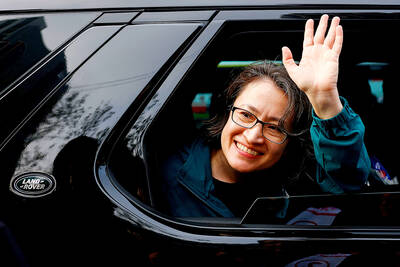
Relations between Taiwan and the Czech Republic have flourished in recent years. However, not everyone is pleased about the growing friendship between the two countries. Last month, an incident involving a Chinese diplomat tailing the car of vice president-elect Hsiao Bi-khim (蕭美琴) in Prague, drew public attention to the People’s Republic of China’s (PRC) operations to undermine Taiwan overseas. The trip was not Hsiao’s first visit to the Central European country. It was meant to be low-key, a chance to meet with local academics and politicians, until her police escort noticed a car was tailing her through the Czech capital. The

April 15 to April 21 Yang Kui (楊逵) was horrified as he drove past trucks, oxcarts and trolleys loaded with coffins on his way to Tuntzechiao (屯子腳), which he heard had been completely destroyed. The friend he came to check on was safe, but most residents were suffering in the town hit the hardest by the 7.1-magnitude Hsinchu-Taichung Earthquake on April 21, 1935. It remains the deadliest in Taiwan’s recorded history, claiming around 3,300 lives and injuring nearly 12,000. The disaster completely flattened roughly 18,000 houses and damaged countless more. The social activist and

Over the course of former President Ma Ying-jeou’s (馬英九) 11-day trip to China that included a meeting with Chinese Communist Party (CCP) leader Xi Jinping (習近平) a surprising number of people commented that the former president was now “irrelevant.” Upon reflection, it became apparent that these comments were coming from pro-Taiwan, pan-green supporters and they were expressing what they hoped was the case, rather than the reality. Ma’s ideology is so pro-China (read: deep blue) and controversial that many in his own Chinese Nationalist Party (KMT) hope he retires quickly, or at least refrains from speaking on some subjects. Regardless


 RSS
RSS