


Lovely Taiwan (台灣好•店) mixes together the old and the new and gives birth to something relatively rare in Taipei — a store that focuses exclusively on traditional Taiwanese crafts.
Shopping at the sleekly appointed space near Zhongshan MRT Station (中山捷運站) is like taking a trip around the country in a few minutes.
Profits from the sale of black tea leaves grown in Nantou County help a community there recover from the 921 earthquake, while sales of soap made from locally harvested herbs enable a Taoyuan special education school to purchase supplies. Shoppers can take home a piece of Taiwan — literally, in the form of stone carvings made by artisans in Hualien County.
The store was launched in March by the Lovely Taiwan Foundation (台灣好基金會), which is dedicated to promoting native Taiwanese culture.
“Part of the point of selling these artisans’ work is helping them carry on their traditions,” said store manager Lisa Yeh (葉莉慧).
“I think people who come to the store are sometimes surprised that there are so many different styles of handicrafts made in Taiwan and that the level of workmanship is so high,” she added.
Part of the store’s takings is distributed directly to artisans. Without the involvement of middlemen, the prices are very reasonable. A bag made using Aboriginal needle-working techniques is NT$1,300, while intricately handcrafted tin birds start at NT$750.
In some cases, selling handmade items gives communities a much-needed source of income, which boosts their economic independence.
Some of Lovely Taiwan’s most popular products are hand-carved wooden animals from Sanyi Duck Treasure Shop (三義ㄧㄚ箱寶) in Sanyi Township (三義鄉), Miaoli County. Craftsmen from the woodworking studio’s predecessor, Shuangfeng (雙峰), once produced mallard duck decoys and other items for export, but were eventually overwhelmed by competition from factories in China and Southeast Asia. In 2002, the studio was reborn as a tourist attraction, teaching woodcarving classes and making colorful figures based on Taiwanese animals, like the Formosan black bear and the fairy pitta, a small endangered bird.
Other best sellers include home furnishings and bags crafted by members of Aboriginal tribes in Jinfeng Township (金峰鄉), Taitung County. The artisans are close relatives of students at the town’s Xinxing Primary School (新興國小). The school’s principal, Cheng Han-wen (鄭漢文), noticed that parents were often unable to participate in their children’s education because they were too busy searching for jobs, which are scarce in the area. Cheng launched a program that gave parents the skills and material resources to create the items now sold in Lovely Taiwan. The furniture is carved from driftwood and the bags are embroidered with traditional motifs like two-headed snakes.
“We’ve worked with this program for two years now and having a stable source of income has really made a difference for these families,” said Yeh.
While some of the items sold in Lovely Taiwan help their makers achieve economic independence, other artisans see preserving their community’s traditions as the main goal.
Yuma•Taru, a member of the Taiya tribe (泰雅族), left her office job in Taipei 20 years ago to return to Miaoli County and learn dyeing and weaving techniques from tribal elders.
“Lovely Taiwan is important because it promotes traditional culture and crafts as something that is desirable,” said Yuma, whose work is on exhibit in the store’s gallery until Aug. 26. “Many Taiwanese people don’t think Taiwanese culture is modern or fashionable enough. They’d rather buy something from Louis Vuitton.”
In 2002, Yuma founded Yetong Workshop (野桐工坊) to preserve traditional Taiya fiber art. The intricate fabrics the workshop produces are woven with fibers and dyed with pigments from locally harvested plants.
“I studied history in university, so I know that if members of a group do not appreciate their own culture and know how to keep it alive, then they don’t know who they are and they don’t know where they are going,” Yuma said.
STORE NOTES:
WHAT: Lovely Taiwan (台灣好•店)
WHERE: 18-2, Ln 25, Nanjing W Rd, Taipei City (台北市南京西路25巷18-2號)
HOURS: Daily from noon to 9pm, except Mondays
TELEPHONE: (02) 2558-2616
ON THE NET: www.lovelytaiwan.org.tw

In late October of 1873 the government of Japan decided against sending a military expedition to Korea to force that nation to open trade relations. Across the government supporters of the expedition resigned immediately. The spectacle of revolt by disaffected samurai began to loom over Japanese politics. In January of 1874 disaffected samurai attacked a senior minister in Tokyo. A month later, a group of pro-Korea expedition and anti-foreign elements from Saga prefecture in Kyushu revolted, driven in part by high food prices stemming from poor harvests. Their leader, according to Edward Drea’s classic Japan’s Imperial Army, was a samurai

Located down a sideroad in old Wanhua District (萬華區), Waley Art (水谷藝術) has an established reputation for curating some of the more provocative indie art exhibitions in Taipei. And this month is no exception. Beyond the innocuous facade of a shophouse, the full three stories of the gallery space (including the basement) have been taken over by photographs, installation videos and abstract images courtesy of two creatives who hail from the opposite ends of the earth, Taiwan’s Hsu Yi-ting (許懿婷) and Germany’s Benjamin Janzen. “In 2019, I had an art residency in Europe,” Hsu says. “I met Benjamin in the lobby
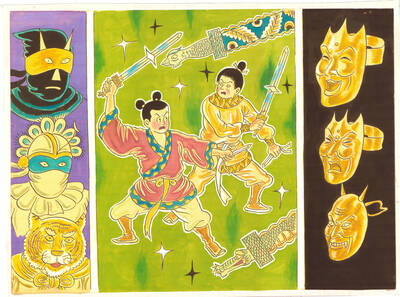
April 22 to April 28 The true identity of the mastermind behind the Demon Gang (魔鬼黨) was undoubtedly on the minds of countless schoolchildren in late 1958. In the days leading up to the big reveal, more than 10,000 guesses were sent to Ta Hwa Publishing Co (大華文化社) for a chance to win prizes. The smash success of the comic series Great Battle Against the Demon Gang (大戰魔鬼黨) came as a surprise to author Yeh Hung-chia (葉宏甲), who had long given up on his dream after being jailed for 10 months in 1947 over political cartoons. Protagonist

A fossil jawbone found by a British girl and her father on a beach in Somerset, England belongs to a gigantic marine reptile dating to 202 million years ago that appears to have been among the largest animals ever on Earth. Researchers said on Wednesday the bone, called a surangular, was from a type of ocean-going reptile called an ichthyosaur. Based on its dimensions compared to the same bone in closely related ichthyosaurs, the researchers estimated that the Triassic Period creature, which they named Ichthyotitan severnensis, was between 22-26 meters long. That would make it perhaps the largest-known marine reptile and would


 RSS
RSS