


VIEW THIS PAGE It's the director’s worst nightmare: the audience leaves halfway through a movie or play. But at Eslite Gallery, such behavior is encouraged.
For Looking Up! Looking Down! (抬頭一看,生活裡沒有任何美好的事), the gallery’s current exhibition, there is no seating for six out of seven video installations on display, even though there are plenty of benches in a reception room.
“Nobody ever watches [the videos] all the way through,” said Jenning King (金振寧), the gallery’s public relations manager.
Herein lies a problem that afflicts many contemporary conceptual art shows — and their viewers — and one that Looking Up!, a collection of video, photographic and sculptural installations by 11 artists, also suffers from: the content is abstruse because of a lack of context concerning how the work was made or what it is about. Gallery literature tends to focus, rather, on the artists’ ages and educational backgrounds, and uses jargon and pretentious diction to give relatively straightforward concepts an added air of sophistication.
Which is unfortunate because there is considerable talent on display here, in the form of imaginative and thought-provoking work that deserves mention.
This is particularly true of Chou Wen-chin’s (周文欽) The Trialectics of a Stolen Bicycle: The Thief, the Police and I (單車失竊記之各有處境篇). This 17-minute video opens with grainy closed-circuit images of a thief smashing the artist’s car window and making off with his bike. It then segues to an old black-and-white movie of a man attempting to enlist the help of police officers who respond apathetically to his entreaties — a scene King said replicates almost verbatim Chou’s own experience at a Taipei police station.
Kao Jun-honn (高俊宏) employs music videos from MTV and YouTube as well as colonial architecture in Loser’s Grand Narrative (失敗者大敘事) to explore cultural transformation. The three-segment video begins with Michael Jackson’s Thriller, which, after running for roughly a minute, is replaced by a performer from India imitating the recently deceased entertainer’s moves. The third segment shows a student comically imitating the Indian dancer. Viewed as a whole, the video reveals that although the imitators might not possess Jackson’s phenomenal talents, they still manage to create something of their own that is both fresh and humorous.
Kao’s plywood installation positioned directly across from the video mixes three colonial architectural styles common to Taiwan and other Southeast Asian countries. The structure appears to be unfinished, possibly a reference to Taiwan’s unfinished project of creating its own cultural identity. As with the riffs on Jackson’s dancing, the plywood installation shows how influences from one culture are appropriated by another to make something new.
Yeh Chen-yu (葉振宇) used detritus found along Tamsui River to build and furnish a shelter on the riverside, which he filmed in Go Home After Ebbing (潮退了,我們就回家). When the water rises inside the shack, the furniture floats around; as it recedes the interior is rearranged, a reference to the arbitrary nature of life.
The three videos listed above deploy concise and seamlessly edited visual narratives to investigate a theme — whether the insouciance of authorities, cultural identity or unpredictability.
But Chiu Shueh-meng’s (邱學盟) installation Floating Prayers (漂流的禱) — 17 transparent plastic bags of water, each containing a photograph that has rolled up and faded because of its immersion in liquid — is difficult, if not impossible, to make anything of. Is it about memory? The environment?
And Lai Chih-sheng’s (賴志盛) upside-down video footage of a car driving through Taipei in The Reverse Reality — (Episode II)(天空裡的現實II) might offer an alternate perspective on day-to-day existence, but it required a discussion with the curator to understand how. The video is of the route the artist takes on a daily basis from his studio to the university he works at, the curator explained. Inverting this routine shows how perceptions change as one’s perspective changes.
Lee Ji-hong’s (李基宏) 15-minute video 20081029 Square (20081029廣場) explores the concept of time. He spent 24 hours walking around the square in front of Taipei’s Grand Formosa Hotel as pictures were taken of him every six seconds. Lee said the video is meant to illustrate the repetitious nature of the daily grind. This is an idea many people can relate to, and some viewers will not doubt understand it intuitively. Others will likely watch a few seconds of the video, become bored and walk away scratching their heads.
“Some ordinary people do not have the art education to look at a piece and transfer it into their normal life,” Lee said when asked about the video’s meaning.
Perhaps. But it seems that most “ordinary people” do have this ability when the piece is accompanied with a brief introduction or explanation written in plain language. Although some of the installations in Looking Up! are self-explanatory, many will leave the viewer feeling more apathetic than enlightened.
Exhibition notes:
What: Looking Up! Looking Down! (抬頭一看,生活裡沒有任何美好的事)
Where: Eslite Xinyi Bookstore (誠品信義店), 5F, 11 Songgao Rd, Taipei City (台北市松高路11號5樓)
When: Until Aug. 2. Open Tuesdays to Sundays from 11am to 7pm
Telephone: (02) 8789-3388 X1588
Admission: Free
In late October of 1873 the government of Japan decided against sending a military expedition to Korea to force that nation to open trade relations. Across the government supporters of the expedition resigned immediately. The spectacle of revolt by disaffected samurai began to loom over Japanese politics. In January of 1874 disaffected samurai attacked a senior minister in Tokyo. A month later, a group of pro-Korea expedition and anti-foreign elements from Saga prefecture in Kyushu revolted, driven in part by high food prices stemming from poor harvests. Their leader, according to Edward Drea’s classic Japan’s Imperial Army, was a samurai
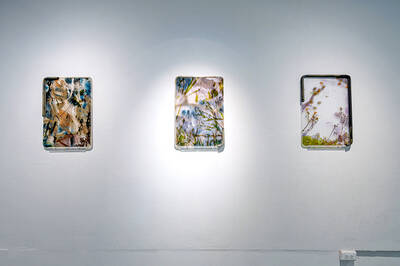
Located down a sideroad in old Wanhua District (萬華區), Waley Art (水谷藝術) has an established reputation for curating some of the more provocative indie art exhibitions in Taipei. And this month is no exception. Beyond the innocuous facade of a shophouse, the full three stories of the gallery space (including the basement) have been taken over by photographs, installation videos and abstract images courtesy of two creatives who hail from the opposite ends of the earth, Taiwan’s Hsu Yi-ting (許懿婷) and Germany’s Benjamin Janzen. “In 2019, I had an art residency in Europe,” Hsu says. “I met Benjamin in the lobby
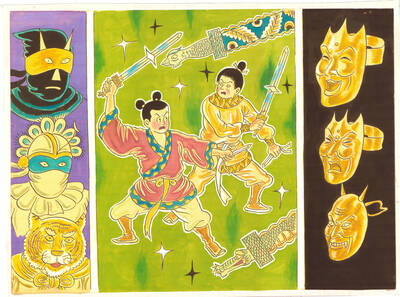
April 22 to April 28 The true identity of the mastermind behind the Demon Gang (魔鬼黨) was undoubtedly on the minds of countless schoolchildren in late 1958. In the days leading up to the big reveal, more than 10,000 guesses were sent to Ta Hwa Publishing Co (大華文化社) for a chance to win prizes. The smash success of the comic series Great Battle Against the Demon Gang (大戰魔鬼黨) came as a surprise to author Yeh Hung-chia (葉宏甲), who had long given up on his dream after being jailed for 10 months in 1947 over political cartoons. Protagonist

A fossil jawbone found by a British girl and her father on a beach in Somerset, England belongs to a gigantic marine reptile dating to 202 million years ago that appears to have been among the largest animals ever on Earth. Researchers said on Wednesday the bone, called a surangular, was from a type of ocean-going reptile called an ichthyosaur. Based on its dimensions compared to the same bone in closely related ichthyosaurs, the researchers estimated that the Triassic Period creature, which they named Ichthyotitan severnensis, was between 22-26 meters long. That would make it perhaps the largest-known marine reptile and would


 RSS
RSS