


If you’re at all susceptible to them, books can radically change your mood. Last week I read Peter Ackroyd’s The Last Testament of Oscar Wilde and was in seventh heaven when engaging with its panache and literary wizardry. My days raced by. After that I turned to Cao Naiqian’s (曹乃謙) There’s Nothing I Can Do When I Think of You Late at Night, newly translated from Chinese, and the contrast was dramatic. I slept badly, dragged my feet, and felt the world must surely be able to offer a more invigorating spectacle than the depressing world I was confronting.
Yet many of the great and the good from the world of Chinese literature in translation have come together to celebrate this book. Goran Malmqvist, the member of the Nobel Prize committee said to be responsible for giving the 2000 prize to Gao Xingjian (高行健), is Cao’s translator into Swedish and encouraged the present translator John Balcom to undertake the task, and Howard Goldblatt, finest of translators of modern Chinese fiction, is thanked in the book’s acknowledgements. Balcom makes comparisons with Sherwood Anderson, William Faulkner and Erskine Caldwell. All seemed set for a great read. So what happened?
There’s Nothing I Can Do was first published in Chinese in Taiwan in 2005, and an edition for China followed two years later. (This is yet another tribute to Taipei’s eminence in the world of Chinese-language publishing, as neither the author nor the content has anything to do with Taiwan — though I did notice one comic reference to the old cadre who is prominent in the tale, saying the villagers should “liberate Taiwan and rescue [its] commune members from [their] abyss of suffering”).
The book consists of 30 stories, many published in magazines in China during the 1980s and 1990s. But the same characters reappear and the work ends up becoming a sort of novel. It’s set during the Cultural Revolution and the location is Shanxi Province, a short distance from the border of Inner Mongolia. The author, who comes from that area, wrote the whole book in Shanxi dialect, something the translator, who has enough problems without needing more, doesn’t attempt to replicate.
The feeling you have is that this is the remotest and poorest village imaginable. It has almost no connection with life elsewhere, and the characters, all of whom live in caves, have names like Lucky Ox, Zits Wu, Little Dog, Big Dog, or just Dog. Moreover they all appear to have only two interests in life — food and sex.
From the first story onwards an atmosphere of gross farce is established. As you progress through the book you encounter sex with animals, two men sharing a wife, and sex with one’s mother. The final tale, Corncob, seems to be an attempt to combine all these things into a single narrative, though it ends in tragedy rather than remaining on the absurdist level most of the other stories inhabit.
So why did this book, which on the face of it must sound high-spirited and rambunctious if nothing else, depress me so much? I think the answer lies in its repetitiveness.
Take the language first. It’s tempting to say that swear words proliferate, but the actuality is that it’s just one, the dreaded f-word, that reappears over and over again, perhaps thousands of times in all. It appears as an adjective and as part of some of the characters’ names as well as a simple expletive. This becomes extremely wearying, like the endless reappearance of the French word “merde” in Alfred Jarry’s classic satirical farce King Ubu.
The effect of this repetition is numbing on the reader’s sensibility, and in the end it just becomes boring. Is that really what the book is like in the Shanxi-dialect Chinese, you wonder? It’s clear that what the translator is trying to do is convey some aspect of the original, and that what Cao is himself presumably trying to convey is the terrible narrowness of his characters’ horizons, just humping animals and eating awful food and talking in this endlessly dumbed-down, mind-numbing manner.
The subject matter, too, mostly concerns the repetitive preoccupations of rural life — the castration of animals, the biting of gadflies and the burning of wormwood to ward off mosquitoes. The only pleasant place near the village is rarely visited because it’s believed to harbor ghosts. Against this background, dreams of copulation are never far away.
The Communist Party is portrayed as being just one more cross the poor peasants have to bear. Supposed malefactors, or simple fools, are frequently tied up and beaten by the local Committee for the Dictatorship of the Masses. Apparently this passed China’s censorship because the book is set in the past and not the present.
Balcom is a distinguished translator, incidentally. He’s translated several Taiwanese books including Running Mother and Other Stories (奔跑的母親) by Guo Songfen (郭松棻) [reviewed in the Taipei Times on March 29, 2009] and a version of the Wintry Night (寒夜續曲) trilogy by Li Qiao (李喬).
This collection of bizarre tales is probably intended as a send-up, simultaneously compassionate and farcical, of official versions of the virtuous life of the countryside, to experience which Mao Zedong (毛澤東) sent down a whole generation of young city-dwellers. And it’s perhaps wrong to give the impression that the entire book is depressing — maybe it was unfortunate that I read it so soon after Ackroyd’s dazzling tour de force. Nonetheless, this is certainly not a volume to be recommended unreservedly to the fainthearted. It’s slightly unnerving, too, to learn that the author is, of all things, a police detective in the very province he writes about.

In late October of 1873 the government of Japan decided against sending a military expedition to Korea to force that nation to open trade relations. Across the government supporters of the expedition resigned immediately. The spectacle of revolt by disaffected samurai began to loom over Japanese politics. In January of 1874 disaffected samurai attacked a senior minister in Tokyo. A month later, a group of pro-Korea expedition and anti-foreign elements from Saga prefecture in Kyushu revolted, driven in part by high food prices stemming from poor harvests. Their leader, according to Edward Drea’s classic Japan’s Imperial Army, was a samurai
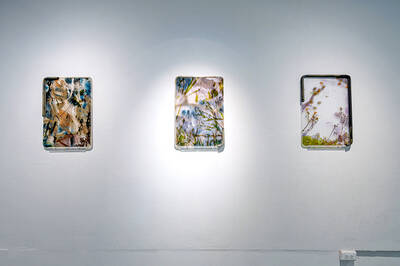
Located down a sideroad in old Wanhua District (萬華區), Waley Art (水谷藝術) has an established reputation for curating some of the more provocative indie art exhibitions in Taipei. And this month is no exception. Beyond the innocuous facade of a shophouse, the full three stories of the gallery space (including the basement) have been taken over by photographs, installation videos and abstract images courtesy of two creatives who hail from the opposite ends of the earth, Taiwan’s Hsu Yi-ting (許懿婷) and Germany’s Benjamin Janzen. “In 2019, I had an art residency in Europe,” Hsu says. “I met Benjamin in the lobby
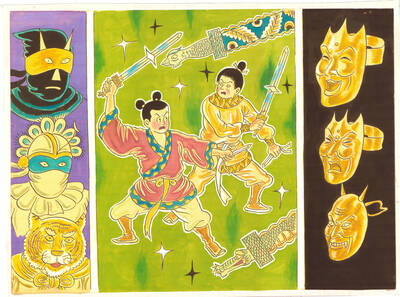
April 22 to April 28 The true identity of the mastermind behind the Demon Gang (魔鬼黨) was undoubtedly on the minds of countless schoolchildren in late 1958. In the days leading up to the big reveal, more than 10,000 guesses were sent to Ta Hwa Publishing Co (大華文化社) for a chance to win prizes. The smash success of the comic series Great Battle Against the Demon Gang (大戰魔鬼黨) came as a surprise to author Yeh Hung-chia (葉宏甲), who had long given up on his dream after being jailed for 10 months in 1947 over political cartoons. Protagonist

Peter Brighton was amazed when he found the giant jackfruit. He had been watching it grow on his farm in far north Queensland, and when it came time to pick it from the tree, it was so heavy it needed two people to do the job. “I was surprised when we cut it off and felt how heavy it was,” he says. “I grabbed it and my wife cut it — couldn’t do it by myself, it took two of us.” Weighing in at 45 kilograms, it is the heaviest jackfruit that Brighton has ever grown on his tropical fruit farm, located


 RSS
RSS