


The mood of the Afghan people has tipped into a popular revolt in some parts of southern Afghanistan, presenting incoming US forces with an even harder job than expected in reversing military losses to the Taliban and winning over the population.
Villagers in some districts have taken up arms against foreign troops to protect their homes or in anger after losing relatives in airstrikes, several community representatives said in interviews. Others have been moved to join the insurgents out of poverty or simply because the Taliban’s influence is so pervasive here.
On Thursday morning, 4,000 US Marines began a major offensive to try to take back the region from the strongest Taliban insurgency in the country. The Marines are part of a larger deployment of additional troops being ordered by the new US commander in Afghanistan, General Stanley A. McChrystal, to concentrate not just on killing Taliban fighters but on protecting the population.
Yet Taliban control of the countryside is so extensive in provinces like Kandahar and Helmand that winning districts back will involve tough fighting and may ignite further tensions, residents and local officials warn. The government has no presence in five of Helmand’s 13 districts, and in several others, like Nawa, it holds only the district town, where troops and officials live virtually under siege.
The Taliban’s influence is so strong in rural areas that much of the local population has accepted their rule and is watching the US troop buildup with trepidation. Villagers interviewed in late June said they preferred to be left alone under Taliban rule and complained about artillery fire and airstrikes by foreign forces. “We Muslims don’t like them — they are the source of danger,” a villager, Hajji Taj Muhammad, said of the foreign forces. His house in Marja, a town west of this provincial capital that has been a major opium trading post and Taliban base, was bombed two months ago, he said.
The southern provinces have suffered the worst civilian casualties since NATO’s deployment to the region in 2006. Thousands of people have already been displaced by fighting and taken refuge in the towns.
“Now there are more people siding with the Taliban than with the government,” said Abdul Qadir Noorzai, head of the Afghan Independent Human Rights Commission in southern Afghanistan.
In many places, people have never seen or felt the presence of the Afghan government, or foreign forces, except through violence, but the Taliban are a known quantity, community leaders said.
“People are hostages of the Taliban, but they look at the coalition also as the enemy, because they have not seen anything good from them in seven or eight years,” said Hajji Abdul Ahad Helmandwal, a district council leader from Nadali in Helmand province.
Foreign troops continue to make mistakes that enrage whole sections of this deeply tribal society, like the killing of a tribal elder’s son and his wife as they were driving to their home in Helmand two months ago. Only their infant daughter survived. The tribal elder, Reis-e-Baghran, a former member of the Taliban who reconciled with the government, is one of the most influential figures in Helmand.
The infusion of more US troops into southern Afghanistan is aimed at ending a stalemate between NATO and Taliban forces. The governor of Helmand, Gulab Mangal, said extra forces were needed since the Taliban were now so entrenched in southern Afghanistan that they had permanent bases from which they mounted operations.
Yet he and others warn that there will be more bloodshed and that the large influx of foreign forces could prompt a backlash.
In parts of Helmand and Kandahar, resentment and frustration are rampant. People who traveled to Lashkar Gah from the districts complained of continued civilian suffering and questioned US intentions.
“They come here just to fight, not to bring peace,” said Allah Nazad, a farmer.
People from Marja said that foreign troops carrying out counternarcotics operations conducted nighttime raids on houses, sometimes killed people inside their homes, and used dogs that bit the occupants.
“The people are very scared of the night raids,” said Spin Gul, a local farmer. “When they have night raids, the people join the Taliban and fight.”
“Who are the Taliban?” interjected another man, who did not give his name. “They are local people.”
One man, Hamza, said he would fight if foreigners raided his house. “I will not allow them,” he said. “I will fight them to the last drop of blood.”
Many do not side with the Taliban out of choice, however, and could be won over, community leaders said.
Fazel Muhammad, a member of the district council of Panjwai, an area west of Kandahar where three years of fighting have ruined livelihoods, said he knew people who were laying mines for the Taliban to feed their families. He estimated that 80 percent of insurgents were local people driven to fight out of poverty and despair. Offered another way out, only 2 percent would support the Taliban, he said.
Yet mistrust of the government remains so strong that even if the Taliban were defeated militarily, the government and the US-led coalition would find the population reluctant to cooperate, said Hajji Abdullah Jan, the leader of the provincial council of Helmand.
“These people will still not trust the government,” he said. “Even if security is 100 percent, it will take time because the government did not keep its promises in the past.”

Last week Joseph Nye, the well-known China scholar, wrote on the Australian Strategic Policy Institute’s website about how war over Taiwan might be averted. He noted that years ago he was on a team that met with then-president Chen Shui-bian (陳水扁), “whose previous ‘unofficial’ visit to the US had caused a crisis in which China fired missiles into the sea and the US deployed carriers off the coast of Taiwan.” Yes, that’s right, mighty Chen caused that crisis all by himself. Neither the US nor the People’s Republic of China (PRC) exercised any agency. Nye then nostalgically invoked the comical specter
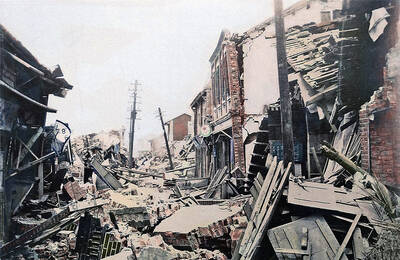
April 15 to April 21 Yang Kui (楊逵) was horrified as he drove past trucks, oxcarts and trolleys loaded with coffins on his way to Tuntzechiao (屯子腳), which he heard had been completely destroyed. The friend he came to check on was safe, but most residents were suffering in the town hit the hardest by the 7.1-magnitude Hsinchu-Taichung Earthquake on April 21, 1935. It remains the deadliest in Taiwan’s recorded history, claiming around 3,300 lives and injuring nearly 12,000. The disaster completely flattened roughly 18,000 houses and damaged countless more. The social activist and

Over the course of former President Ma Ying-jeou’s (馬英九) 11-day trip to China that included a meeting with Chinese Communist Party (CCP) leader Xi Jinping (習近平) a surprising number of people commented that the former president was now “irrelevant.” Upon reflection, it became apparent that these comments were coming from pro-Taiwan, pan-green supporters and they were expressing what they hoped was the case, rather than the reality. Ma’s ideology is so pro-China (read: deep blue) and controversial that many in his own Chinese Nationalist Party (KMT) hope he retires quickly, or at least refrains from speaking on some subjects. Regardless

Approaching her mid-30s, Xiong Yidan reckons that most of her friends are on to their second or even third babies. But Xiong has more than a dozen. There is Lucky, the street dog from Bangkok who jumped into a taxi with her and never left. There is Sophie and Ben, sibling geese, who honk from morning to night. Boop and Pan, both goats, are romantically involved. Dumpling the hedgehog enjoys a belly rub from time to time. The list goes on. Xiong nurtures her brood from her 8,000 square meter farm in Chiang Dao, a mountainous district in northern Thailand’s


 RSS
RSS