


To record his next hit, El Micha, one of Cuba’s rising stars of reggaeton music, which blends reggae, Latin and electronic rhythms, just has to knock on his neighbor’s door.
A microphone plugged into an old computer in an apartment in Havana’s working-class suburb of Reparto Electrico serves as the studio where some of Cuba’s most successful reggaeton songs are recorded.
“Reggaeton is unstoppable because it is recorded at home. It is totally independent,” says Michael “El Micha” Sierra, 27, a former basketball player whose bottom row of gold teeth flash when he gives one of his frequent broad smiles.
With little official support or air time on state-controlled radio, the songs Cuban reggaeton artists record in makeshift studios lined with egg cartons for sound insulation are mostly transmitted though homemade CDs and on computer flash memory sticks.
That is how the tropical fever of reggaeton is sweeping communist-ruled Cuba, captivating its youth and enraging a cultural establishment alarmed by the vulgarity of some of its lyrics, which include phrases like “Coge mi tubo” (“Grab my pipe”) and “Metela” (“Stick it in”).
“Cubans know about music and if they picked reggaeton they have to be respected. The people are the ones who decide,” said Sierra.
Reggaeton, a cocktail of reggae, Latin and electronic rhythms, first became popular in Puerto Rico in the mid-1990s and has spread rapidly through Latin America. In Cuba, it is played on crowded buses, shakes neighborhood windows with its throbbing bass and packs discos night after night.
Its vibrations even seem to be shaking Cuba’s cultural establishment, decades after the island shook the entertainment music world with its native-born mambo and cha cha cha.
Like hip-hop, its relative, reggaeton chronicles real life in the streets. But its popularity stems from a catchy, sensual rhythm that is perfectly suited for dance-crazy Cubans.
OFFICIAL ALARM OVER ‘NEOLIBERAL’ MUSIC
“Teachers and family cannot be naive regarding this matter,” warned state-controlled TV as it showed six-year-olds doing covers of Puerto Rican reggaeton megastar Daddy Yankee.
That was the latest sign of official alarm over what the authorities see as a vulgarization of Cuban culture.
The official daily Juventud Rebelde called reggaeton a reflection of “neoliberal thinking” and Culture Minister Abel Prieto said it should be “pushed away.”
“In the cultural world there is concern about the excessive popularity of reggaeton,” Julian Gonzalez, president of the National Council for Visual Arts, said.
But at a disco in Guanabo, a beach resort just east of Havana where El Micha played on a recent Sunday, 28-year-old kindergarten teacher Selene showed little sign of concern, however, shaking her hips frenetically to the music.
“It is true, reggaeton can sometimes have vulgar lyrics. But I like it and dance it,” she said. “Come on. Do they want young people to dance danzon?”
Some Cuban officials have suggested promoting more traditional Cuban dance rhythms like danzon, son and casino to counter the reggaeton offensive.
“Declaring war on reggaeton would be a mistake. These are not times for that kind of response,” said Gonzalez.
He may be right, says Puerto Rican researcher Raquel Z. Rivera, co-editor of Reggaeton, a book recently published by Duke University Press. An attempt to ban it in Puerto Rico only made it more popular.
“Cuban authorities are wary for the same reason as authorities in other countries — reggaeton tends to be hypersexual and to glorify consumerism and fashion,” she said.
PREJUDICES AND PIRACY
Cuban reggaeton musicians say prejudices keep them off the recording labels and radio airwaves. Their music cannot be found in stores. Fans simply burn their own CDs.
“In Cuba, reggaeton moves thanks to piracy,” said El Micha.
A beginner typically records at a makeshift studio for US$2 an hour, burns as many CDs as he can afford to and spreads them around. Some became famous giving free CDs to taxi drivers.
A few have achieved local success like Gente de Zona, Baby Lores or Kola Loka, and some even dream of breaking into the US market including Elvis Manuel, a 19-year-old reggaeton star who disappeared last year while trying to cross the Florida Straits to the US.
But most just fly under the radar only to emerge during weekends for concerts at state-owned discos.
“Reggaeton is treading a fine line between official and unofficial/independent worlds,” said Geoff Baker, a lecturer at the University of London’s Royal Holloway College who has researched the topic in Cuba.
Cuban reggaeton has a distinctive rhythm from its Puerto Rican roots, local musicians say. It is also less violent in its lyrics than the imported version.
“My lyrics talk about what young people live without getting into politics, because I don’t really care about that. Reggaeton is music for people’s pleasure,” said El Micha as he got ready to go on stage.

Last week Joseph Nye, the well-known China scholar, wrote on the Australian Strategic Policy Institute’s website about how war over Taiwan might be averted. He noted that years ago he was on a team that met with then-president Chen Shui-bian (陳水扁), “whose previous ‘unofficial’ visit to the US had caused a crisis in which China fired missiles into the sea and the US deployed carriers off the coast of Taiwan.” Yes, that’s right, mighty Chen caused that crisis all by himself. Neither the US nor the People’s Republic of China (PRC) exercised any agency. Nye then nostalgically invoked the comical specter

Relations between Taiwan and the Czech Republic have flourished in recent years. However, not everyone is pleased about the growing friendship between the two countries. Last month, an incident involving a Chinese diplomat tailing the car of vice president-elect Hsiao Bi-khim (蕭美琴) in Prague, drew public attention to the People’s Republic of China’s (PRC) operations to undermine Taiwan overseas. The trip was not Hsiao’s first visit to the Central European country. It was meant to be low-key, a chance to meet with local academics and politicians, until her police escort noticed a car was tailing her through the Czech capital. The
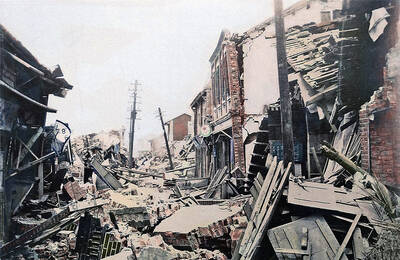
April 15 to April 21 Yang Kui (楊逵) was horrified as he drove past trucks, oxcarts and trolleys loaded with coffins on his way to Tuntzechiao (屯子腳), which he heard had been completely destroyed. The friend he came to check on was safe, but most residents were suffering in the town hit the hardest by the 7.1-magnitude Hsinchu-Taichung Earthquake on April 21, 1935. It remains the deadliest in Taiwan’s recorded history, claiming around 3,300 lives and injuring nearly 12,000. The disaster completely flattened roughly 18,000 houses and damaged countless more. The social activist and

Over the course of former President Ma Ying-jeou’s (馬英九) 11-day trip to China that included a meeting with Chinese Communist Party (CCP) leader Xi Jinping (習近平) a surprising number of people commented that the former president was now “irrelevant.” Upon reflection, it became apparent that these comments were coming from pro-Taiwan, pan-green supporters and they were expressing what they hoped was the case, rather than the reality. Ma’s ideology is so pro-China (read: deep blue) and controversial that many in his own Chinese Nationalist Party (KMT) hope he retires quickly, or at least refrains from speaking on some subjects. Regardless


 RSS
RSS