


You’ve heard of the National Palace Museum (國立故宮博物院), the Taipei Fine Arts Museum (臺北市立美術館), and probably even the Miniatures Museum of Taiwan (袖珍博物館), but chances are you’ve never heard of the Shung Ye Museum of Formosan Aborigines (順益台灣原住民博物館).
It’s not tucked away in some remote town or community. It’s in Shilin, diagonally across from the National Palace Museum. But on a recent Sunday, while the latter was teeming with hordes of visitors, hardly a soul strolled the display areas of the Shung Ye Museum.
Unfortunately, many tourists and even local residents neglect to take the time to learn about the history of Taiwan’s earliest inhabitants. Images of Aboriginal singers and dancers are widely used to promote tourism, and many tourists are taken by their tour guides to see Aboriginal performances, but few itineraries include a stop at a museum dedicated to the rich culture and fascinating lifestyle of the country’s Aboriginal tribes.
This is something the Shung Ye Museum’s operators and officials at the Executive Yuan’s Council of Indigenous Peoples (行政院原住民族委員會) hope to change, though they acknowledge they need to improve museums that showcase Aboriginal culture.
“In terms of professionalism, manpower and funding, museums focusing on indigenous people’s cultures are inadequate in all three areas,” said Chen Min-shong (簡明雄), chief of the culture section of the Council’s education and culture division.
“We’re hoping the museums can become more proactive, by reaching out to educational sectors and doing more self-promotion. Then people will come. We can’t simply wait for the tourists to show up,” Chen said.
Altogether, Taiwan has about 30 museums devoted to showcasing artifacts from Aboriginal cultures, not counting informal museums in community centers in areas where there are large Aboriginal populations. Many of the museums opened in the late 1990s, and all are non-profit.
Chen said that initially people in the communities where these institutions are located were slow to recognize the importance of their museum. But now the museums are slowly “becoming part of the community” and in recent years overall attendance has been increasing.
“Some museums now offer space for local artists to perform and local residents contribute items to the displays,” said Chen. “The residents also like to go there to see old photos.”
The Shung Ye Museum is the biggest museum of its kind in Taipei and the second-largest in the country. Other notable museums devoted to Aboriginal culture include the Wulai Atayal Museum (烏來泰雅民族博物館) in Taipei County, the Ketagalan Cultural Museum (凱達格蘭文化館) in Taipei’s Beitou District, and the Taiwan Indigenous Peoples Culture Park (台灣原住民族文化園區), which is operated by the Council of Indigenous Peoples Culture Park Area Management Bureau (文化園區管理局) in Pingtung and is the country’s largest.
The Shung Ye Museum is perhaps the most accessible and comprehensive of these and is at the forefront of efforts towards improving exhibits and attracting more visitors.
Lin Ching-fu (林清富), an ethnic Han Chinese businessman, opened the museum in 1994. At that time it was Taiwan’s first Aboriginal museum, said Lin Wei-chen (林威臣), the museum’s supervisor.
The initial collection of 800 to 900 items was donated by Lin Ching-fu, who had collected numerous Aboriginal artifacts over the years. The collection now comprises 2,000 items.
Each year, the large four-story structure attracts about 30,000 visitors. That is not considered a high number, given the museum’s size, convenient location and the fact that nearly three quarters of its visitors are students on field trips.
Lin Wei-chen said the museum is not well known among the general public. “People who know are those who really like Aboriginal culture or are students. Of course, we hope there could be more people who visit the museum. That’s the greatest hope of our founder,” he said.
Part of the reason for the low visitor numbers is that patrons might find the tickets too expensive compared to other museums, he said.
Ticket prices are already quite low, given the museum is entirely funded by Lin Ching-fu. This year, he contributed more than NT$40 billion, 90 percent of which came from his personal funds and 10 percent from his trading company, Shung Ye Co Ltd. None of that money is used for advertising, said Lin Wei-chen.
“We put all our budget into operating the museum,” he said, noting that the museum has only 10 employees, in addition to 50 volunteers.
To attract more visitors, the Shung Ye Museum has initiated a joint program with the National Palace Museum to offer cheaper admission if patrons buy tickets for both museums. Adults can visit both institutions for NT$250 and students for NT$130. (Admission to just the Shung Ye Museum costs NT$160 for adults and NT$150 for students.)
The museum has also steadily improved the quality of its displays. In the beginning, these consisted of items such as a model of a traditional house; later, people and animal figurines were added to enliven the displays, and a few years ago the museum commissioned videos to be filmed in Aboriginal villages to show museumgoers how people actually live in such houses. Additional videos show crafts such as cloth weaving, woodcarving and pottery making, as well as traditional dances.
There is little material concerning the problems Aborigines currently face, including encroachment on their land, high rates of unemployment and the danger of losing their languages and culture. But the museum does not shy away from referencing historical events, such as conflicts between Aborigines and Han Chinese settlers and the Wushe Incident (霧社事件) — the biggest and the last rebellion against Japanese colonial forces in Taiwan, which resulted in a massacre of hundreds of Seediq (賽德克) in 1930 by Japanese troops and rival Aboriginal warriors.
Lin Wei-chen said many Aborigines who visit are touched to find that man who founded and funds the museum is not an Aborigine, but he added that for some reason many do not spend much time gazing at the exhibits, perhaps because they believe they already know enough about their own history and culture.
Those who do stay end up learning things about their own tribe’s culture as well as that of other Aboriginal tribes, said Lin Wei-chen. “They might know their own tribe, but not other tribes.”
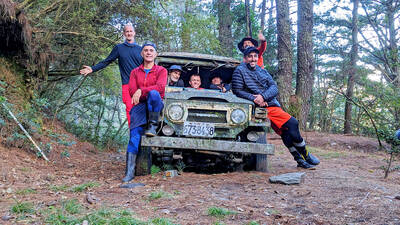
The year was 1991. A Toyota Land Cruiser set out on a 67km journey up the Junda Forest Road (郡大林道) toward an old loggers’ camp, at which point the hikers inside would get out and begin their ascent of Jade Mountain (玉山). Little did they know, they would be the last group of hikers to ever enjoy this shortcut into the mountains. An approaching typhoon soon wiped out the road behind them, trapping the vehicle on the mountain and forever changing the approach to Jade Mountain. THE CONTEMPORARY ROUTE Nowadays, the approach to Jade Mountain from the north side takes an

Last week Joseph Nye, the well-known China scholar, wrote on the Australian Strategic Policy Institute’s website about how war over Taiwan might be averted. He noted that years ago he was on a team that met with then-president Chen Shui-bian (陳水扁), “whose previous ‘unofficial’ visit to the US had caused a crisis in which China fired missiles into the sea and the US deployed carriers off the coast of Taiwan.” Yes, that’s right, mighty Chen caused that crisis all by himself. Neither the US nor the People’s Republic of China (PRC) exercised any agency. Nye then nostalgically invoked the comical specter

Relations between Taiwan and the Czech Republic have flourished in recent years. However, not everyone is pleased about the growing friendship between the two countries. Last month, an incident involving a Chinese diplomat tailing the car of vice president-elect Hsiao Bi-khim (蕭美琴) in Prague, drew public attention to the People’s Republic of China’s (PRC) operations to undermine Taiwan overseas. The trip was not Hsiao’s first visit to the Central European country. It was meant to be low-key, a chance to meet with local academics and politicians, until her police escort noticed a car was tailing her through the Czech capital. The
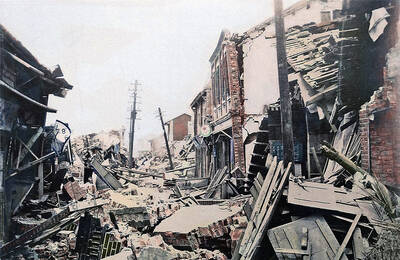
April 15 to April 21 Yang Kui (楊逵) was horrified as he drove past trucks, oxcarts and trolleys loaded with coffins on his way to Tuntzechiao (屯子腳), which he heard had been completely destroyed. The friend he came to check on was safe, but most residents were suffering in the town hit the hardest by the 7.1-magnitude Hsinchu-Taichung Earthquake on April 21, 1935. It remains the deadliest in Taiwan’s recorded history, claiming around 3,300 lives and injuring nearly 12,000. The disaster completely flattened roughly 18,000 houses and damaged countless more. The social activist and


 RSS
RSS