


Earlier this year, at the Berlin film festival, the starry directorial lineup included Theo Angelopoulos, Chen Kaige (陳凱歌), Lukas Moodysson, Costa-Gavras, Andrej Wajda and Peter Strickland. Peter Strickland? Who he? That is a question almost the entire film industry has been asking ever since.
Strickland’s meteoric rise to prominence is nothing short of astonishing, and should hearten anyone toiling in obscurity. The plain facts are these. Strickland is 35, with an English father and Greek mother (both teachers), and was raised and educated in the English provincial town of Reading, west of London. “Oscar Wilde was thrown in prison there. That’s all you need to know about Reading,” he says. But how did Strickland come to leave “dull and flat” Reading for “exciting and mountainous” Transylvania to shoot a feature film in Hungarian, a language he didn’t speak?
Katalin Varga, an eerily beautiful, rural revenge tragedy, is not the first film of Strickland’s to be presented in a film festival. In 1997, he got his 15-minute short Bubblegum into Berlin. In order to make it, Strickland took what little savings he had and went to New York to track down Nick Zedd, the underground filmmaker behind the Cinema of Transgression manifesto, and Holly Woodlawn, one of Andy Warhol’s drag queens, to play “a crypto-Elvisian rockabilly” and his ageing fan respectively. Five years later, after a series of soul-destroying jobs and trying to find a producer interested in his scripts, he decided to spend an inheritance from his uncle to escape from England and make a feature film.
“I was relatively wealthy for the first time in my life and realized that this might be my only chance to make a feature,” Strickland says, sitting in a modest apartment in Budapest where he now lives with his Hungarian girlfriend. “Almost everyone said I was insane, suicidal, deluded, etc, and that it’s impossible to make a film for less than US$330,000 even in Romania. I had barely a third of that. There were many times when I seriously doubted what I was doing. I often thought of just buying a flat, as almost everyone advised. But I asked myself, ‘Should I buy myself a one-bedroom flat in Bracknell (near Reading) or should I make a revenge film in Transylvania?’ I think the main thing that kept me going was knowing that if I bought a flat, I would always wonder, ‘What if?’ Even if I failed, I would know I tried my very best.”
Katalin Varga is set in the Hungarian-speaking part of Romania. Strickland only had a smattering of Hungarian, and directed the film in English. “Even though I got to know the Hungarian translation quite well, I felt very helpless if the actors wanted to improvise certain parts. For me, this film represents a movie Transylvania — but not in the Dracula sense. Everything is heightened — the goat bells, crickets, wind ... It’s a conglomeration of what I felt as an outsider. To help the certain intense atmosphere I wanted to capture, I listened to Pornography by The Cure and Suicide by Suicide on headphones endlessly during the writing process. I also watched Charles Laughton’s Night of the Hunter and Paradjanov’s Shadows of Our Forgotten Ancestors again and again.
All the ingredients for the film were in these and the Popol Vuh soundtrack to Herzog’s Nosferatu.
“The shoot was difficult, but not as bad as expected. We had a very short and intense period of many people living together in one house with no beds, only sleeping bags, and one bathroom in a small village in the Carpathian mountains. There was just one grocery store and a small bar.
“The period up until the end of shooting was very romantic and exhilarating for all of us. There was a strong feeling of ‘us against them’ because we were outside the film industry fighting to do something on our own terms. We really wanted to work within the industry, but we never got that chance. Now I’m glad it worked out that way. Whatever happens to me or the film, nobody can tarnish those memories. I just can’t imagine how the shoot would have been if we turned up in trucks and taxis with line producers from Soho bringing their supplies of sushi and pomegranate juice.” The film was made completely independently for around US$40,000 with a very small crew of 11 people including transport and catering. Strickland paid everyone on the shoot out of his own pocket, apart from the focus-puller, who agreed to work for free.
“That was the best time. But what is usually ignored by newspaper articles on the making of films is the paralyzing fear when you get home and wait and wait for something to happen. Filmmaking isn’t difficult: it’s the waiting and fear of failure that is.” It was during post-production that the rot set in. Strickland’s inheritance money was quickly drying up. He had to put the film on hold for eight months and go back to Reading to find a job. “If I’d known it would be only eight months, I would have coped, but I assumed it was the end. People ask me how I survived shooting in the Carpathian mountains. What they should really ask me is how I survived living in Reading afterwards. I was out of money and luck. I had made a feature film but couldn’t afford to edit it. It was a terrible period of depression and frustration.”
Strickland approached many production companies and the reaction was always negative. An obscure film by an unknown director, not made in English, seemed to put off UK investors. “With digital technology, everyone has a film in their pocket. How are you going to convince producers to spend an hour watching what you’ve shot when hundreds of others are doing the same? I’m not trying to put people off making films, but when you see how many hundreds of people are hustling at festivals and elsewhere just to have their work looked at, it’s quite daunting. I was very naive, thinking that if I sent a rough DVD copy to festivals, it would be accepted. My God, was I wrong!”
Strickland returned to Budapest and got a job teaching English, which he is still doing. “I’ve always had to balance projects with normal jobs to survive, but it’s very difficult to find the mental energy to write when you get home from work. During the darkest days of post-production, I craved a producer to take the weight off my shoulders.” In the meanwhile, he was approaching as many people as possible — until finally two Romanian producers, Oana and Tudor Giurgiu, paid attention. They saw the rough cut and came on board as
co-producers, providing the funds to make a proper sound mix and blow-up from the Super 16mm negatives. It was then snapped up by the Berlin film festival and a French distributor. The lesson is that without a producer, the film would never have been properly finished, nor exist in the public domain.
“The biggest irony about recent events is that I haven’t changed, but I’m viewed more sympathetically by certain people, whereas a year ago, I was essentially seen as a leech. ‘Oh God, it’s that kid from Reading always hassling me to see his film.’”
Katalin Varga goes on general release later this year.

Last week Joseph Nye, the well-known China scholar, wrote on the Australian Strategic Policy Institute’s website about how war over Taiwan might be averted. He noted that years ago he was on a team that met with then-president Chen Shui-bian (陳水扁), “whose previous ‘unofficial’ visit to the US had caused a crisis in which China fired missiles into the sea and the US deployed carriers off the coast of Taiwan.” Yes, that’s right, mighty Chen caused that crisis all by himself. Neither the US nor the People’s Republic of China (PRC) exercised any agency. Nye then nostalgically invoked the comical specter
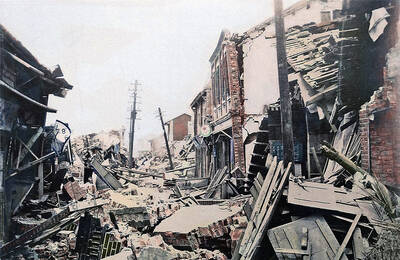
April 15 to April 21 Yang Kui (楊逵) was horrified as he drove past trucks, oxcarts and trolleys loaded with coffins on his way to Tuntzechiao (屯子腳), which he heard had been completely destroyed. The friend he came to check on was safe, but most residents were suffering in the town hit the hardest by the 7.1-magnitude Hsinchu-Taichung Earthquake on April 21, 1935. It remains the deadliest in Taiwan’s recorded history, claiming around 3,300 lives and injuring nearly 12,000. The disaster completely flattened roughly 18,000 houses and damaged countless more. The social activist and

Over the course of former President Ma Ying-jeou’s (馬英九) 11-day trip to China that included a meeting with Chinese Communist Party (CCP) leader Xi Jinping (習近平) a surprising number of people commented that the former president was now “irrelevant.” Upon reflection, it became apparent that these comments were coming from pro-Taiwan, pan-green supporters and they were expressing what they hoped was the case, rather than the reality. Ma’s ideology is so pro-China (read: deep blue) and controversial that many in his own Chinese Nationalist Party (KMT) hope he retires quickly, or at least refrains from speaking on some subjects. Regardless

Approaching her mid-30s, Xiong Yidan reckons that most of her friends are on to their second or even third babies. But Xiong has more than a dozen. There is Lucky, the street dog from Bangkok who jumped into a taxi with her and never left. There is Sophie and Ben, sibling geese, who honk from morning to night. Boop and Pan, both goats, are romantically involved. Dumpling the hedgehog enjoys a belly rub from time to time. The list goes on. Xiong nurtures her brood from her 8,000 square meter farm in Chiang Dao, a mountainous district in northern Thailand’s


 RSS
RSS