


On a hot night at the beginning of June, where does a computer geek go for a good party? That was the question on the minds of many visitors to Taipei’s annual Computex computer exhibition, the second-biggest in the world.
The first answer most people will give is Carnegie’s, otherwise known as Carnage to savvy local expats (for obvious reasons), especially on a Wednesday night — ladies night, when women get in for free and drink “champagne,” gratis.
I heard that hordes of people from the computer industry, be they designers, salespeople or marketing managers, would be there, so I went to check it out.
On arrival, I saw about 50 people outside, swilling champagne, beer from who knows where, whiskey from 7-Eleven, and vodka from duty free shops.
Most were Russian, which was obvious from the songs they were singing and the way they would stop cars in the street to say cheers with a bottle of vodka.
“It’s a Russian party. Almost 50 percent of the people here are Russian,” said Boris Chen, managing director of Gigabyte Russia, a man who would know the difference between a Russian and other foreigners because he speaks the language fluently.
A consultant from India who attended Computex said there was an increase this year in the number of buyers from Russia and Asian countries, including China and India, but a decrease in attendees from Europe. He seemed bemused by the party atmosphere and quickly exited, saying his hotel was nearby.
How did so many Russians find out about this one bar? “It’s a well-known place because it’s worldwide — there’s even a Carnegie’s in Moscow,” said Ivan Volin, testlab chief for Hardware Experts, a consultant for Rambler, a Web server in Russia. “My friends told me to come, so I came.” (Carnegie’s management says there is no franchise in Moscow.)
Inside, it wasn’t easy to move without stepping on a foot, bumping into sweaty, suited men, or spilling your drink down the backside of one of someone’s dress.
The Russians made their presence known on the bar, where a group of five danced, true to Carnegie’s form. But conspicuously absent were the bikini-clad women often seen atop the bar.
Carnegie’s wasn’t the experience Volin was expecting, because “it was too crowded inside, so I stay[ed] outside, where we can drink on the street.”
The bar was full, but despite the fact that Wednesday was ladies night, most patrons were male. If you were there to drink and hang out, it was a great place to be, but if you were a man and looking for romance, the odds were stacked against you.
“Everybody knows about Carnegie’s — a place where ladies dance on the bar — but seriously, there were too many blokes in there,” said Tony Ricardi, sales and marketing director for Mesh computers. “It’s a wiener fest.”
Which should not have come as a surprise: men far outnumber women at Computex. “Of course, it’s like that every year,” said Carnegie’s manager Jonathan Wy, who estimated there were 400 people inside the bar on Wednesday and another 150 to 250 outside. “If it were a fashion show, it would be a different story.”
Not everybody was willing to deal with the five-to-one ratio of guys to girls. One Computex trader from Mexico, who will be known simply as Tony (no relation to Ricardi), said in Spanish: “The girls are very beautiful in Taiwan. But there are too many hombres here. I need to find a woman. Can you tell me where the red light district is?”
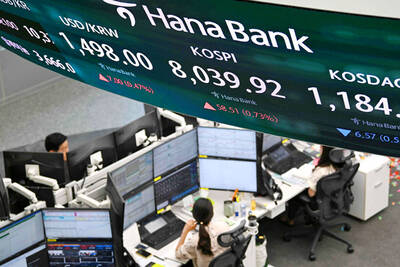
Taiwan’s overtaking of South Korea in GDP per capita is not a temporary anomaly, but the result of deeper structural problems in the South Korean economy says Chang Young-chul, the former CEO of Korea Asset Management Corp. Chang says that while it reflects Taiwan’s own gains, it also highlights weakening growth momentum in South Korea. As design and foundry capabilities become more important in the AI era, Seoul risks losing competitiveness if it relies too heavily on memory chips. IMF forecasts showing Taiwan widening its lead over South Korea have fueled debate in Seoul over memory chip dependence, industrial policy and
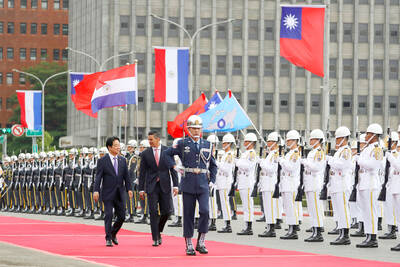
“China wants to unify with Taiwan at the lowest possible cost, and it currently believes that unification will become easier and less costly as time passes,” wrote Amanda Hsiao (蕭嫣然) and Bonnie Glaser in Foreign Affairs (“Why China Waits”) this month, describing how the People’s Republic of China (PRC) is playing the long game in its quest to seize Taiwan. This has been a favorite claim of many writers over the years, easy to argue because it is so trite. Very obviously, if the PRC isn’t attacking Taiwan, it is waiting. But for what? Hsiao and Glaser’s main point is trivial,

And so, in the wake of US President Donald Trump’s trip to the People’s Republic of China (PRC), all the experts on the Strait of Hormuz suddenly became experts on US-China-Taiwan relations. The Internet has certainly expanded human knowledge. Lots of these sudden experts made noise this week about Trump’s words after the meeting with PRC dictator Xi Jin-ping (習近平). Trump is going to sell out Taiwan! Longtime Taiwan commentator J. Michael Cole summed the situation up neatly in the Guardian: “We need to keep in mind that he has a tendency to say many things — sometimes contradicting himself within
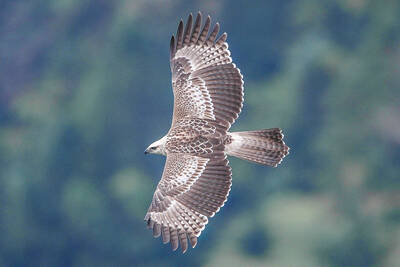
It took 12 years and months of standing in the same mountain location for director Liang Chieh-te (梁皆得) to capture a few seconds of footage: Taiwan’s largest resident raptor locking talons with its mate and spinning through the air in a courtship ritual. With only about 1,000 left in the wild and very short flight windows, the mountain hawk-eagle remains among Taiwan’s most elusive birds. The species generally produces only one offspring per year. Using forest cameras, the film crew and research teams document the arduous process the monogamous pairs go through for the chick to hatch and grow up, weathering


 RSS
RSS