


For the next three weeks, visitors to Fulong Beach can marvel at the artistic and technical wonders that can be molded from a heap of soggy sand. The 2009 Fulong Sand Sculpture Festival, which opened last Saturday and runs until June 28, is free with admission to the beach for NT$90 (NT$70 for students) and features 27 large sculptures that range from the cute to the haunting. A wide-eyed Hello Kitty and a smug-looking Teenage Mutant Ninja Turtle stand near a rendition of Matsu, the goddess of the sea, which seems to gaze serenely upon the beachgoers.
This year’s sculptures are grouped into three themes: The Three-Dimensional World, or cultural, religious and pop icons ranging from Buddha to baseball player Wang Chien-ming (王建民) rendered in sand form, The Fortuitous Meeting of Sea and Land, or creatures melded in unlikely surf-and-turf combinations like a sheep/lobster hybrid, and a series of sculptures based on “the peculiar scenery of the northeast coast” of Taiwan.
Attendees can work on their own masterpiece at a sand-sculpting area, where hoses are on hand to help dampen sand to maximum molding condition. People who don’t want to get their hands dirty can stroll through an easy-to-navigate maze, the walls of which are covered in sculpted sea creatures. Organizers hope the interactive nature of this year’s festival will boost attendance numbers past last year’s estimated 50,000 visitors.
Chi-chun Hsieh (謝啟駿) was on the beach during the festival’s Saturday afternoon opening, touching up the sculpture he made with fellow sculptor Yang Ming-dang (楊明堂). Hsieh, a Keelung-based graphic designer and art teacher who is participating in the festival for the second time this year, explained how a sand sculpture is made as he gently patted and smoothed the base of his creation in front of curious beachcombers.
First, a large wooden structure is hammered together that serves as the mold into which damp sand is shoveled and packed until hard. The casing is removed just one day before the festival opens, after which the sculptors add detail by hand and carefully sprinkle the top layer of sand with water before brushing on a white biodegradable liquid that resembles resin. The wet sand hardens into a shell that protects the sand underneath it from the elements. Each sculpture takes about three weeks to make and will last for two or three months before it erodes completely and fades back into the golden sands of Fulong Beach.
Hsieh says that sand sculpting is both a novel experience for him and something that, despite its ephemeral nature, he believes inspires appreciation for art among the public.
“Five years ago there weren’t sand sculpture festivals at the scale there are now. I’ve always been an artist, but this is something that is new to me and an art form that people really appreciate,” says Hsieh.

In late October of 1873 the government of Japan decided against sending a military expedition to Korea to force that nation to open trade relations. Across the government supporters of the expedition resigned immediately. The spectacle of revolt by disaffected samurai began to loom over Japanese politics. In January of 1874 disaffected samurai attacked a senior minister in Tokyo. A month later, a group of pro-Korea expedition and anti-foreign elements from Saga prefecture in Kyushu revolted, driven in part by high food prices stemming from poor harvests. Their leader, according to Edward Drea’s classic Japan’s Imperial Army, was a samurai

The following three paragraphs are just some of what the local Chinese-language press is reporting on breathlessly and following every twist and turn with the eagerness of a soap opera fan. For many English-language readers, it probably comes across as incomprehensibly opaque, so bear with me briefly dear reader: To the surprise of many, former pop singer and Democratic Progressive Party (DPP) ex-lawmaker Yu Tien (余天) of the Taiwan Normal Country Promotion Association (TNCPA) at the last minute dropped out of the running for committee chair of the DPP’s New Taipei City chapter, paving the way for DPP legislator Su

Located down a sideroad in old Wanhua District (萬華區), Waley Art (水谷藝術) has an established reputation for curating some of the more provocative indie art exhibitions in Taipei. And this month is no exception. Beyond the innocuous facade of a shophouse, the full three stories of the gallery space (including the basement) have been taken over by photographs, installation videos and abstract images courtesy of two creatives who hail from the opposite ends of the earth, Taiwan’s Hsu Yi-ting (許懿婷) and Germany’s Benjamin Janzen. “In 2019, I had an art residency in Europe,” Hsu says. “I met Benjamin in the lobby
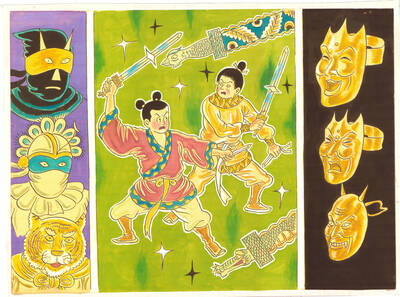
April 22 to April 28 The true identity of the mastermind behind the Demon Gang (魔鬼黨) was undoubtedly on the minds of countless schoolchildren in late 1958. In the days leading up to the big reveal, more than 10,000 guesses were sent to Ta Hwa Publishing Co (大華文化社) for a chance to win prizes. The smash success of the comic series Great Battle Against the Demon Gang (大戰魔鬼黨) came as a surprise to author Yeh Hung-chia (葉宏甲), who had long given up on his dream after being jailed for 10 months in 1947 over political cartoons. Protagonist


 RSS
RSS