


Sitting on a concrete wall I gaze out across the broad anchorage that lies on the tip of the Arabian peninsula. There’s a wrecked Indian ship, hull upturned, a couple of ocean-battered yachts and a few distant container ships. Further away are the hazy mountains of Yemen’s interior and behind me is Aden, a great purple crust of a volcanic island attached to the Yemeni mainland by a causeway. This, I remind myself, is the Arabia Felix of the Romans, a land of fabulous mountain scenery and stunning architecture, the original home of frankincense and coffee, a place that has inspired towering stacks of sumptuous photography books.
The rock of Aden itself is lifeless in the early morning heat, the streets that skirt the crag are empty. Everything here is either broken or dilapidated: the worn adverts from the 1960s, the faded hotels with their empty cocktail lounges, the grand entrance hall for boat arrivals with its archaic signs. This viewpoint, I reflect, tells the story of how a town can lose its place in the tourist world and go from riches to rags.
Yousif, an out-of-work Russian-trained engineer who drives a taxi, points out the significant landmarks. “Just behind us is the Gold Mohur Hotel — that was where Osama bin Laden exploded his first terrorist bomb in 1992. You know, we used to have tourists in the late 80s and early 90s.” His finger moves on ... “In front of us is where the USS Cole was blown up in 2000. The 1950s and early 1960s were good for visitors — lots of ships — but that stopped when communism came. And over here at the head of the causeway is the Movenpick Hotel, looted in the 1994 war when the communists were finally defeated.”
I nodded. A memory of The Movenpick night club back in 1993 crossed my mind: the image of a blonde Ukrainian belly dancer gyrating on the table, an 11-piece Egyptian orchestra building up a fever, and a mixed crowd of tourists and locals drinking beer and going wild. Aden did have visitors then. It had a brewery too — the only one in Arabia. That world is long gone.
Yousif sighs. “Now we have pirates instead of tourists.”
It’s a bad, bad world, and Yemen has long see-sawed between the delightful and dangerous for its visitors. Having lived in the place, and visited many times, I’d come back to meet a party of intrepid British tourists coming across to Aden from Djibouti by boat with the adventure travel company Wild Frontiers. I wanted to write about how one reaches those difficult decisions: whether to go, or not to go; whether to heed the warnings, or not. Where is that tricky line between courage and folly? I also wanted to see if this lost corner of Arabia, one of the Earth’s most stunning landscapes and cultures, is safe to visit.
HOSTAGE-TAKING AND HOSPITALITY
Yemen has long been one of those countries that visitors treat with extreme caution, and not without good reason. In 1612 the first British visitor, Sir Henry Middleton, a director of the British East India Company, came to buy sacks of an exciting new commodity called coffee, but instead was bundled into captivity, rolled around and spat out, ruffled but unharmed, some months later. Others, like the Italian Ludovico Varthema, here a century earlier, were also taken prisoner, but treated regally. The Italian’s picaresque account captures both sides: the mysterious romance of the country, and its xenophobic brutality. Yemen was a place where hostage-taking and hospitality could become blurred.
Since the late 1990s, however, it has been violent extremists who have grabbed the headlines with several deadly attacks on tourists. Just one day before I set out for Yemen, a terrorist attack on the US embassy led to the deaths of 18 local people. The downgrading of Yemen’s security risk by the UK government was looking like it might be rather short-lived.
Down on the sea wall at Steamer Point in Aden, a spot still presided over by a rather forlorn statue of Queen Victoria, a Frenchman appears, the skipper of a yacht. Isn’t it reckless to be sailing through pirate-infested waters to a bandit-infested country — just for the hell of it?
“Pah!” He waves his hands in the air. “You want everyone to stay at home and die of boredom?!”
The Wild Frontiers group, when they arrived, were not at all what I had expected: the majority were in late middle age and, from their sun hats to their sandals, unmistakably British. They were also possessed of remarkable insouciance when it came to adventurous travel. “I weigh up the risks,” said Richard, a retired insurance manager. “I look at the [UK government] guidelines. But you could be run over by a bus in London ...” He raises an eyebrow. “Or shot on a subway train.”
Like Richard and his wife Sally, many of the group had lived and worked abroad — a good way to build up some sangfroid. David and Claire from the south east of England, had been in Iran in the build up to the 1979 revolution. “Actually,” says David, a little misty-eyed, “The most memorable thing for me about those times was playing fly-half in the Iranian rugby team.”
After two nights in the city of Ta’izz, in the Yemeni highlands, we head down to Zabid, near the coast, a UNESCO world heritage site because of its stunningly beautiful stucco and mud architecture from the Ottoman period. The houses here are shady and cool, furnished with creaking rope beds, walls embellished with ornate arabesques. After lunch, we lounge on the beds under a thatched roof, perspiring and sipping cold drinks. The only danger appears to be heat exhaustion, but I ask Nabil, our driver, if he thinks Yemen is risky for outsiders.
He shakes his head. “It’s the best place in the world to live.”
“Most foreigners might find that hard to believe. Maybe if you visited England, you would change your mind.”
He grins. “But I did visit England! I went in the late 1980s and stayed for three months. I did like the countryside a lot, but ...” he shakes his head. “In the towns, with so much drinking of alcohol, I think it is very dangerous — fighting and everything.” Several of the group look like the thought of a cold beer might send them into a swoon at that point.
We re-embark and set out for the mountains, cutting through deep gorges where custard apple trees and bananas grow in profusion, then zigzagging up 2,400m of terraced hillsides, most of them covered in qat bushes. The mildly stimulating leaves of this plant provide Yemenis with a social drug that, as Nabil points out, never leads to fights.
This mountainous escarpment of Yemen is the secret of its fertility: hot air from the Red Sea is forced up, cooling rapidly and creating a mysterious world of villages glimpsed through mist. In the deep valleys you can find African birds like the paradise flycatcher flitting among stands of rustling bamboo. There are even a few leopards that live here, though they are hard-pressed by an expanding human population.
By late afternoon we are climbing into the clouds around the town of Manakha. The town is in the heart of Jabal Haraz region where, among the villages perched on improbable crags, many of the inhabitants are Ismaili Muslims, something that sets them apart from other Yemenis. I walk up to one of the settlements, enjoying the mountain trails that open up spectacular views. The village is a warren of narrow alleyways, often simply bare rock worn smooth by centuries of human feet and donkey hooves. The walls of the houses are white-washed with bright zigzag patterns. Children call from windows and run after me excitedly. A donkey clatters past, apparently en route for home.
In the market that evening I eat beans with rashush, a delicious stretchy flat bread sprinkled with nigella seeds. Yemen has some amazing food, most memorably, salta, a foaming green monster of a fenugreek dish eaten before qat sessions.
Strolling around the market there are the usual enquiries faced by any stranger, but no questions about religion, no attempts to convert me and, I notice, no big beards. Previous experience in Yemen tells me this is unusual. Next day in the villages along our route north, and then in the town of Mahwit, I notice the same. Has there been a sea-change I wonder — here in the heartland of the Islamic revival?
For our party, however, there are more immediate concerns. A phone call from Britain alerts the group leader to the change in [UK government] guidelines about visiting San’a: it is “essential business only” once again, possibly invalidating some travel insurance policies.
That evening there is some serious discussion about whether we should proceed to San’a. Perhaps it would be wise to linger here in the beautiful mountains, before slipping into the airport for the flight out? The group weighs up risks, consults guides and drivers, assimilates local information. But it is Gloria, a straight-talking and well-traveled prison officer, who tackles the issue with both precision and brevity. “Look at it this way,” she says. “I don’t give a flying fuck what the [UK] government says — I’m going to San’a.”
The discussion closes with a unanimous decision.
In the event San’a is as welcoming as anywhere in Yemen. This is the kind of city where someone might just come over and bellow in your face, “Welcome to Yemen!” Then invite you to drink tea, or for an afternoon qat session. My old friend Abdulwahab al Sairafi is pleased to hear of a British tour group. “I had to close my shop for lack of tourists,” he says. In previous generations Abdulwahab’s family fitted most of San’a with the distinctive amber-colored alabaster windows that make it such a delight to wander the old city at night. Now he makes table lamps and wall lights, but business is slow.
RISK ASSESSMENT
At Hammam al-Maidan, a 16th-century Ottoman steam bath house, I bump into an old friend, Mohammed, and ask about the decline of the Yemeni beard. Does it signify anything?
“The television pictures of suicide bombings in Iraq have had a big effect here,” he says. “People are no longer sympathetic to terrorism. A lot of beards have been cut.”
If ordinary Muslims in countries like Yemen have lost all sympathy with radicalism, then the high water mark of Islamic terrorism may have passed. I recall an incident a few days earlier in the town of Ta’izz. Wandering through the market at night, inspecting the stalls selling bandoliers and daggers, I notice that I am being followed. A smartly dressed young man 18m behind me who stops when I stop. Alarm bells ring. Finally I lose patience and turn on him.
“Are you following me?”
He smiles and nods. “I am police.”
“Is it dangerous here?”
He looks surprised. “No! I want to ask something.” Taking my arm, he steers me into a shop that sells traditional silver jewelry. This is a hustle, I think, but I’m wrong. The shopkeeper brings us tea. The policeman huddles closer and hands me his cellphone.
I read a text message in English. “Ramzi, I love you. Please come and live with me in Hounslow.”
He shows me other messages. “386 texts in two years!” His face shines with masculine pride. “We met here in this market when she came on holidays.” He taps my knee. “My friend. Should I go?”
I think for a moment.
“I know what you are thinking,” he says. “Too dangerous.”
“Dangerous?” That was not the first thought I had.
He frowns. “I heard on the BBC about the knife crime. Hounslow is part of London, isn’t it? And many young men are getting killed.”
In a country where men habitually carry traditional daggers, the BBC reports had been noted by many people; he wasn’t the first to mention the issue. I put his mind at rest and he relaxes, insisting that I read a selection of his messages. After another glass of tea we reach a unanimous decision. He will try life in Hounslow, and to hell with the danger.

Last week Joseph Nye, the well-known China scholar, wrote on the Australian Strategic Policy Institute’s website about how war over Taiwan might be averted. He noted that years ago he was on a team that met with then-president Chen Shui-bian (陳水扁), “whose previous ‘unofficial’ visit to the US had caused a crisis in which China fired missiles into the sea and the US deployed carriers off the coast of Taiwan.” Yes, that’s right, mighty Chen caused that crisis all by himself. Neither the US nor the People’s Republic of China (PRC) exercised any agency. Nye then nostalgically invoked the comical specter
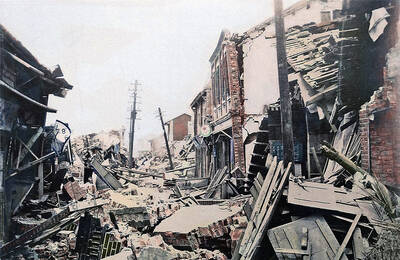
April 15 to April 21 Yang Kui (楊逵) was horrified as he drove past trucks, oxcarts and trolleys loaded with coffins on his way to Tuntzechiao (屯子腳), which he heard had been completely destroyed. The friend he came to check on was safe, but most residents were suffering in the town hit the hardest by the 7.1-magnitude Hsinchu-Taichung Earthquake on April 21, 1935. It remains the deadliest in Taiwan’s recorded history, claiming around 3,300 lives and injuring nearly 12,000. The disaster completely flattened roughly 18,000 houses and damaged countless more. The social activist and

Over the course of former President Ma Ying-jeou’s (馬英九) 11-day trip to China that included a meeting with Chinese Communist Party (CCP) leader Xi Jinping (習近平) a surprising number of people commented that the former president was now “irrelevant.” Upon reflection, it became apparent that these comments were coming from pro-Taiwan, pan-green supporters and they were expressing what they hoped was the case, rather than the reality. Ma’s ideology is so pro-China (read: deep blue) and controversial that many in his own Chinese Nationalist Party (KMT) hope he retires quickly, or at least refrains from speaking on some subjects. Regardless

Approaching her mid-30s, Xiong Yidan reckons that most of her friends are on to their second or even third babies. But Xiong has more than a dozen. There is Lucky, the street dog from Bangkok who jumped into a taxi with her and never left. There is Sophie and Ben, sibling geese, who honk from morning to night. Boop and Pan, both goats, are romantically involved. Dumpling the hedgehog enjoys a belly rub from time to time. The list goes on. Xiong nurtures her brood from her 8,000 square meter farm in Chiang Dao, a mountainous district in northern Thailand’s


 RSS
RSS