


The White Ribbon, a meticulous examination of patriarchal domination, won the Palme d’Or at the 62nd Cannes Film Festival on Sunday. Directed by the Austrian-born Michael Haneke and shot in black and white, the much-admired film — a foundation story about National Socialism set in a rural pre-World War I German community — turns on a series of violent events that appear to be the work of some children. In 2001, Haneke won the Grand Prix (effectively second place) for his harrowing drama The Piano Teacher, which starred Isabelle Huppert, president of this year’s competition jury.
The Grand Prix, also announced Sunday, went to A Prophet, a pitch-perfect film from the French director Jacques Audiard about a young inmate who becomes a master criminal during a prison stretch. The film was the critical favorite throughout the festival, and Audiard received a standing ovation from the audience when he mounted the stage. Far more surprising was the Jury Prize (third place), which was split between Fish Tank, a slice of Brit-grit realism from Andrea Arnold, and the neo-exploitation vampire flick Thirst, from the South Korean director Park Chan-wook. Both were booed by the press watching the show via live broadcast.
The director Terry Gilliam, here with the noncompetition film The Imaginarium of Doctor Parnassus, delivered some funny onstage shtick by pretending to accept the directing prize, which he was meant to bestow. (“Terry, you don’t receive, you give,” the host explained, promising that Gilliam could have something next year if he didn’t create a scandal.) The actual winner of the director award was Brillante Mendoza, from the Philippines, whose grisly, widely loathed shocker, Kinatay (Slaughter), hinges on a man who doesn’t prevent a murder. The screenwriting award went to Mei Feng (馮玫) for Spring Fever (春風沉醉的晚上), a rather baggy if underappreciated drama about young Chinese malaise.
Huppert handed the prize for best actress to Charlotte Gainsbourg, who delivers a wild, fearless performance as a grieving mother in Antichrist, an English-language film from the Danish director Lars von Trier. It’s easy to imagine that Huppert and her fellow juror, the actress Asia Argento, both ferocious screen performers, were impressed with the intensity of Gainsbourg’s performance, which involves a fair amount of nudity and some frantic (and graphic) backwoods masturbation.
The best-actor award for the Austrian Christoph Waltz, who plays a Nazi officer in Quentin Tarantino’s World War II movie, Inglourious Basterds, made everyone happy. Speaking in French, English and German, Waltz called the film an “unbelievable experience,” thanked his co-star Brad Pitt, along with the creator of Waltz’s “unique and inimitable” character, Colonel Landa. His voice colored with emotion, he addressed Tarantino directly: “You gave me my vocation back.”
Huppert presented the director Alain Resnais — who turns 87 next month — with a “lifetime achievement award for his work and his exceptional contribution to the history of cinema.”
He should have won something as well for his dazzling competition entry, Wild Grass. Wearing sunglasses (bright lights bother him), a dark suit, a red shirt and a magnificent swirl of white hair, Resnais took the stage and was greeted with a sustained standing ovation. He expressed his gratitude to the jury and the festival and asked his cast to stand and receive applause before he was cut short by the music.
The Camera d’Or for best first feature, awarded
by another jury, went to an Australian film by
Warwick Thornton that was largely below the critical radar, Samson and Delilah, a teenage love story set
in the Outback.
Despite the on-screen carnage that was amply rewarded by Huppert and her jury, the festival put on its usual glittering show that for 12 days made cinema seem as if it mattered to the world. News media attendance and spirits might have been down, but the sun came out, as did the jostling crowds, red-carpet stars and distributor wallets.
“This is the center of independent films from around the world,” Michael Barker, co-president of Sony Pictures Classics, said Saturday. Unlike many Americans, he stays until the end because one never knows what might turn up: Last year his company bought the Palme winner, The Class, which was screened on the last day. This year it bought The White Ribbon and A Prophet.
Although big Hollywood still turns up at Cannes (the Pixar movie Up opened the festival), the studios don’t show much work here unless Clint Eastwood has a new one. All too often quality is now the province of their specialty divisions, some of which were recently shut down. That makes older, established companies like Sony Classics and newcomers like Oscilloscope Laboratories even more important. IFC Films, for one, has made a nice habit of buying some of the best movies here, and this year grabbed Antichrist and Ken Loach’s Looking for Eric, a crowd-pleaser about a postman who, in the midst of a meltdown, conjures the philosophizing form of his favorite soccer star. It’s no wonder that IFC Entertainment’s president, Jonathan Sehring, characterized the festival as “very, very good.”
But while Hollywood movies are not much in abundance, the stars still come out, if somewhat fewer this year. Most of the American headliners (“Brad!” “Angelina!”) turned up at the premiere of Inglourious Basterds. They soon disappeared, but Tarantino was everywhere. He danced on the red carpet, chatted in English on French television and praised Mendoza’s Kinatay. Mendoza, a rising talent who was at Cannes last year with the rowdy Serbis, could use all the help he can get with this movie. A morality tale that he wields like a blunt instrument, Kinatay hinges on the inaction of a police-academy student while a prostitute is murdered and dismembered. The movie had its respectful fans, but many others fled the theater.
By closing night a lot was still in play, which may portend good news for American movie lovers. Oscilloscope, the company founded by the Beastie Boy Adam Yauch, bought Wendy and Lucy last year, and this year picked up another film, but has not announced its title. This was Yauch’s first time at Cannes.
“I was glad to see everyone in tuxes and ball gowns going up the red carpet,” he said in an e-mail message from New York on Sunday. “I was afraid that the photos I’ve seen of Grace Kelly and Cary Grant would have faded into history like everything else, and that people would be walking into premieres in shorts, T-shirts and Crocs. So I was impressed when I saw a man in a suit turned away because he was wearing sneakers. Perhaps Cannes is the last bastion of dignified decadence.”

In late October of 1873 the government of Japan decided against sending a military expedition to Korea to force that nation to open trade relations. Across the government supporters of the expedition resigned immediately. The spectacle of revolt by disaffected samurai began to loom over Japanese politics. In January of 1874 disaffected samurai attacked a senior minister in Tokyo. A month later, a group of pro-Korea expedition and anti-foreign elements from Saga prefecture in Kyushu revolted, driven in part by high food prices stemming from poor harvests. Their leader, according to Edward Drea’s classic Japan’s Imperial Army, was a samurai

Located down a sideroad in old Wanhua District (萬華區), Waley Art (水谷藝術) has an established reputation for curating some of the more provocative indie art exhibitions in Taipei. And this month is no exception. Beyond the innocuous facade of a shophouse, the full three stories of the gallery space (including the basement) have been taken over by photographs, installation videos and abstract images courtesy of two creatives who hail from the opposite ends of the earth, Taiwan’s Hsu Yi-ting (許懿婷) and Germany’s Benjamin Janzen. “In 2019, I had an art residency in Europe,” Hsu says. “I met Benjamin in the lobby
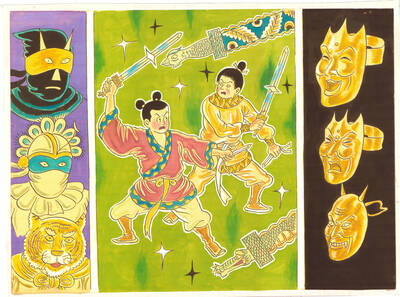
April 22 to April 28 The true identity of the mastermind behind the Demon Gang (魔鬼黨) was undoubtedly on the minds of countless schoolchildren in late 1958. In the days leading up to the big reveal, more than 10,000 guesses were sent to Ta Hwa Publishing Co (大華文化社) for a chance to win prizes. The smash success of the comic series Great Battle Against the Demon Gang (大戰魔鬼黨) came as a surprise to author Yeh Hung-chia (葉宏甲), who had long given up on his dream after being jailed for 10 months in 1947 over political cartoons. Protagonist

A fossil jawbone found by a British girl and her father on a beach in Somerset, England belongs to a gigantic marine reptile dating to 202 million years ago that appears to have been among the largest animals ever on Earth. Researchers said on Wednesday the bone, called a surangular, was from a type of ocean-going reptile called an ichthyosaur. Based on its dimensions compared to the same bone in closely related ichthyosaurs, the researchers estimated that the Triassic Period creature, which they named Ichthyotitan severnensis, was between 22-26 meters long. That would make it perhaps the largest-known marine reptile and would


 RSS
RSS