


Recorded 20 years ago, Steven Patrick Morrissey’s throwaway B-side Get Off the Stage was a funny, biting attack on the dinosaur rock stars of the early 1990s. “It’s really about the Rolling Stones,” he told me at the time, “people of that ilk who just refuse to die in the physical sense; all these boring old faces … I don’t understand why they’re still omnipresent, why they have this ubiquitousness.”
Yet on Friday this poet, former Smith and ever-controversial solo artist turned 50 himself, joining, against all grave expectations and protestations, the ever-burgeoning ranks of rock ’n’ roll’s seniors’ tour.
Feted by artists as diverse as Bono, JK Rowling, Michael Stipe, David Walliams, Noel Gallagher and Rufus Wainwright, the impact of Morrissey’s lyrics on wider popular culture is greater than ever. Following Douglas Coupland’s novel Girlfriend in a Coma, Jo Brand’s latest book is titled The More You Ignore Me the Closer I Get. Then there’s the recent, celebrated Swedish vampire movie Let the Right One In, not forgetting Keri Koch’s new feature about Morrissey’s extraordinary Latino fan base, Passions Just Like Mine.
All are titles stolen from the big-mouthed bard’s own songs; fitting tributes to a man who has spent the last three decades plagiarizing ideas from Warhol and Virginia Woolf, from Patti Smith and Sandie Shaw, from Alan Bennett and George Eliot, from the New York Dolls and Anthony Newley, from the TV soap Coronation Street and the Carry On films. As a recent two-day Irish symposium on his lyricism showed, international academics now queue up alongside the passionate fans to celebrate Morrissey as a living work of art.
He has, without doubt, extended the subject matter of popular songs more than any artist of the late 20th and early 21st centuries. Child murder, working-class poverty, suicide, soccer hooliganism, mental illness, police corruption, disability, animal cruelty, violence, pedophilia, racism, death, the loss of faith — all have been addressed. Typically and topically, the recent track Children In Pieces deals with the abuse of children in schools run by the Roman Catholic church.
I first encountered Morrissey at London’s Venue back in September 1983. Against the post-Falklands backdrop of New Romanticism, unemployment and rampant Thatcherism, Morrissey’s disillusioned but desperately funny lyrics struck a chord. In the summer of 1984, when I was living with my parents in Newcastle upon Tyne, England, following my younger brother’s suicide, the Smiths’ Heaven Knows I’m Miserable Now seemed to capture the battered spirit of Northern England during the miners’ strike.
On joining the NME music paper as a youthful reporter, I followed the Smiths passionately, reporting on their brief involvement with Red Wedge, struggling to capture in words the power and chaos of their 1986 Queen Is Dead tour, gradually becoming aware of the internal frictions that would soon destroy this extraordinary band. I was shattered when they split and, given that Morrissey had declared “the Smiths were like a life-support machine to me,” I was also concerned about his future. Like all who had studied his lyrics about mortality and suicide (Shakespeare’s Sister, Stretch Out and Wait, Asleep, Cemetry Gates, Death at One’s Elbow), I feared the collapse of the Smiths might push him over the edge.
Morrissey had talked to me of his fascination with artists who lived fast and died young, notably James Dean and Marilyn Monroe. Many times he reflected on death and even suicide.
“I’m nearly 29,” Morrissey said when his first solo album, Viva Hate, came out in 1988. “I’ll be dead in a couple of years ... I have a dramatic, unswayable, unavoidable obsession with death. I can remember being obsessed with it from the age of eight or nine. I often wondered if it was quite a natural inbuilt emotion for people who are destined to ... take their own lives. I think if there was a magical, beautiful pill that one could take that would retire you from the world … I would take it.”
And yet he’s still here — and, having never been one for the sex and drugs of rock ’n’ roll, he looks rather fitter than most of his fellow fifty-something stars.
What’s more, unlike most of his 1980s contemporaries, Morrissey has retained his provocative, spiky quality. Although 90 percent of his worldview can loosely be categorized as radical and of the left — the vegetarianism and animal rights, the celebration of gay and lesbian artists, the hostility to everyone from Thatcher to Bush — his strong views on immigration and the protection of British culture from outside influences continue to cause controversy. And he genuinely seems to thrive on the hostility.
“People find me enormously irritating,” he has told me. “If you don’t have 100 percent passion for every move I make, then I’m the most irritating person you could hope to hear. I know this because people write and tell me ... it’s a tremendous accolade.”
In our numerous encounters over the years, however, he has always been warm and funny — sometimes quiet and shy, but with outbursts of desperate laughter and memorable moments of Carry On comic timing. When I once asked Morrissey about his famously solitary celibate existence, he responded, “In order to concentrate absolutely and perfectly on everything I had to … give up sausages.” Physically he has changed; there is no Dorian Gray-style picture in Morrissey’s attic. The working-class face is fuller and more Irish looking, and instead of the pipe-cleaner thin physique he used to display beneath those big girls’ blouses, he now struts the stage like Elvis in Vegas. And having once described his genitals as a “cruel practical joke,” he was willing to parade naked (with his bandmates) on the sleeve of his latest album, Years of Refusal, with only a seven-inch single cloaking his manhood.
Morrissey’s detractors would argue that his worldview hasn’t changed much over the last 30 years. They can, with some justification, complain that his lyrics bang on about the same old personal problems.
But if there remains in him an inability to accentuate the positive and eliminate the negative, Morrissey has always said he’s just being honest and realistic. “I don’t want to break into a Ralph McTell song; I do feel the light has gone out and that things just get progressively worse in every way ... But it isn’t pessimism at all. If I was a pessimist I wouldn’t get up, I wouldn’t shave, I wouldn’t watch Batman at 7.30am. Pessimists don’t do that sort of thing.”
Certainly, no one can accuse him of mellowing. Joe Orton, another of Morrissey’s icons, once declared in What the Butler Saw that, “providing one spends the time drugged or drunk, the world is a fine place.”
But if you choose to abstain, like Morrissey, then the path through life isn’t quite so smooth, particularly within the music industry.
“I’ve gone through managers like people go through Shredded Wheat,” he told the novelist Michael Bracewell in 1995. “Nobody looks after you, which is why most groups end up disbanding and most artists end up dead, or on heroin.”
Len Brown’s biography, ‘Meetings With Morrissey,’ is published by Omnibus.

Last week Joseph Nye, the well-known China scholar, wrote on the Australian Strategic Policy Institute’s website about how war over Taiwan might be averted. He noted that years ago he was on a team that met with then-president Chen Shui-bian (陳水扁), “whose previous ‘unofficial’ visit to the US had caused a crisis in which China fired missiles into the sea and the US deployed carriers off the coast of Taiwan.” Yes, that’s right, mighty Chen caused that crisis all by himself. Neither the US nor the People’s Republic of China (PRC) exercised any agency. Nye then nostalgically invoked the comical specter
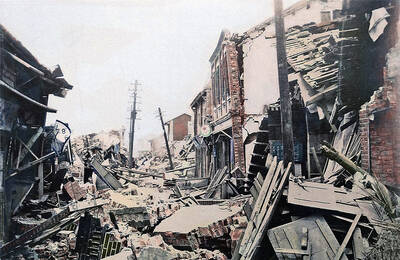
April 15 to April 21 Yang Kui (楊逵) was horrified as he drove past trucks, oxcarts and trolleys loaded with coffins on his way to Tuntzechiao (屯子腳), which he heard had been completely destroyed. The friend he came to check on was safe, but most residents were suffering in the town hit the hardest by the 7.1-magnitude Hsinchu-Taichung Earthquake on April 21, 1935. It remains the deadliest in Taiwan’s recorded history, claiming around 3,300 lives and injuring nearly 12,000. The disaster completely flattened roughly 18,000 houses and damaged countless more. The social activist and

Over the course of former President Ma Ying-jeou’s (馬英九) 11-day trip to China that included a meeting with Chinese Communist Party (CCP) leader Xi Jinping (習近平) a surprising number of people commented that the former president was now “irrelevant.” Upon reflection, it became apparent that these comments were coming from pro-Taiwan, pan-green supporters and they were expressing what they hoped was the case, rather than the reality. Ma’s ideology is so pro-China (read: deep blue) and controversial that many in his own Chinese Nationalist Party (KMT) hope he retires quickly, or at least refrains from speaking on some subjects. Regardless

Approaching her mid-30s, Xiong Yidan reckons that most of her friends are on to their second or even third babies. But Xiong has more than a dozen. There is Lucky, the street dog from Bangkok who jumped into a taxi with her and never left. There is Sophie and Ben, sibling geese, who honk from morning to night. Boop and Pan, both goats, are romantically involved. Dumpling the hedgehog enjoys a belly rub from time to time. The list goes on. Xiong nurtures her brood from her 8,000 square meter farm in Chiang Dao, a mountainous district in northern Thailand’s


 RSS
RSS