


“Movie directors are desperate people. You’re totally desperate every second of the day when you’re involved in a film, through
pre-production, production, post-production, and certainly when you’re dealing with the press.” Martin Scorsese isn’t talking about his own career, but that of one of his heroes, the British director Michael Powell. And in particular, Scorsese is referring to the all-consuming creative passion Powell and Emeric Pressburger captured in their 1948 classic The Red Shoes. That swooning Technicolor tragedy was ostensibly set in the world of ballet, with Moira Shearer fatally torn between her personal and professional loyalties; equally, it is a portrait of artistic sacrifice and compromise in the film-makers’ own industry. “Over the years, what’s really stayed in my mind and my heart is the dedication those characters had, the nature of that power and the obsession to create,” Scorsese says, before finding the right analogy in another Powell and Pressburger title: “It made it a matter of life and death, really.”
Had he not been so entranced by The Red Shoes as a boy, Scorsese might never have become a movie director. Watching the film for the first time — aged nine, at the cinema with his father — was the start of a lifelong relationship with Powell’s movies, one that ultimately led to a friendship with the man himself; now, nearly 20 years after Powell’s death, it extends to a stewardship of his legacy. Scorsese took the stage on Friday at Cannes to introduce a new restored print of The Red Shoes — a culmination, of sorts, to Scorsese’s ongoing mission to rehabilitate his hero. Scorsese was instrumental not just in initiating the physical restoration of Powell and Pressburger’s deteriorating back catalogue, but in restoring Powell’s career and reputation when they were at their lowest ebb. He even, inadvertently, found him a wife.
Scorsese considers Powell and Pressburger’s run of films through the 1930s and 1940s to be “the longest period of subversive film-making in a major studio, ever”. But when Scorsese first met Powell, in 1975, that run had come to an abrupt halt. Peeping Tom, Powell’s first effort as a solo director, had been released in 1960, and its combination of violence, voyeurism, nudity and general implication of the audience (not to mention the film industry, again) was too strong for the British censors and critics. He hadn’t worked since. So he must have been somewhat taken aback to discover that an eager young American director was trying to track him down, and that other young American film-makers were going back to his work.
“We’d been asking for years about Powell and Pressburger,” says Scorsese. “There was hardly anything written about their films at that time. We wondered how the same man who made A Matter of Life and Death, The Red Shoes, Black Narcissus, and The Life and Death of Colonel Blimp could also have made Peeping Tom. We actually thought for a while Michael Powell was a pseudonym being used by other filmmakers.”
Scorsese came to Britain for the Edinburgh film festival with Taxi Driver, and a mutual contact arranged a meeting at a London restaurant. “He was very quiet and didn’t quite know what to make of me,” Scorsese recalls. “I had to explain to him that his work was a great source of inspiration for a whole new generation of filmmakers — myself, Spielberg, Paul Schrader, Coppola, De Palma. We would talk about his films in Los Angeles often. They were a lifeblood to us, at a time when the films were not necessarily immediately available. He had no idea this was all happening.”
It’s easy to forget how obscure most movies were in the days before DVD, video on demand, or even VHS. Studio boss J Arthur Rank lost faith in the commercial potential of The Red Shoes on first seeing it, and sent only a single print to the US. So for two years it played continuously at a single movie theatre in New York, before eventually breaking out to become a huge success, picking up Oscars in 1949 for best art direction and music. Scorsese saw it that first time in color; after that, the only way to see such movies was on television. “Even with commercial breaks, in black and white, and cut to about an hour and a half, it still had a powerful magic,” he says. “The vibrancy of the movie and the sense of color in the storytelling actually came through. Then, eventually, the prize was to track down a 16mm Technicolor print. I was able to do that a few times.” The rest of the Powell/Pressburger back catalogue Scorsese would track down one film at a time. “We were in a process of discovery.”
After Scorsese found him, Powell was taken to the US by Francis Ford Coppola and feted by his new Hollywood fans. They saw him as a kindred spirit: a fiercely independent filmmaker who had fought for, and justified, the need for complete creative freedom. Coppola installed him as senior director-in-residence at his Zoetrope studios; he took teaching posts; retrospectives were held of his work; and the great and good of Hollywood queued up to meet him. Scorsese even had a cossack shirt made in the same style as that of Anton Walbrook’s character in The Red Shoes, which he wore to the opening of Powell and Pressburger’s 1980 retrospective at the Museum of Modern Art in New York. To that event, Scorsese brought along his editor on Raging Bull, Thelma Schoonmaker. “Marty told me I had to go and see Colonel Blimp on the big screen,” Schoonmaker later tells me. She introduced herself to Powell, they hit it off, and four years later they married.
Schoonmaker, who still edits all Scorsese’s films, experienced first-hand both Scorsese’s worship of Powell and his subsequent friendship with him. “One of the first things Marty said to me was, ‘I’ve just discovered a new Powell and Pressburger masterpiece!’ We were working at night on Raging Bull and he said, ‘You have to come into the living room and look at this right now.’ He had a videocassette of I Know Where I’m Going. For him to have taken an hour and a half out of our editing time is typical of the way he proselytizes. Anyone he meets, or the actors he works with, he immediately starts bombarding with Powell and Pressburger movies.”
Powell’s influence is all over Scorsese’s work. His trademark use of the color red is a direct homage to Powell, for example — though Powell told him he overused the color in Mean Streets. And Powell was practically a consultant on Raging Bull, giving Scorsese script advice and even guiding him towards releasing the film in black and white. (Again, Powell observed that Robert de Niro’s boxing gloves were too red.) Meanwhile, Powell’s Tales of Hoffman informed the movements of Raging Bull’s fight scenes. “Marty was always asking Michael, ‘How did you do that shot?’ or ‘Where did you get that idea?’” Schoonmaker says. “They shared a tremendous passion for the history of film — but he didn’t always go along with Marty’s taste in modern filmmakers. For example, Michael didn’t quite get Sam Fuller. Marty showed him Forty Guns, or started to show it to him, and Michael walked out halfway through. Marty was heartbroken.”
The restoration of The Red Shoes came about when Schoonmaker tried to buy Scorsese a print of The Life and Death of Colonel Blimp for his 60th birthday. She was alarmed to discover the printing negative was worn out, and that there wasn’t enough money to restore it. Much of the Powell and Pressburger legacy was, and still is, in a similar condition. So she and Scorsese set about raising the cash to fund the restoration. “It’s been over two years now of checking test prints and determining how the picture should be restored,” says Scorsese. “In restoration circles, very often three-strip Technicolor film can only reach a certain technical level. The colors start to become yellow and you get fringing — where the strips don’t quite line up. But the techniques we used here are top of the line. So it looks better than new. It’s exactly like what the filmmakers wanted at the time, but they couldn’t achieve it back then.”
Other Powell/Pressburger movies are now in line for restoration, but Scorsese and Schoonmaker’s rehabilitation mission does not stop there. For some years, between movie projects (they are currently completing Scorsese’s latest, Shutter Island, with Leonardo DiCaprio), they have been working on a documentary about British cinema, in the vein of Scorsese’s 1999 personal appreciation of Italian cinema, My Voyage in Italy. Powell and Pressburger will be in there of course; but also Hitchcock, Korda, Anthony Asquith and possibly others we’ve forgotten about ourselves. British cinema is sorely misunderstood, Scorsese feels, and it needs this documentary even more than Italian cinema did.
Perhaps that’s something for next year’s Cannes? “Well, I’m still working on my speech,” says Scorsese. “I never know what to say. I’m trying to hone it down to my key emotional connection to the film. My favorite scene is the one near the beginning at the cocktail party. Where Lermontov [Anton Walbrook] asks Vicky [Moira Shearer], ‘Why do you want to dance?’ and she replies, ‘Why do you want to live?’ Despite all the other beautiful sequences in the film, that’s the one that stays in my mind.”

In late October of 1873 the government of Japan decided against sending a military expedition to Korea to force that nation to open trade relations. Across the government supporters of the expedition resigned immediately. The spectacle of revolt by disaffected samurai began to loom over Japanese politics. In January of 1874 disaffected samurai attacked a senior minister in Tokyo. A month later, a group of pro-Korea expedition and anti-foreign elements from Saga prefecture in Kyushu revolted, driven in part by high food prices stemming from poor harvests. Their leader, according to Edward Drea’s classic Japan’s Imperial Army, was a samurai

The following three paragraphs are just some of what the local Chinese-language press is reporting on breathlessly and following every twist and turn with the eagerness of a soap opera fan. For many English-language readers, it probably comes across as incomprehensibly opaque, so bear with me briefly dear reader: To the surprise of many, former pop singer and Democratic Progressive Party (DPP) ex-lawmaker Yu Tien (余天) of the Taiwan Normal Country Promotion Association (TNCPA) at the last minute dropped out of the running for committee chair of the DPP’s New Taipei City chapter, paving the way for DPP legislator Su
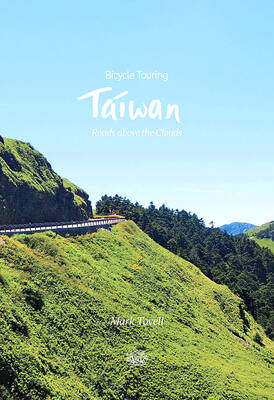
It’s hard to know where to begin with Mark Tovell’s Taiwan: Roads Above the Clouds. Having published a travelogue myself, as well as having contributed to several guidebooks, at first glance Tovell’s book appears to inhabit a middle ground — the kind of hard-to-sell nowheresville publishers detest. Leaf through the pages and you’ll find them suffuse with the purple prose best associated with travel literature: “When the sun is low on a warm, clear morning, and with the heat already rising, we stand at the riverside bike path leading south from Sanxia’s old cobble streets.” Hardly the stuff of your
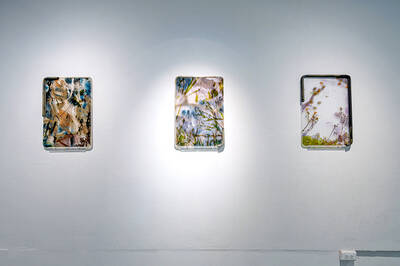
Located down a sideroad in old Wanhua District (萬華區), Waley Art (水谷藝術) has an established reputation for curating some of the more provocative indie art exhibitions in Taipei. And this month is no exception. Beyond the innocuous facade of a shophouse, the full three stories of the gallery space (including the basement) have been taken over by photographs, installation videos and abstract images courtesy of two creatives who hail from the opposite ends of the earth, Taiwan’s Hsu Yi-ting (許懿婷) and Germany’s Benjamin Janzen. “In 2019, I had an art residency in Europe,” Hsu says. “I met Benjamin in the lobby


 RSS
RSS