


Shih Shu-ching (施叔青), one of Taiwan’s most celebrated authors, lived in Hong Kong for 15 years, spending eight of them researching and writing City of the Queen, her trilogy about the former British colony. It was published in Chinese in 1993, 1995 and 1997. This English rendition, by the celebrated husband-and-wife translating team Howard Goldblatt and Sylvia Li-chun Lin, is an abbreviated version, reducing the original to one volume.
The novel tells the story of a 13-year-old girl from China, Huang Deyun (黃得云), who in 1892 is kidnapped and taken to Hong Kong to work as a prostitute. She quickly moves on, however, and ends up as a rich landowner. Fifty years of Hong Kong’s history are surveyed in the process, plus another fifty, via what in this version are rather brief tales of Huang’s descendants, to the territory’s handover to Beijing in 1997.
The first thing to be said about this translation is that the historical detail is a lot more interesting than the story itself. Not only is the varied cavalcade presented with great vividness, but in addition the reader learns a lot about Hong Kong’s social history. Opium, gold and plague all feature prominently in the early chapters and, as if that wasn’t enough, you also learn a lot about the kind of brothels that existed and how they were furnished.
This book, then, is both popular in tone and well-informed. But there are some apparent errors. That snow covers Hong Kong’s Mount Taiping (Victoria Peak) “every winter” is certainly not the case. The British would have played snooker, not “pool,” and the Anglican cathedral of St John’s wouldn’t say “mass.” “Mid-Levels,” describing the residential area half-way up Hong Kong Island, is always used in the plural, not in the singular as here. And it’s untrue that HSBC (“Wayfoong Bank,” 匯豐銀行) had the exclusive right to issue Hong Kong’s banknotes — they were also issued by the Standard Chartered Bank.
Shih is subtle in her analysis of relations between the Chinese and the British. Each group took for granted the worst alleged attributes of the other. The richest and the poorest members of the population were Chinese, but the British kept a tight hold on power until comparatively late in their administration, and for this and other reasons (notably inequality of pay for the same or similar work) they held on to their dominant social position.
There’s an enormous amount of period detail. You learn that the Chinese rang bells to scare away demons in times of plague, that there was a 10pm curfew at a certain period, that Sikhs were regularly used as security guards, that prisoners were beaten in Victoria Prison in Central, and that termites were a routine problem, as were water shortages.
You’re treated to depictions of Queen Victoria’s Diamond Jubilee in 1897 and the acquisition of the New Territories in 1898, when the British used armed force to disperse protesting villagers. There are descriptions of the widespread disbelief that followed Darwin’s theory of evolution, of the strikes of 1922, and of the Japanese occupation during World War II. It’s also asserted that during Hong Kong’s early days the most powerful voice in the colony was that of “the opium-dealer Jardine,” followed by the Jockey Club, and only then by the governor.
There’s a fascinating paragraph on ice — cut in blocks from North American rivers and lakes, then covered in sawdust and chaff to prevent it from melting, and transported to Asia in sailing ships. You also read about the firm Dent and Co, one of whose operations was transporting impoverished Chinese to be sold as laborers in South America, with sometimes as many deaths during the passage as in the better-known slave trade.
One of the reasons it’s such a pity that we only have this abbreviated translation of City of the Queen is that the novel inevitably invites comparison with The Song of Everlasting Sorrow (長恨歌) by Wang Anyi (王安憶) [reviewed in Taipei Times on Aug. 31, 2008]. That book also looked at the history of one modern Chinese city, Shanghai, via the life of one of its female inhabitants and her lovers. I’ve only read this shortened version of City of the Queen, but I have to say that The Song of Everlasting Sorrow appears to
be undoubtedly the finer book. But then its aims, though superficially similar, are actually different. Wang’s novel is like Proust — atmospheric, sophisticated, implicitly claiming the status of literature. Shih’s, by contrast, is like Zola — realistic, shocking, well-researched and aspiring to a kind of higher journalism. There’s no question of influence in either direction as Wang’s book was published in Chinese in 1995, at roughly the same time as Shih’s trilogy.
The problem with this shortened English edition is that the narrative falls off badly towards the end, becoming a series of largely inconsequential moments. Goldblatt and Lin note that originally Shih’s third volume was narrated in the first person, but that this was changed, presumably to give the one-volume reduction a degree of uniformity. But was this really necessary?
The translators, possibly aware that they may be open to criticism, also pointedly state that Shih approved “both the editing and the translation.” Even so, doubts remain. Was the balance between historical detail and fictional narrative the same, for instance, in the three-volume original as it is here, where history appears to overweigh the story line at several points?
City of the Queen now deserves a full-length translation, especially in the light of the translators’ assertion that to their knowledge this novel is the only one in existence that surveys the last 100 years of Hong Kong’s history from a Hong Kong resident’s perspective.

In late October of 1873 the government of Japan decided against sending a military expedition to Korea to force that nation to open trade relations. Across the government supporters of the expedition resigned immediately. The spectacle of revolt by disaffected samurai began to loom over Japanese politics. In January of 1874 disaffected samurai attacked a senior minister in Tokyo. A month later, a group of pro-Korea expedition and anti-foreign elements from Saga prefecture in Kyushu revolted, driven in part by high food prices stemming from poor harvests. Their leader, according to Edward Drea’s classic Japan’s Imperial Army, was a samurai

Located down a sideroad in old Wanhua District (萬華區), Waley Art (水谷藝術) has an established reputation for curating some of the more provocative indie art exhibitions in Taipei. And this month is no exception. Beyond the innocuous facade of a shophouse, the full three stories of the gallery space (including the basement) have been taken over by photographs, installation videos and abstract images courtesy of two creatives who hail from the opposite ends of the earth, Taiwan’s Hsu Yi-ting (許懿婷) and Germany’s Benjamin Janzen. “In 2019, I had an art residency in Europe,” Hsu says. “I met Benjamin in the lobby
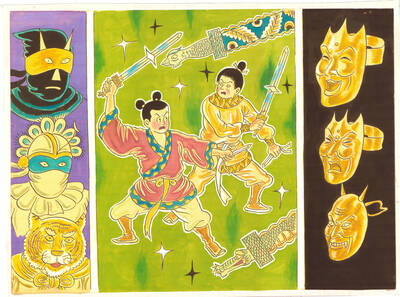
April 22 to April 28 The true identity of the mastermind behind the Demon Gang (魔鬼黨) was undoubtedly on the minds of countless schoolchildren in late 1958. In the days leading up to the big reveal, more than 10,000 guesses were sent to Ta Hwa Publishing Co (大華文化社) for a chance to win prizes. The smash success of the comic series Great Battle Against the Demon Gang (大戰魔鬼黨) came as a surprise to author Yeh Hung-chia (葉宏甲), who had long given up on his dream after being jailed for 10 months in 1947 over political cartoons. Protagonist

A fossil jawbone found by a British girl and her father on a beach in Somerset, England belongs to a gigantic marine reptile dating to 202 million years ago that appears to have been among the largest animals ever on Earth. Researchers said on Wednesday the bone, called a surangular, was from a type of ocean-going reptile called an ichthyosaur. Based on its dimensions compared to the same bone in closely related ichthyosaurs, the researchers estimated that the Triassic Period creature, which they named Ichthyotitan severnensis, was between 22-26 meters long. That would make it perhaps the largest-known marine reptile and would


 RSS
RSS