


The philosopher Isaiah Berlin famously divided thinkers into two categories: hedgehogs (like Plato, Pascal, Hegel, Dostoyevsky, Nietzsche, Ibsen and Proust), who know one big thing and tend to view the world through the lens of a single organizing principle, and foxes (like Herodotus, Shakespeare, Montaigne, Goethe, Balzac and Joyce), who know many things and who pursue various unrelated, even contradictory ends.
According to Joshua Cooper Ramo’s provocative new book, The Age of the Unthinkable, one study — in which hundreds of experts in subjects like economics, foreign policy and politics were asked to make predictions about the short-term future and whose predictions were evaluated five years later — showed that foxes, with their wide-ranging curiosity and willingness to embrace change, tended to be far more accurate in their forecasts than hedgehogs, eager for closure and keen on applying a few big ideas to an array of situations.
It’s a finding enthusiastically embraced by Ramo, who argues in these pages that today’s complex, interconnected, globalized world requires policymakers willing to toss out old assumptions (about cause and effect, deterrence and defense, nation states and balances of power) and embrace creative new approaches. Today’s world, he suggests, requires resilient pragmatists who, like the most talented Silicon Valley venture capitalists on the one hand or the survival-minded leadership of Hezbollah on the other, possess both an intuitive ability to see problems in a larger context and a willingness to rejigger their organizations continually to grapple with ever-shifting challenges and circumstances.
With this volume, Ramo, managing director at the geostrategic advisory firm Kissinger Associates and a former editor at Time magazine, seems to have set out to write a Malcolm Gladwellesque book: a book that popularizes complicated scientific theories while illustrating its arguments with colorful case studies and friendly how-to exhortations.
In drawing upon chaos science (explored in detail in James Gleick’s 1987 book, Chaos), complexity theory and the theory of disruptive innovation (pioneered by the Harvard Business School professor Clayton Christensen), Ramo does a nimble job of showing how such theories shed light on the current political and economic climate while avoiding the worst pitfalls (like an overreliance on suggestion and innuendo and the use of unrepresentative examples) of Gladwell’s clumsy last book, Outliers.
But if Ramo is adept at assessing the precarious state of today’s post-Cold War world — in which nation states face asymmetric threats from the likes of terrorists, drug cartels and computer hackers — he proves much less convincing in articulating practical means of grappling with such daunting problems.
The central image that Ramo uses to evoke what he calls this “age of surprise” is Per Bak’s sand pile — that is, a sand pile described some two decades ago by the Danish-American physicist Per Bak, who argued that if grains of sand were dropped on a pile one at a time, the pile, at some point, would enter a critical state in which another grain of sand could cause a large avalanche — or nothing at all. It’s a hypothesis that shows that a small event can have momentous consequences and that seemingly stable systems can behave in highly unpredictable ways.
It’s also a hypothesis that Ramo employs in this book as a metaphor for a complex world in which changes — in politics, ecosystems or financial markets — take place not in smooth, linear progressions but as sequences of fast, sometimes catastrophic events.
Real-life sand-pile avalanches, like the collapse of the Soviet Union or the 1929 crash of the stock market, Ramo declares, demand “a complete remapping of the world”: policymakers must junk a lot of their old thinking to cope with this unpredictable new order.
For instance, many of the assumptions of the realist school of foreign-policy making — which focused on nation states, “assumed countries were rational, and made the bet that pure power was the solution to any problem” — have been undercut by the irrationalities and contingencies that have recently multiplied on the world stage.
As Ramo observes, “Theories that involve only armies and diplomats don’t have much use” when “confronted with the peculiar nature of a financially interconnected world, where danger, risk and profit are linked in ways that can be impossible to spot and manage.”
To make matters even more complicated, Ramo continues, complex systems “tend to become more complex as time goes on.”
“The systems never get simpler. There was no moment at which they would evaporate or condense into a single, easy-to-spot target such as the USSR. The 1979 Islamic revolution in Iran, for example, was a single very knotty event that, in turn, gave birth to hundreds of jihadist groups, each of which developed different methods of terror, particular techniques of attack and destruction, which themselves were always changing and evolving.”
In this sand-pile world, a small group of terrorists armed with box cutters can inflict a terrible blow on a superpower — as al-Qaida did on 9/11, just as bands of insurgents in Iraq managed to keep the mighty US military at bay for three long years.
Iraq, Ramo astutely notes, is a war that showcased all of America’s most “maladaptive” tendencies. It was inaugurated on the premise of flawed idees fixes: that it would have “a clean, fast end” and would lead to a democratic regime that would transform the Middle East in a positive fashion. And the certainty of Bush administration officials not only led to incorrect assumptions (like the bet that “the ecosystem of Iraq would settle into something stable that could be left to run itself”) but also resulted in an ill-planned and rigid occupation that was “incapable of the speedy refiguring that life in a war zone” inevitably requires.
So how should leaders cope with the sand-pile world? How can they learn to “ride the earthquake” and protect their countries from the worst fallout of such tremors? Ramo suggests that they must learn to build resilient societies with strong immune systems: instead of undertaking the impossible task of trying to prepare for every possible contingency, they ought to focus on things like “national health care, construction of a better transport infrastructure and investment in education.”
He suggests that leaders should develop ways of looking at problems that focus more on context than on reductive answers. And he talks about people learning to become gardeners instead of architects, of embracing Eastern ideas of indirection instead of Western patterns of confrontation, of seeing “threats as systems, not objects.”
Though Ramo sounds annoyingly fuzzy and vaguely New Agey when he tries to outline tactics for dealing with “the age of the unthinkable,” he’s at least managed, in this stimulating volume, to make the reader seriously contemplate the alarming nature of a rapidly changing world — a world in which uncertainty and indeterminacy are givens, and avalanches, negative cascades and tectonic shifts are ever-present dangers.

In late October of 1873 the government of Japan decided against sending a military expedition to Korea to force that nation to open trade relations. Across the government supporters of the expedition resigned immediately. The spectacle of revolt by disaffected samurai began to loom over Japanese politics. In January of 1874 disaffected samurai attacked a senior minister in Tokyo. A month later, a group of pro-Korea expedition and anti-foreign elements from Saga prefecture in Kyushu revolted, driven in part by high food prices stemming from poor harvests. Their leader, according to Edward Drea’s classic Japan’s Imperial Army, was a samurai

Located down a sideroad in old Wanhua District (萬華區), Waley Art (水谷藝術) has an established reputation for curating some of the more provocative indie art exhibitions in Taipei. And this month is no exception. Beyond the innocuous facade of a shophouse, the full three stories of the gallery space (including the basement) have been taken over by photographs, installation videos and abstract images courtesy of two creatives who hail from the opposite ends of the earth, Taiwan’s Hsu Yi-ting (許懿婷) and Germany’s Benjamin Janzen. “In 2019, I had an art residency in Europe,” Hsu says. “I met Benjamin in the lobby
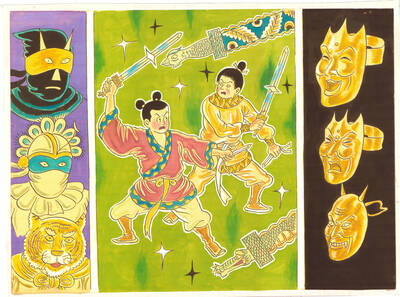
April 22 to April 28 The true identity of the mastermind behind the Demon Gang (魔鬼黨) was undoubtedly on the minds of countless schoolchildren in late 1958. In the days leading up to the big reveal, more than 10,000 guesses were sent to Ta Hwa Publishing Co (大華文化社) for a chance to win prizes. The smash success of the comic series Great Battle Against the Demon Gang (大戰魔鬼黨) came as a surprise to author Yeh Hung-chia (葉宏甲), who had long given up on his dream after being jailed for 10 months in 1947 over political cartoons. Protagonist

A fossil jawbone found by a British girl and her father on a beach in Somerset, England belongs to a gigantic marine reptile dating to 202 million years ago that appears to have been among the largest animals ever on Earth. Researchers said on Wednesday the bone, called a surangular, was from a type of ocean-going reptile called an ichthyosaur. Based on its dimensions compared to the same bone in closely related ichthyosaurs, the researchers estimated that the Triassic Period creature, which they named Ichthyotitan severnensis, was between 22-26 meters long. That would make it perhaps the largest-known marine reptile and would


 RSS
RSS