


Guo Songfen (郭松棻) was Taiwan’s shy modernist. Born in 1938, he published only a handful of short stories before his death in 2006 in the US, where he’d been living for 40 years. Because he’d been to China to get support from Zhou Enlai (周恩來) for Taiwan’s protests at the US’ 1971 decision to return the Senkaku, or Diaoyutai (釣魚台) islands to Japanese jurisdiction, he was denied re-entry to Taiwan. He took a job as translator at the UN in 1972 and stayed there for the rest of his life.
He’d been brought up in Taipei and studied and taught at the National Taiwan University. Some of his colleagues eventually became celebrated Taiwanese modernists, but Guo was always diffident, and a fastidious perfectionist. This volume of six stories marks a welcome reappearance, in persuasive English translations, of this elusive figure.
What was literary modernism? It’s helpful to think of the equivalent movement in painting where 20th century modernists did everything except paint things as they actually appeared. Similarly, the literary modernists wrote in all the ways they could imagine other than telling a gripping story with a beginning, a middle and an end (the way stories had been told for thousands of years).
To do this, they had to invent devices to replace the attraction of the traditional narratives. James Joyce, for instance, linked different colors, scents and parts of the human body to each section of Ulysses. Guo employs many non-traditional stylistic devices as well. One story in this book, Moon Seal, consists entirely of isolated sentences, each printed as a separate paragraph. In another, Clover, the two characters are presented as “you” and “he,” as in the following: “You saw a face full of life’s perplexities. He was not yet thirty years old.”
The title story, Running Mother (奔跑的母親), is characteristic of Guo’s writing. A man is talking to a psychiatrist, a friend since school days, about a recurring dream of his mother running away from him. He also has an obsession with the line where the night seascape meets the sky. There are many Proust-like evocations as well — musty odors of mildew and camphor, memories of the narrator’s mother soaking her long hair in cold tea, the scent of osmanthus flowers and the sight of egrets.
The story circles around itself, themes rising to the surface and then sinking from view, but the perpetually running mother never entirely leaves the scene. The story is thus very like a dream in which nothing gets resolved, but certain preoccupations nonetheless refuse to go away.
It’s full of memories of Taiwan’s era of Martial Law and White Terror. The psychiatrist’s father had “unexpectedly been shot dead in the [Chiayi] Train Station,” and the narrator’s father similarly goes out one day and never comes back.
But these political references aren’t taken up by Guo to form part of some wider social protest. Instead, they’re scattered through these stories as startling, shocking interpolations, stumbled on and then passed over, though the author can naturally rely on his reader’s knowledge that such events were in fact only too real.
Guo has been called unusual among modernists in including such routine political allusions in his stories. He may be untypical in this in the Taiwanese context, but many Western modernists were highly political in their concerns. Joyce himself put a lot of recent Irish history into his early books, and Ezra Pound included ill-organized material about Italian economics in the Renaissance period in his Cantos.
The one exception to Guo’s lack of an explicit political focus is the last story in this book, Brightly Shine the Stars Tonight. This features an army general at the time of the 228 Incident, widely seen as being Taiwan Executive Administrator Chen Yi (陳儀), though Guo denied this in an interview. What’s distinctive is that the general is portrayed sympathetically, longing to return to private life and thinking the army’s rule did people little real good. Once again, Guo’s concern to try untested waters is displayed.
Like many slow, fastidious writers, Guo embeds aphorisms and carefully polished sentences in his work. He’s also fond of recording aesthetic impressions, registering changes in the light, commenting on “the chill feebleness of life,” and having characters cry “for no reason other than for life itself.”
There are some brilliant moments, as when one character who complains of insomnia decides she may have had a perfect night, and only dreamed that she couldn’t sleep.
The difference between Taiwan’s modernists and their European and American counterparts is that the Taiwanese came later. They were in actuality imitating their Western predecessors, but it was also part of a very widespread desire to reject traditional Chinese culture in favor of foreign models. The tendency flourished in many areas of society — clothing, food and music, etc — and is still present today, and obvious in every aspect of Taiwanese life. It’s what makes Taipei, for instance, in so many ways an “international” city.
Guo is in essence a stylist — it’s no accident his favorite book was Madame Bovary, as his wife reveals in a Foreword. An introspective, contemplative writer, his stories have much in common with chamber music, with themes appearing, disappearing, and then re-emerging when you least expect it. Sometimes there’s a grand moment when they all appear together before the final silence.
Running Mother and Other Stories (edited by John Balcom and translated by a variety of translators) is a very valuable publication, and an important addition of Columbia’s indispensable Modern Chinese Literature from Taiwan series. This now contains over 20 titles and is still going strong.

Last week Joseph Nye, the well-known China scholar, wrote on the Australian Strategic Policy Institute’s website about how war over Taiwan might be averted. He noted that years ago he was on a team that met with then-president Chen Shui-bian (陳水扁), “whose previous ‘unofficial’ visit to the US had caused a crisis in which China fired missiles into the sea and the US deployed carriers off the coast of Taiwan.” Yes, that’s right, mighty Chen caused that crisis all by himself. Neither the US nor the People’s Republic of China (PRC) exercised any agency. Nye then nostalgically invoked the comical specter

Relations between Taiwan and the Czech Republic have flourished in recent years. However, not everyone is pleased about the growing friendship between the two countries. Last month, an incident involving a Chinese diplomat tailing the car of vice president-elect Hsiao Bi-khim (蕭美琴) in Prague, drew public attention to the People’s Republic of China’s (PRC) operations to undermine Taiwan overseas. The trip was not Hsiao’s first visit to the Central European country. It was meant to be low-key, a chance to meet with local academics and politicians, until her police escort noticed a car was tailing her through the Czech capital. The
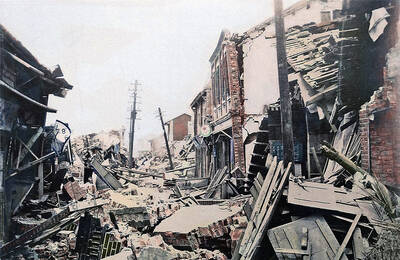
April 15 to April 21 Yang Kui (楊逵) was horrified as he drove past trucks, oxcarts and trolleys loaded with coffins on his way to Tuntzechiao (屯子腳), which he heard had been completely destroyed. The friend he came to check on was safe, but most residents were suffering in the town hit the hardest by the 7.1-magnitude Hsinchu-Taichung Earthquake on April 21, 1935. It remains the deadliest in Taiwan’s recorded history, claiming around 3,300 lives and injuring nearly 12,000. The disaster completely flattened roughly 18,000 houses and damaged countless more. The social activist and

Over the course of former President Ma Ying-jeou’s (馬英九) 11-day trip to China that included a meeting with Chinese Communist Party (CCP) leader Xi Jinping (習近平) a surprising number of people commented that the former president was now “irrelevant.” Upon reflection, it became apparent that these comments were coming from pro-Taiwan, pan-green supporters and they were expressing what they hoped was the case, rather than the reality. Ma’s ideology is so pro-China (read: deep blue) and controversial that many in his own Chinese Nationalist Party (KMT) hope he retires quickly, or at least refrains from speaking on some subjects. Regardless


 RSS
RSS