


Gouache painting has a long and storied history in Taiwan. The genre was first popularized during the Japanese colonial period when it fell under the influence of the toyoga, or “Eastern painting” style. It suffered a serious decline for almost three decades because of the Chinese Nationalist Party’s (KMT) re-Sinification policies. Artist and academic Lin Chih-chu (林之助) revived the art form, today known as “Eastern gouache,” during the 1970s and since then it has enjoyed growing popularity.
The Eastern Gouache Exhibition of Chen Shir-juh (陳石柱膠彩畫展), currently displayed on the second floor of the National Museum of History, shows roughly 80 works by Chen Shir-juh (陳石柱), who was Lin’s student. The paintings, completed between the late 1940s and 2006, provide viewers with a clear picture of the Chen’s visual style and are complemented by a display case that shows some of the materials he used.
Chen’s warm and radiant works are primarily concerned with the observation and depiction of Taiwan’s luminous flora and winged creatures. Lotus Pond Scenery (蓮池農景) is fairly representative of his subject matter, palette and style. A pair of mandarin ducks, the drake with fiery orange and wine-red plumage, the female washed in speckled earthy browns, swim in a pond rendered in turquoise and abounding with deep green lotus flowers in bloom. Blooming Orchid (洋蘭盛開) depicts two charcoal-colored swallowtail butterflies flittering around an orchid’s snow white and crimson flowers.
The exhibit shows Chen’s process of creation through a display of materials he worked with. He would begin a painting by sketching a draft outline in the field with charcoal or pencil and then transcribe the drawing onto rice paper. His sketchbooks show the different colors he planned to add to a flower here or bird there. The colors were prepared by mixing the powdery pigment with melted gelatin. He finally applied the colorful mixture on respective sections layer by layer.
Although the museum provides clear explanations of the medium of gouache painting, it fails to delineate any theme. The composition and color of the fire-red blooms found in the 1949 painting Kopok Flower (木棉花), for example, resemble those found in the 1992, 2001 and 2002 paintings of the same name. Placing the four in the same exhibit leaves the viewer with the impression that Chen underwent very little development as an artist.
An exhibit at Taichung’s National Taiwan Museum of Fine Arts on Chan Chien-yu (詹前裕) — another artist who worked in the Eastern gouache tradition — deftly illustrates, through images and explanations, the artist’s different periods. That the National History Museum didn’t do the same results in a show that is somewhat repetitious and starved of meaning.

Last week Joseph Nye, the well-known China scholar, wrote on the Australian Strategic Policy Institute’s website about how war over Taiwan might be averted. He noted that years ago he was on a team that met with then-president Chen Shui-bian (陳水扁), “whose previous ‘unofficial’ visit to the US had caused a crisis in which China fired missiles into the sea and the US deployed carriers off the coast of Taiwan.” Yes, that’s right, mighty Chen caused that crisis all by himself. Neither the US nor the People’s Republic of China (PRC) exercised any agency. Nye then nostalgically invoked the comical specter
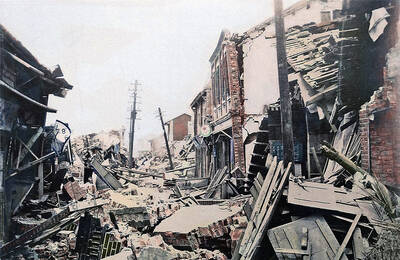
April 15 to April 21 Yang Kui (楊逵) was horrified as he drove past trucks, oxcarts and trolleys loaded with coffins on his way to Tuntzechiao (屯子腳), which he heard had been completely destroyed. The friend he came to check on was safe, but most residents were suffering in the town hit the hardest by the 7.1-magnitude Hsinchu-Taichung Earthquake on April 21, 1935. It remains the deadliest in Taiwan’s recorded history, claiming around 3,300 lives and injuring nearly 12,000. The disaster completely flattened roughly 18,000 houses and damaged countless more. The social activist and

Over the course of former President Ma Ying-jeou’s (馬英九) 11-day trip to China that included a meeting with Chinese Communist Party (CCP) leader Xi Jinping (習近平) a surprising number of people commented that the former president was now “irrelevant.” Upon reflection, it became apparent that these comments were coming from pro-Taiwan, pan-green supporters and they were expressing what they hoped was the case, rather than the reality. Ma’s ideology is so pro-China (read: deep blue) and controversial that many in his own Chinese Nationalist Party (KMT) hope he retires quickly, or at least refrains from speaking on some subjects. Regardless

Approaching her mid-30s, Xiong Yidan reckons that most of her friends are on to their second or even third babies. But Xiong has more than a dozen. There is Lucky, the street dog from Bangkok who jumped into a taxi with her and never left. There is Sophie and Ben, sibling geese, who honk from morning to night. Boop and Pan, both goats, are romantically involved. Dumpling the hedgehog enjoys a belly rub from time to time. The list goes on. Xiong nurtures her brood from her 8,000 square meter farm in Chiang Dao, a mountainous district in northern Thailand’s


 RSS
RSS