


This is only the second work of fiction that Japanophile and polymath Ian Buruma has published, and it isn’t hard to imagine the thought processes that led him to opt again for the form. He’s always been an enthusiast for Japanese cinema, and the long career of the Japanese actress Yoshiko Yamaguchi must have seemed like an ideal subject for his talents. But there may have been problems of accountability and confidentiality that led Buruma to reject his usual non-fiction approach. The good news, however, is that he’s managed to come up with an exceptionally absorbing and enjoyable novel instead.
Buruma could write a history of Japanese cinema with ease, and The China Lover is in many ways an attempt at just such a project without the necessity of being all-inclusive. It has thee different narrators and they’re all film buffs: the first in his official capacity as promoter of Japanese culture in 1930s Manchuria; the second as a film critic on the post-war Japan Evening Post; and the third through his involvement in making soft-core romantic movies in Tokyo before going to the Middle East as a convert to the cause of Palestinian militancy. I counted 41 films mentioned by name in the book, and in addition several illustrious film directors appear in cameo roles.
This device allows Buruma to follow the career of Yamaguchi through its many phases in a way that would have been impossible using a single narrator. She is a real-life figure, of course, and Buruma informs us that she “graciously allowed me to interview her on several occasions in Tokyo.” Now called Otaka Yoshiko, her birth name, she grew to fame in 1930s Manchuria as Li Xianglan (李香蘭, Ri Koran in Japanese) playing Chinese roles in films that presented the Japanese presence there in an almost invariably favorable light. The fact that she was actually born Japanese herself was carefully concealed, and her efforts, especially her 1940 film China Nights, led to a brief enthusiasm for all things Chinese back in Japan, following the inevitable vilification of China in general that had accompanied Japan’s military incursions into the country earlier in the decade.
After World War II, Yamaguchi returned to Japan before emigrating to the US where, as Shirley Yamaguchi, she starred in several Hollywood productions. Back in Tokyo in the 1960s she re-invented herself again as a TV talk-show hostess, traveled to Vietnam and the Middle East as a TV reporter, and finally entered politics where she served 18 years in the upper house of the Japanese parliament.
There can’t be many people today possessed by the romance of Manchukuo, Tokyo’s puppet state in Manchuria that flourished from 1932 until the end of Japan’s imperial ambitions in 1945 and was ruled over by the last scion of China’s Qing Dynasty, Emperor Pu Yi (溥儀). Buruma imagines just such a romantic, however, as the first of his three narrators, a man who ran an organization there for the promotion of New Asian Culture, albeit in part as a cover
for other activities.
His second narrator is a young gay American who finds the land of his heart’s desire in the devastated Tokyo of 1946. He works initially censoring films, is sent back home in disgrace after director Nobuo Hotta’s film Time of Darkness is passed for distribution, but manages soon after to return, this time as a film critic. This job leads to his extending his contacts with Japanese cinema celebrities of the day, Yamaguchi included.
In order to cover Yamaguchi’s exploits as a political TV journalist beginning in the 1960s, Buruma invents his third narrator, this time a Japanese passionate about the cause of the Palestinians. He goes to the Middle East to train in guerilla techniques and is imprisoned in Lebanon after his involvement, as a member of the Japanese Red Army, in the Lod Airport Massacre of 1972.
It will be obvious that this scenario allows Buruma to share his insights into huge swathes of Japanese 20th-century history. These insights are welcome, and the fact that the three different narrative voices are not always made as distinct as a seasoned novelist would have made them scarcely matters. They’re distinct when Buruma remembers to make them so, but when he’s delivering what are clearly his own judgments on Japan and Japanese affairs there’s rarely any doubt as to who’s talking.
Nevertheless, this is a fascinating and highly readable book, informative about a whole range of topics from perceived Jewish involvement in 1930s Manchuria to such landmarks of Japanese cinema as its first
on-screen kiss (given and received by Yamaguchi in Ichiro Miyagawa’s Sounds of Spring).
There’s a hilarious chapter describing a visit to Tokyo, and request for guidance from Buruma’s second narrator, by Truman Capote. “I thought you might be my Cicerone in this garden of vice, or should I say my Mephistopheles?” He proves dissatisfied by the prospect, which the narrator finds so alluring, of young Japanese males, however — “Just look at their thumbs, honey. It never fails.”
Yamaguchi is treated with respect, and even affection. Her short-lived marriage to the Japanese artist Isamu Noguchi, for instance, is evoked with discretion. She’s seen in essence as an example of humanity’s ability to make itself new, just as the Japanese nation remade itself after 1945. In a way it’s her innocence that saves her, and Buruma’s own humanity and wide-ranging cultural sympathies are the perfect tools for depicting so many attitudes, decades, characters and locations.
This fine novel is yet another opportunity for the author to display his love for a country that is so endlessly intriguing, so richly exotic and yet, inevitably, not without its faults — for which, as Buruma would be the first to argue, it has suffered so disproportionately and so hideously.

In late October of 1873 the government of Japan decided against sending a military expedition to Korea to force that nation to open trade relations. Across the government supporters of the expedition resigned immediately. The spectacle of revolt by disaffected samurai began to loom over Japanese politics. In January of 1874 disaffected samurai attacked a senior minister in Tokyo. A month later, a group of pro-Korea expedition and anti-foreign elements from Saga prefecture in Kyushu revolted, driven in part by high food prices stemming from poor harvests. Their leader, according to Edward Drea’s classic Japan’s Imperial Army, was a samurai

Located down a sideroad in old Wanhua District (萬華區), Waley Art (水谷藝術) has an established reputation for curating some of the more provocative indie art exhibitions in Taipei. And this month is no exception. Beyond the innocuous facade of a shophouse, the full three stories of the gallery space (including the basement) have been taken over by photographs, installation videos and abstract images courtesy of two creatives who hail from the opposite ends of the earth, Taiwan’s Hsu Yi-ting (許懿婷) and Germany’s Benjamin Janzen. “In 2019, I had an art residency in Europe,” Hsu says. “I met Benjamin in the lobby
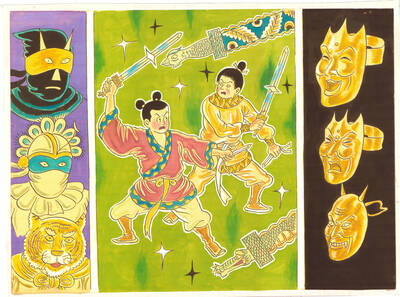
April 22 to April 28 The true identity of the mastermind behind the Demon Gang (魔鬼黨) was undoubtedly on the minds of countless schoolchildren in late 1958. In the days leading up to the big reveal, more than 10,000 guesses were sent to Ta Hwa Publishing Co (大華文化社) for a chance to win prizes. The smash success of the comic series Great Battle Against the Demon Gang (大戰魔鬼黨) came as a surprise to author Yeh Hung-chia (葉宏甲), who had long given up on his dream after being jailed for 10 months in 1947 over political cartoons. Protagonist

Peter Brighton was amazed when he found the giant jackfruit. He had been watching it grow on his farm in far north Queensland, and when it came time to pick it from the tree, it was so heavy it needed two people to do the job. “I was surprised when we cut it off and felt how heavy it was,” he says. “I grabbed it and my wife cut it — couldn’t do it by myself, it took two of us.” Weighing in at 45 kilograms, it is the heaviest jackfruit that Brighton has ever grown on his tropical fruit farm, located


 RSS
RSS