


People who have worked with Clint Eastwood invariably talk about the first time he rang and the effect of his creaky, whispery voice on their nervous system. In a studio on the Warner Brothers lot in Burbank, California, his arrival is counted down in paces between the coffee urn and the biscuit tray, while outside people queue for a chatshow next door and executives glide to lunch in their golf buggies. Eastwood enters with an awkward, loping gait, as from another era. He has made films of every stripe in the past 10 years, but for most of us he will always be that man: who starts a fight in a saloon, who defends a lady’s honor, who, now that Paul Newman is gone, is one of the last American heroes. Or, as he puts it with conscientious self-mockery and a flash of his green, green eyes, “the jerk from the plains.”
Longevity in Hollywood can inspire embarrassing devotion and Eastwood, heading towards 80, finds much of what comes his way unseemly. Men have a hard time comporting themselves in his presence; women make regrettable observations about his green eyes. The myth is so established, one forgets that in the 1960s and early 1970s, he made a lot of schlocky, forgettable westerns as well as classics such as The Good, The Bad and the Ugly. The cowboy, marshal or gunslinger whose idea of showing emotion is to shift a cigar from one side of his mouth to the other is a heroic type we are supposed to have outgrown. And yet the glamour persists, entwined as it is with ideas of what it is to be American and a nostalgia, perhaps, for less officious eras.
Eastwood didn’t say much in those films, but what he did say — “You didn’t hear the lady, did you, boy?” “Cool it, cowboy,” “Next time I’ll knock your damn head off” — compacted over time into legend. Even the most banal line — “Put your pants on, chief” — was transformed by Eastwood’s growl into something sounding like wisdom.
Today he settles in his director’s chair with the cool, polite detachment he reserves, one imagines, for outlaws and journalists. There are spots of high color on his cheeks that make him look, oddly, rather vulnerable and take the menace out of his pointy incisors. Eastwood’s tough-guy image was always leavened by something soft at the edges, the beauty spot above his lip, the fact that he was, throughout the 1960s, very obviously a man who got as much use out of his hairdryer as Warren Beatty. He worked hard to break the mould of that early career in a way he now jokes about. Eastwood is about to cast for a film about Nelson Mandela, adapted from John Carlin’s book, and when I ask who will play him, he looks devilish and says, “I’m going to play him. I’m going to show you my versatility.” (It will actually be Morgan Freeman. “Perfect casting for Mandela.”)
One way or another, Eastwood’s interests always seem to come back to the issue of heroism, particularly to the unsympathetic hero. In his new film, Gran Torino, he plays Walt Kowalski, a trigger-happy, cantankerous old bigot (imagine if Henry Fonda in On Golden Pond had been armed) who learns over time to love his Asian neighbors more than his petulant family and to make a great sacrifice for them. It sounds corny, but it’s a better film than Million Dollar Baby, the sentimental Oscar-winner he directed in 2004 and in which he played a similar role. Once Eastwood stops snarling and overacting — a pitfall of directing oneself — he turns in a touching performance and the film is funny and moving and unexpectedly shocking. Did he want to play Walt from the off?
“Yeah.”
Yeah?
“Yeah.”
Right. Eventually, he continues: “Yeah, I liked the dilemmas he had to go through. I liked the message of antique America that is maybe obsolete. Walt may be obsolete.” He laughs gently. “But he does learn new things. And that’s what makes it interesting. You take a guy who’s way out opinionated, insulting to equal opportunity” — this sounds like a phrase he’s had to adjust to — “an insulter, and you put him with people where he’s antagonistic as hell. And then all of a sudden he looks in the mirror and says, ‘I have more in common with these people than my own spoilt, rotten family.’ He’s realizing these folks like having him around, even though he’s not particularly on the surface likable.”
The film nervously calibrates Walt’s bigotry by going overboard with examples of affectionate racial mockery between Irish, Italians and Poles to show that, you know, there are levels to these things. I ask whether he was anxious about getting this tone right. “I wasn’t anxious about anything. I figure one thing when you get to my age is, what can they do to ya?” Likewise, he bats away being overlooked at the Oscars. Gran Torino was number one at the US box office but didn’t get a single nomination. “I have had three films nominated out of the last five I’ve made. I just make the film the best I can. The rest is political stuff and posturing. I’m not terribly good at that. I think our message was as good as any message out there this year. There we are.”
At some point, the reticence of Dirty Harry and Joe Kidd turned into the old-age misanthropy of Walt Kowalski and Frankie Dunn, and when, in 2000, Eastwood made Space Cowboys with Tommy Lee Jones and Donald Sutherland, the joke was it should have been called Grumpy Old Astronauts. At 78, he is still wiry and tough looking, but his posture is bad and his famous whisper sounds, occasionally, like the frailty of age. “Eighty is just a number,” he says. “A lot of people are old at 40.” No twinges of vanity when he sees himself on screen? “It’s too late for vanity. If I was 30, maybe, I’d say, ‘Hey, that’s not a good angle.’ But there is no good angle now. So you just kinda accept it and go ahead.”
Eastwood is kept young, perhaps, by his family; he has seven children who range in age from 12 to their early 40s. The 12-year-old daughter, Morgan, lives with him and his second wife, Dina Ruiz, a former TV anchorwoman from Arizona. He married his first wife, Maggie Johnson, when he was 21 and had two children with her. They didn’t divorce for 30 years, during which time he had a child with Roxanne Tunis, two with Jacelyn Reeves and one with Frances Fisher, while conducting a long relationship with the actor Sondra Locke. I wonder if Morgan thinks he’s cool or embarrassing. Eastwood looks surprised. “I think she thinks I’m a cool dad. We get along very well. I have a teenage daughter as well. And I think they think I’m all right. I’m not totally objective. I don’t think they think of me as a guy who should be their grandfather. I used to joke about it: that my kids didn’t give me any grandchildren, so I just had my own grandchildren.”
One imagines that being the son of Clint Eastwood throws up very particular problems, as being the daughter of some icon of femininity might for a girl. I ask if his sons have had a tougher time of it than his daughters. “Maybe. Maybe not. I don’t think so.” He pauses. “Maybe.” Another long pause. “I don’t think they need to get screwed up. The parents have to keep instilling in them the logic of life. Not everyone becomes a known figure. There’s disadvantages to it and there’s advantages to it. Don’t try to make it any more than it is.” This isn’t, of course, something he can entirely control, the way his fame affects his children. “You’re never in total control. But you have to have ambitions to set the agenda and fate does the rest.”
Control is a big thing for Eastwood, whose “logic of life” is deeply entwined with his Libertarian politics, which he brings up with a wry smile, taking into account that most people think Libertarianism is at best unrealistic and at worst crackpot. He registered as a Republican in 1951 in support of Eisenhower, whom he admired for his World War II heroism and election promise to end the war in Korea. Eastwood’s short tenure as mayor of Carmel, the town south of San Francisco where he lives, was premised, he told the New Yorker, on “doing things for people who can’t stand up for themselves.” Since then, he says, the Republican party has lost its way — he was not in favor of going to war in Iraq, and the evangelical side of the party annoys him. “The only thing John McCain and I really agreed upon was that the Republicans had lost their way because they lost their philosophy.” The core of that philosophy, he says, is that “people should be responsible for themselves and fiscal responsibility is very, very important.” He says of the current economic crisis: “The great saying that if you don’t pay attention to history you’re doomed to repeat it is pretty much true. Pretty much true. Now we’re repeating it. You get what you deserve.”
For the election, his wife registered as an independent, although, he says, they both thought, “Obama seemed like a nice guy.” And Eastwood? “I registered,” he smiles, “Libertarian. I like the philosophies. The Libertarian party is nothing and they don’t have any candidates. But I do believe if we just leave everybody alone, quit trying to think of ways to run everybody else’s life, maybe we’d be better off. It may be impractical. It may be obsolete, that kind of thinking.” He looks off into the distance: “It’s just kinda the way I was raised.”
Eastwood’s long-term vision about his career was unusual both in its accuracy and the tenacity with which he pursued it. In his early 30s, he could see that if he carried on making westerns they would get worse and he would eventually fall out of fashion. The way to save himself was to diversify. He is a pianist and has written the scores for many of his films, but it was to directing that he turned. He had campaigned to direct episodes of Rawhide, the TV series that started his career; the studio refused, but finally, in 1971, he was given Play Misty for Me, a low-budget film about a woman stalking a local radio star. Misty is still a tense, well-managed thriller today, although there is a self-indulgent bit where the character played by Eastwood and his girlfriend frolic on a beach, in a wood and under a waterfall, that would presage overlong sequences in many of his films. Directing, he says, is the greater joy. “You’re the storyteller. As an actor you’re just involved with the one component, your component. And your relationship to the ensemble. I prefer directing. I have to. I’m at the age where I should. So.”
Eastwood is not a shouter on set; his is a quiet authority. Apart from Spike Lee, no one in the industry seems to have a bad word for him. He is said to be gentlemanly to a fault, professional, deeply engaged. He is also disinclined to censor himself. It is customary when making a film based on a novel not to bad-mouth the source material. In 1995 he made The Bridges of Madison County, one of the directing roles that, with Unforgiven, raised his profile as a serious director; he called Robert James Waller’s novel “fancy, pretentious writing” that he had “fought” to get through. His tiff with Spike Lee last year followed Lee’s accusations that Eastwood did not include any black soldiers in his World War II film Flags of Our Fathers, the story of the men who raised the US flag after the battle of Iwo Jima. It is a bleak, beautiful film that seems to go on for several days and, amid all the battle scenes, exploits what Eastwood has always done best: stillness. He replied that Lee should “shut his face” — the film was historically accurate. Now he says, “It wasn’t really a tiff. I was in Cannes and somebody said that he was quoted saying this and that. Some journalist. And I said, well if he said that ... and I shot my mouth off. But he’s a nice guy. I think Spike was just trying to promote his flick. I understand the game.” He grins. “I just thought I wasn’t going to let him off the hook.”
He won’t speculate on how he has influenced cinema, or who he considers to be the heirs to Dirty Harry or Josey Wales. Jason Bourne, perhaps, although he gets too weepy over his dead girlfriend. Eastwood never betrayed an interior life beyond the hint of a secret sadness. He never fell for the posse mentality, and even when he was playing a cop, he was as suspicious of the law as of the outlaws — in Hang ’Em High, a judge admonishes his Marshal Jedediah Cooper: “You can be the best I’ve ever had, the best there is, if you remember this: you work for the government. You work for justice.” His characters didn’t work for anyone, of course, which is why we’ll always love them. For his own inspiration, he says, he looked to John Wayne and Gary Cooper, “old-time movie actors. I was influenced by James Cagney a lot. I liked his inner vitality. And he was fearless. Not afraid to do crazy things, take a grapefruit in the face. I’ve always felt that suited me as well.”
What is that, not being afraid to fail? “I think it’s just ... not being afraid.” He quotes FDR — “The only thing to fear is fear itself” — then repeats it in a silly voice, to show he isn’t that pompous. “Anyway, it was like that mentality. Yeah, I’ll just barge in, make that commitment, go for it, otherwise you miss great opportunities to enjoy yourself and have fun and create characters that are interesting. Sometimes you have to swing hard and miss the ball. But you have to swing hard.”
Given his fame, Eastwood has an unusually sensible attitude. He hasn’t burned out, or become an addict, or cast himself against women half his age. There’s no great mystery to it, he says. “Just stacking up information. Not forgetting it.” He drops his voice even lower than his usual whisper and leans in. “Not forgetting.” His eyes really are very green.

In late October of 1873 the government of Japan decided against sending a military expedition to Korea to force that nation to open trade relations. Across the government supporters of the expedition resigned immediately. The spectacle of revolt by disaffected samurai began to loom over Japanese politics. In January of 1874 disaffected samurai attacked a senior minister in Tokyo. A month later, a group of pro-Korea expedition and anti-foreign elements from Saga prefecture in Kyushu revolted, driven in part by high food prices stemming from poor harvests. Their leader, according to Edward Drea’s classic Japan’s Imperial Army, was a samurai

Located down a sideroad in old Wanhua District (萬華區), Waley Art (水谷藝術) has an established reputation for curating some of the more provocative indie art exhibitions in Taipei. And this month is no exception. Beyond the innocuous facade of a shophouse, the full three stories of the gallery space (including the basement) have been taken over by photographs, installation videos and abstract images courtesy of two creatives who hail from the opposite ends of the earth, Taiwan’s Hsu Yi-ting (許懿婷) and Germany’s Benjamin Janzen. “In 2019, I had an art residency in Europe,” Hsu says. “I met Benjamin in the lobby
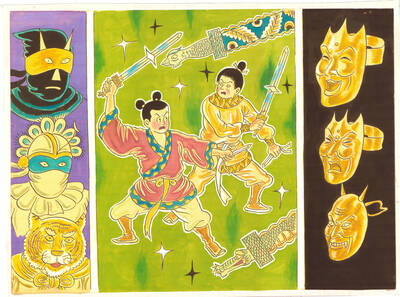
April 22 to April 28 The true identity of the mastermind behind the Demon Gang (魔鬼黨) was undoubtedly on the minds of countless schoolchildren in late 1958. In the days leading up to the big reveal, more than 10,000 guesses were sent to Ta Hwa Publishing Co (大華文化社) for a chance to win prizes. The smash success of the comic series Great Battle Against the Demon Gang (大戰魔鬼黨) came as a surprise to author Yeh Hung-chia (葉宏甲), who had long given up on his dream after being jailed for 10 months in 1947 over political cartoons. Protagonist

Peter Brighton was amazed when he found the giant jackfruit. He had been watching it grow on his farm in far north Queensland, and when it came time to pick it from the tree, it was so heavy it needed two people to do the job. “I was surprised when we cut it off and felt how heavy it was,” he says. “I grabbed it and my wife cut it — couldn’t do it by myself, it took two of us.” Weighing in at 45 kilograms, it is the heaviest jackfruit that Brighton has ever grown on his tropical fruit farm, located


 RSS
RSS