


The cluster of temples at the heart of this dusty, traffic-clogged town are picturesque reminders of China’s faded Buddhist past. On a recent day, dogs warmed themselves in the winter sun as a few toothless devotees bowed before smiling Buddhas. The only sounds were the occasional clanging of wind chimes and the splash of coins tossed into a mucky pond.
While soothing to some, the tranquility is galling to Guandu’s city fathers, who recently spent US$3 million to rebuild the four temples. They had become schools and warehouses during an earlier era, when the Communist Party sought to suppress nearly all religious activity, including that by Buddhists.
To sweeten the lure for free-spending tourists, they tore down the jumble of ancient homes that surrounded the 1,000-year-old temples and built rows of antique-looking shops that sell bootleg DVDs, sneakers and stuffed Santas.
Still no one came.
“The temples have been money losers,” grumbled Dou Weibao, the commissioner of ethnic and religious affairs in Guandu, which has long since been subsumed by the sprawl of Kunming, the capital of Yunnan province.
Dou found a savior 2,000km away, in the Song Mountains of central China, where the warrior monks of Shaolin have long since mastered the art of monastery marketing. Since the early 1990s, the chief abbot, Shi Yongxin (釋永信), has turned Shaolin into a lucrative draw for kung fu aficionados and has transformed his lithe disciples into global emissaries for the temple’s crowd-pleasing mix of Zen Buddhism and fly-kick combat.
In November, the two parties struck a straightforward deal. In exchange for managing the Guandu temples for 30 years, the monks will keep all proceeds from the donation boxes and gift shops. In a news release announcing the arrangement, Shaolin said its primary goals were to carry out charitable activities, maintain the temples and “spread the faith.”
Dou, who described himself as an atheist, sees things somewhat differently. “We’re going to use their fame to attract more business,” he said on Wednesday as he and a batch of newly arrived monks exchanged pleasantries.
Guandu officials say they will get no money from the deal but they hope the Shaolin mystique will pull in the kind of crowds that have turned the monastery’s Henan province flagship into one of China’s most popular tourist destinations. Dou said the government would save the US$88,000 once spent on temple maintenance each year. They are also counting on the tax revenue from a vast new mall that is nearing completion next to the temple complex.
The management deal has provoked howls among some Chinese, with many critics decrying the commercialization wrought by Yongxin, who drives a Land Rover and has established Shaolin branches in Italy, Germany and Australia.
“Shaolin Chain Store,” read the headline of one recent posting written on Sina.com, a popular Web site. “There’s nothing wrong with chasing profits and fame, but they can’t use the name of Buddha.”
Such sentiments are hard to find in Guandu, where people seem to enjoy the sudden uptick in tourism. Last Wednesday, a squadron of incense vendors surged around visitors, and the Liu family noodle shop was doing a brisk business feeding the famished. “Before the monks came, the only people who came were old and they didn’t spend any money,” said Cao Jinbu, the shop’s owner.
Wan Liqiong, who runs a trinket stand across from the temple gate, said she would probably have to switch some of her stock to include Shaolin-oriented souvenirs. “We’ve really been struggling here,” she said. Then she offered up an expression that roughly translates to “if you burn incense, they will come.”
After reading about the Shaolin deal in his local newspaper, Ying Daojin, made the eight-hour journey by bus just to catch a glimpse of the monks. A 30-year-old corn farmer from northeast Yunnan, Ying described himself as a non-believer but seemed willing to give religion a try. “I’ve heard Buddhism can open your mind,” he said wide-eyed as a monk glided by. “Kung fu is also good for your health.”
According to his secretary, Yongxin, the head monk based in Henan province, does not give telephone interviews but he encouraged a reporter to seek out Master Yanjiang, the abbot assigned to run the Guandu complex.
Yanjiang, however, proved just as elusive and refused to discuss his plans for the temples. His monks were decidedly unapproachable.
The young men waved away inquiries. When one bespectacled monk found himself the subject of a photographer’s interest, he grabbed the camera and then offered a menacing martial arts pose when his demand to have the picture erased went unmet. Negotiations proved fruitless and the pictures were deleted. The monk bowed, smiled and walked away.
Others were busy helping to renovate the new gift shop while another group of monks was handling the bequest of an adherent who stopped by bearing gifts.
A few days after their arrival, the monks taped a handwritten poster at the temple entrance advertising kung fu lessons. The cost: US$44 for a month of instruction, nearly a full month’s wage for some Chinese workers.
The security guard at the front gate said the classes were selling well, with more than 100 people already signed up. He showed off the student roster, most of them children and teenagers. “Everyone loves the Shaolin monks,” he said with a smile.

In late October of 1873 the government of Japan decided against sending a military expedition to Korea to force that nation to open trade relations. Across the government supporters of the expedition resigned immediately. The spectacle of revolt by disaffected samurai began to loom over Japanese politics. In January of 1874 disaffected samurai attacked a senior minister in Tokyo. A month later, a group of pro-Korea expedition and anti-foreign elements from Saga prefecture in Kyushu revolted, driven in part by high food prices stemming from poor harvests. Their leader, according to Edward Drea’s classic Japan’s Imperial Army, was a samurai

The following three paragraphs are just some of what the local Chinese-language press is reporting on breathlessly and following every twist and turn with the eagerness of a soap opera fan. For many English-language readers, it probably comes across as incomprehensibly opaque, so bear with me briefly dear reader: To the surprise of many, former pop singer and Democratic Progressive Party (DPP) ex-lawmaker Yu Tien (余天) of the Taiwan Normal Country Promotion Association (TNCPA) at the last minute dropped out of the running for committee chair of the DPP’s New Taipei City chapter, paving the way for DPP legislator Su

Located down a sideroad in old Wanhua District (萬華區), Waley Art (水谷藝術) has an established reputation for curating some of the more provocative indie art exhibitions in Taipei. And this month is no exception. Beyond the innocuous facade of a shophouse, the full three stories of the gallery space (including the basement) have been taken over by photographs, installation videos and abstract images courtesy of two creatives who hail from the opposite ends of the earth, Taiwan’s Hsu Yi-ting (許懿婷) and Germany’s Benjamin Janzen. “In 2019, I had an art residency in Europe,” Hsu says. “I met Benjamin in the lobby
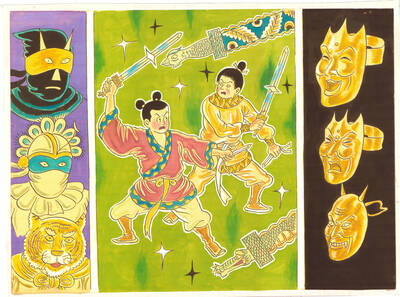
April 22 to April 28 The true identity of the mastermind behind the Demon Gang (魔鬼黨) was undoubtedly on the minds of countless schoolchildren in late 1958. In the days leading up to the big reveal, more than 10,000 guesses were sent to Ta Hwa Publishing Co (大華文化社) for a chance to win prizes. The smash success of the comic series Great Battle Against the Demon Gang (大戰魔鬼黨) came as a surprise to author Yeh Hung-chia (葉宏甲), who had long given up on his dream after being jailed for 10 months in 1947 over political cartoons. Protagonist


 RSS
RSS