


On 20 May 1989, the writer Henning Mankell opened a telephone directory and began looking for a name. Any name. Mankell had decided to turn his hand to crime fiction. He needed a policeman, and the policeman needed a name.
He rifled through the book and stopped at W. Then he moved his fingers across one page until he came to the name Wallander. And there he stopped. Thus life was first breathed into Kurt Wallander, Sweden’s fabulously grumpy, dysfunctional fictional detective.
More than 25 million copies of Wallander novels have been sold since Mankell created the character and featured him in Faceless Killers, published in 1991. In the process the author has become Sweden’s most successful literary export.
In the southern town of Ystad, where the books are set, there are guided tours of “Wallander country,” much to Mankell’s embarrassment, while the books have been televised at home, with Krister Henriksson as the tortured detective.
What are the complexities of this dark, humorless misanthrope that make him so endearing to audiences?
Even Mankell admits that he dislikes the messily divorced, diabetic, fast-food addict that he created from his perusals of Swedish telephone directories. “I would rather be friends with Sherlock Holmes,” the author once remarked.
So what is the attraction? According to publisher and writer Julian Evans, an expert on European fiction, it is Wallander’s uncompromising self-destruction that so fascinates.
“He’s quite unsalvageable, Wallander, in a way very, very few fictional characters really are. In an existential sense, he seems close to the end, all the time. You can’t say that at all of all detectives. His woeful relationship with his daughter ... his inability to manage any female relationship. Every crime he solves or fails to solve, you still think the next thing he is going to do is just ... die.”
This is a man permanently on the edge, “a sort of walking open wound,” as Branagh describes his character, and he makes absorbing television.
Then there is the background: the bleak, unforgiving soil of Sweden’s Skane (pronounced Skonner) region in the south. “Border areas have a dynamism all their own,” Mankell says. “They set off a reflex of unease.”
And Mankell certainly knows a thing or two about borders. Born in 1948 and raised from the age of two by his father Ivan, a judge, after Henning’s mother had walked out on the family, the author-to-be joined the merchant navy at 16 in 1964 and became a stevedore on a coal and iron ore freighter.
This was his “real university,” he claims. A couple of years later, he arrived in Paris and stayed for the riots and student activism that were to grip the city in 1968. It was to be a formative period. As his publisher, Dan Israel, has remarked: “Henning and I are children of 1968.”
The author returned to Sweden to become a playwright and author, publishing his first novel, The Stone-Blaster, at 24. He later traveled extensively in Africa and in 1987 was asked to run the Teatro Avenida in Maputo, Mozambique. He has held that post ever since, dividing his time between Africa and his farm near Ystad, in Sweden, writing his books in both locations.
Thus, half of the Wallander novels — with their vivid evocations of the bleak Swedish landscape and their chilling stories of serial murder — have been written in Africa, a striking contrast, to say the least, though for his part Mankell finds nothing unusual in this geographical dichotomy. “When I [first] got off the airplane in Africa, I had a curious feeling of coming home,” he once said.
Over the years, the author has had a string of affairs and has fathered four children by four different mothers, although he insists, emphatically, that his current marriage — to Ingmar Bergman’s daughter Eva — will be “the last.”
Bergman turns out to have been a fan of the Wallander books — as is just about every Swede on the planet, it seems. Mankell recalls walking down a street in Stockholm during a referendum about joining the EU and was approached politely by a man in his sixties, who asked whether Wallander would vote yes or no. “That was the moment I grasped the size of the character,” says the author.
His appeal is harder to assess, however. It is not simple travelogue, Evans insists. “I reject the argument that Wallander is popular here because there’s a kind of ‘northern’ fiction, particularly crime fiction,” says Evans. It is the mental landscape that he inhabits that gives him such appeal, he argues.
In addition, there is the simple issue of availability in key book buying markets. “I think it’s cyclical,” says Evans. “We’ve taken a long time away from European art, European fiction in particular. We had our eyes to the Americas. Part of the problem is simply the translation. There has been truly great stuff going on in European fiction for 15 years or more, and perhaps it’s only now we’re beginning to let it in.”
There is more to the issue than that, however. Many other novels about foreign detectives are now translated into English and none has had the impact of those involving the resolutely depressive Kurt Wallander.
In that sense, Mankell has bigger issues to address than the average detective novelist, which perhaps explains his elusive appeal. Mankell is, to repeat the description of his publisher, a child of 1968. “The fundamental driving force for me is to create a change in the world we live in ... It is about exploitation, plundering and degradation,” he says. “I have a small possibility to participate in the resistance. Most of the things that I do are part of a resistance, a form of solidarity work.”
His books, and the series made from them, are investigations of the failure of political promise, say critics. “All of Henning’s books are an elegy to the broken socialist dream of Sweden,” the publisher Christopher MacLehose remarked recently. “Henning still can’t get used to the idea that Sweden has failed to deliver its social democratic dream.”
Thus we get more than a mere who-dunnit with a Wallander story. We get edge, a sense that a good man is hunting through a landscape of broken dreams for signs that some decency has survived and who rarely succeeds in his quest. There is a resonance here that goes far beyond standard detective novels.
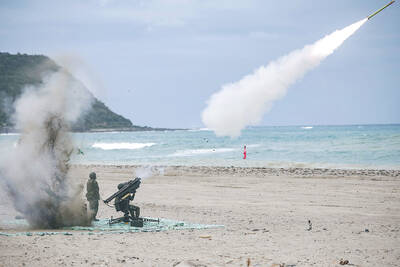
In late October of 1873 the government of Japan decided against sending a military expedition to Korea to force that nation to open trade relations. Across the government supporters of the expedition resigned immediately. The spectacle of revolt by disaffected samurai began to loom over Japanese politics. In January of 1874 disaffected samurai attacked a senior minister in Tokyo. A month later, a group of pro-Korea expedition and anti-foreign elements from Saga prefecture in Kyushu revolted, driven in part by high food prices stemming from poor harvests. Their leader, according to Edward Drea’s classic Japan’s Imperial Army, was a samurai

Located down a sideroad in old Wanhua District (萬華區), Waley Art (水谷藝術) has an established reputation for curating some of the more provocative indie art exhibitions in Taipei. And this month is no exception. Beyond the innocuous facade of a shophouse, the full three stories of the gallery space (including the basement) have been taken over by photographs, installation videos and abstract images courtesy of two creatives who hail from the opposite ends of the earth, Taiwan’s Hsu Yi-ting (許懿婷) and Germany’s Benjamin Janzen. “In 2019, I had an art residency in Europe,” Hsu says. “I met Benjamin in the lobby
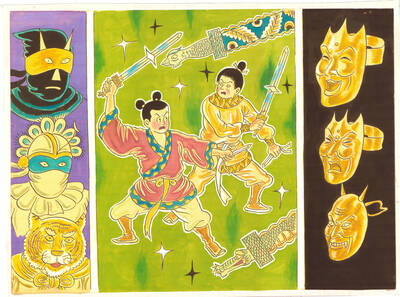
April 22 to April 28 The true identity of the mastermind behind the Demon Gang (魔鬼黨) was undoubtedly on the minds of countless schoolchildren in late 1958. In the days leading up to the big reveal, more than 10,000 guesses were sent to Ta Hwa Publishing Co (大華文化社) for a chance to win prizes. The smash success of the comic series Great Battle Against the Demon Gang (大戰魔鬼黨) came as a surprise to author Yeh Hung-chia (葉宏甲), who had long given up on his dream after being jailed for 10 months in 1947 over political cartoons. Protagonist

Peter Brighton was amazed when he found the giant jackfruit. He had been watching it grow on his farm in far north Queensland, and when it came time to pick it from the tree, it was so heavy it needed two people to do the job. “I was surprised when we cut it off and felt how heavy it was,” he says. “I grabbed it and my wife cut it — couldn’t do it by myself, it took two of us.” Weighing in at 45 kilograms, it is the heaviest jackfruit that Brighton has ever grown on his tropical fruit farm, located


 RSS
RSS