


“This is not Beijing opera,” is the refrain repeated by the cast and crew of Contemporary Legend Theater’s production of Medea (樓蘭女), which opened at the National Theater last night. Director Wu Hsing-kuo (吳興國) reiterated the stance during an interview last month as the production prepared to tour Shanghai and Hong Kong.
Medea may not be Beijing opera, but it would probably not be possible without the demanding combination of physical and vocal training that is the art form’s foundation. That said, the production would have been impossible without Wu’s own experience outside the confines of Beijing opera.
As a graduate of a traditional opera academy, Wu entered professional life with all the skills that an aspiring Beijing opera star requires. But looking to his future, Wu saw a narrow and increasingly circumscribed career in a sector of the entertainment industry that was already struggling against a tide of falling box office takings and indifference from a younger generation.
He formed Contemporary Legend in 1986 [see interview below], and went on to create some of Taiwan’s most innovative theater productions. In Medea, which was produced in 1993 based on a play by Euripides, Wu departed more completely than ever before from his roots in opera and created something that, in its defiance of convention, has remained fresh 15 years after it was first presented on stage.
The first production of Medea was directed by Wu’s partner Lin Hsiu-wei (林秀偉), whose background is in contemporary dance. Her close involvement with the work created a structural foundation more akin to dance than drama, and it is on to this that the very contrary aspects of Beijing opera have been grafted.
The “dancers don’t wear very much on stage and the focus is on their bodies. Beijing opera performers wear many layers of clothing,” Wu said. “[Contemporary dance] uses a very direct means of expression, but in Beijing opera, expression is veiled and indirect. These are profound differences.”
In Medea, the tension between two very different styles is embodied in the title role, which is played by Beijing opera diva Wei Hai-min (魏海敏). Dressed in a costume of almost architectural complexity designed by Tim Yip (葉錦添), the multi-award winning costume and production designer for Crouching Tiger, Hidden Dragon (臥虎藏龍), Red Cliff (赤壁) and many other films, Wei recreates the passion and madness of Medea to the music of Hsu Po-yun (�?�). The score, which is based on Central Asian music, deprives Wei of the usual musical props of a conventional Beijing opera, and she is more than ever reliant on her incredible stage presence to hold the audience.
“The production would simply not be possible without Beijing opera training,” Lin said. “Simply moving around in the costume is a huge challenge.” Wei is backed up by performers who serve both as a Greek chorus and as part of the organic set designed by Lin Keh-hua (林克華). “We wanted the whole stage to come alive to reflect Medea’s emotions,” Lin said. While the costumes will be the same ones used in the 1993 premiere, the set has been totally reworked to give a fuller and more powerful atmosphere of the Central Asian desert, where the story of Medea has been transplanted.
The current production is directed by Wu, who brings a slightly different sensibility to the work, but at the core retains the powerful feminist sensibility provided by Lin in 1993.
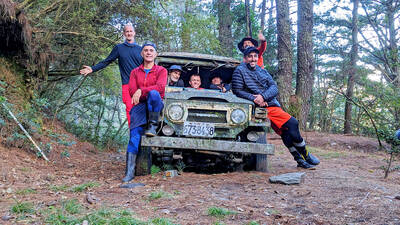
The year was 1991. A Toyota Land Cruiser set out on a 67km journey up the Junda Forest Road (郡大林道) toward an old loggers’ camp, at which point the hikers inside would get out and begin their ascent of Jade Mountain (玉山). Little did they know, they would be the last group of hikers to ever enjoy this shortcut into the mountains. An approaching typhoon soon wiped out the road behind them, trapping the vehicle on the mountain and forever changing the approach to Jade Mountain. THE CONTEMPORARY ROUTE Nowadays, the approach to Jade Mountain from the north side takes an

Last week Joseph Nye, the well-known China scholar, wrote on the Australian Strategic Policy Institute’s website about how war over Taiwan might be averted. He noted that years ago he was on a team that met with then-president Chen Shui-bian (陳水扁), “whose previous ‘unofficial’ visit to the US had caused a crisis in which China fired missiles into the sea and the US deployed carriers off the coast of Taiwan.” Yes, that’s right, mighty Chen caused that crisis all by himself. Neither the US nor the People’s Republic of China (PRC) exercised any agency. Nye then nostalgically invoked the comical specter

Relations between Taiwan and the Czech Republic have flourished in recent years. However, not everyone is pleased about the growing friendship between the two countries. Last month, an incident involving a Chinese diplomat tailing the car of vice president-elect Hsiao Bi-khim (蕭美琴) in Prague, drew public attention to the People’s Republic of China’s (PRC) operations to undermine Taiwan overseas. The trip was not Hsiao’s first visit to the Central European country. It was meant to be low-key, a chance to meet with local academics and politicians, until her police escort noticed a car was tailing her through the Czech capital. The
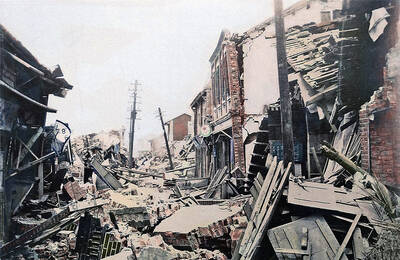
April 15 to April 21 Yang Kui (楊逵) was horrified as he drove past trucks, oxcarts and trolleys loaded with coffins on his way to Tuntzechiao (屯子腳), which he heard had been completely destroyed. The friend he came to check on was safe, but most residents were suffering in the town hit the hardest by the 7.1-magnitude Hsinchu-Taichung Earthquake on April 21, 1935. It remains the deadliest in Taiwan’s recorded history, claiming around 3,300 lives and injuring nearly 12,000. The disaster completely flattened roughly 18,000 houses and damaged countless more. The social activist and


 RSS
RSS