


A hair’s breadth from hagiography, Scott Hicks’s Glass: A Portrait of Philip in Twelve Parts is much like its subject: affable, quotable and emotionally guarded in the extreme.
Planned as a tribute to this work-obsessed musician, Glass proceeds genteelly through an intellectually inquisitive and deeply spiritual life. Balancing prodigious musical commitments with qigong and Taoism, Glass, who turned 71 in January, maintains a rigorous daily schedule that would daunt any man half his age. Somewhere on the fringes his current wife, Holly Critchlow, and two infant children provide the sounds and comforts of family.
Yet whether chatting about his aversion to music theory or appreciation of negative reviews, Glass — like his music — remains frustratingly distant. Interviews with friends, siblings and artistic collaborators like the artist Chuck Close and the filmmaker Errol Morris (“Philip does existential dread better than anyone”) only bolster the film’s admiring and self-satisfied tone.
Not until the final minutes does this veneer crack as Hicks, almost in spite of himself, becomes hypnotized by Critchlow’s sudden confession of emotional pain. While the camera clings to her massive brown eyes, the film falls awkwardly silent: like a lightning bolt on a gloomy day, her unexpected outburst is more harshly illuminating than anything that has gone before.

In late October of 1873 the government of Japan decided against sending a military expedition to Korea to force that nation to open trade relations. Across the government supporters of the expedition resigned immediately. The spectacle of revolt by disaffected samurai began to loom over Japanese politics. In January of 1874 disaffected samurai attacked a senior minister in Tokyo. A month later, a group of pro-Korea expedition and anti-foreign elements from Saga prefecture in Kyushu revolted, driven in part by high food prices stemming from poor harvests. Their leader, according to Edward Drea’s classic Japan’s Imperial Army, was a samurai
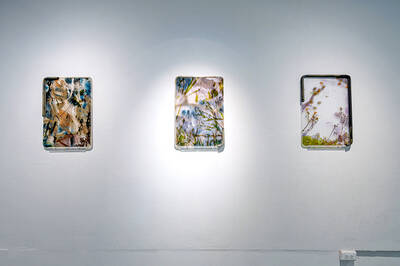
Located down a sideroad in old Wanhua District (萬華區), Waley Art (水谷藝術) has an established reputation for curating some of the more provocative indie art exhibitions in Taipei. And this month is no exception. Beyond the innocuous facade of a shophouse, the full three stories of the gallery space (including the basement) have been taken over by photographs, installation videos and abstract images courtesy of two creatives who hail from the opposite ends of the earth, Taiwan’s Hsu Yi-ting (許懿婷) and Germany’s Benjamin Janzen. “In 2019, I had an art residency in Europe,” Hsu says. “I met Benjamin in the lobby
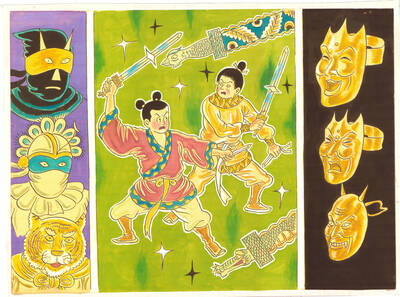
April 22 to April 28 The true identity of the mastermind behind the Demon Gang (魔鬼黨) was undoubtedly on the minds of countless schoolchildren in late 1958. In the days leading up to the big reveal, more than 10,000 guesses were sent to Ta Hwa Publishing Co (大華文化社) for a chance to win prizes. The smash success of the comic series Great Battle Against the Demon Gang (大戰魔鬼黨) came as a surprise to author Yeh Hung-chia (葉宏甲), who had long given up on his dream after being jailed for 10 months in 1947 over political cartoons. Protagonist

A fossil jawbone found by a British girl and her father on a beach in Somerset, England belongs to a gigantic marine reptile dating to 202 million years ago that appears to have been among the largest animals ever on Earth. Researchers said on Wednesday the bone, called a surangular, was from a type of ocean-going reptile called an ichthyosaur. Based on its dimensions compared to the same bone in closely related ichthyosaurs, the researchers estimated that the Triassic Period creature, which they named Ichthyotitan severnensis, was between 22-26 meters long. That would make it perhaps the largest-known marine reptile and would


 RSS
RSS