


You can find almost anything in Taiwan — which is another way of saying that the Taiwanese will put their hands (and invariably their minds and hearts as well) to just about anything. This is certainly true in the musical sphere.
Forum Music specializes in abstract percussion, one of the most austere, not to say abstruse, musical genres. But there’s a way that Taiwanese amiability and good-natured confidence can tame even this. Toneless, tuneless and even clueless it may be to some, but the atmosphere at the Music Forum 2008 Annual Concert (十方樂集2008年度公演 — 時空交擊) held at Taipei’s Zhongshan Hall on Saturday evening was so congenial that the idea that this music might actually be fun appeared to be, if anything, actually taken for granted.
On stage were gongs, tubular bells, xylophones, sheets of metal, and more kinds of drums than I could count. Six items were performed, two of them announced as world premieres, and the number of players ranged from 13 to one. Most surprising of all, the average age of the instrumentalists looked to be mid-20s at most.
Historically, this kind of music began as an aspect of early 20th-century modernism, an equivalent of cubism and abstraction in art and every sort of non-realism in literature. It was as far from lush romanticism as it was possible to go, aspired to be all head and no heart, and attracted a determined few who wanted to have no truck whatsoever with the past.
Yet a century later, in modern Taipei, several hundred followers showed up and applauded wildly. Three of the composers gave brief speeches, all of which provoked appreciative laughter and more applause, and the items themselves were in the event very varied.
One premiere, Chang Chao-jan’s (張超然) Beyond the Boundary (極限之外), was played solo on a gigantic xylophone, a Lyoma Marimba, with ambient sounds drifting from two large speakers. Another, Li Yuan-chen’s (李元貞) Ring (鐘), required four players, each with a mass of equipment, and made a strong impact.
The lasting impression was that you can do whatever you want and call it music if that’s what it is to you. This, I’d have thought, is as democratic and liberating a message as anyone could wish to come away with from any performance.
Meanwhile, at the 9th Taipei Poetry Festival, a simply-staged show was on offer at the Guling Street Avante-Garde Theater. Called Midaregami — Tangled Hair: A Poem of Light and Shadows, it featured a worried, alienated youth and a kimono-clad female shamisen player. Simple cutouts and silhouettes were projected onto a white sheet, along with fragments of poetry by, I was told, two poets. Almost the entire audience of perhaps 60 consisted of women, and all the featured poets this year are female as well.
The tiny, attractive auditorium was sold-out, and all I could gather of the show’s import was that the progressive women of Taiwan are gathering in remote locations on every hand. Lacking identifying insignia, they are engaging in occult rituals, exchanging cabalistic signs and preparing to assault the heights. I was all the more grateful, in these circumstances, for being silently handed a free ticket.

In late October of 1873 the government of Japan decided against sending a military expedition to Korea to force that nation to open trade relations. Across the government supporters of the expedition resigned immediately. The spectacle of revolt by disaffected samurai began to loom over Japanese politics. In January of 1874 disaffected samurai attacked a senior minister in Tokyo. A month later, a group of pro-Korea expedition and anti-foreign elements from Saga prefecture in Kyushu revolted, driven in part by high food prices stemming from poor harvests. Their leader, according to Edward Drea’s classic Japan’s Imperial Army, was a samurai
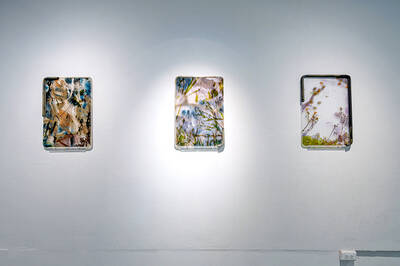
Located down a sideroad in old Wanhua District (萬華區), Waley Art (水谷藝術) has an established reputation for curating some of the more provocative indie art exhibitions in Taipei. And this month is no exception. Beyond the innocuous facade of a shophouse, the full three stories of the gallery space (including the basement) have been taken over by photographs, installation videos and abstract images courtesy of two creatives who hail from the opposite ends of the earth, Taiwan’s Hsu Yi-ting (許懿婷) and Germany’s Benjamin Janzen. “In 2019, I had an art residency in Europe,” Hsu says. “I met Benjamin in the lobby
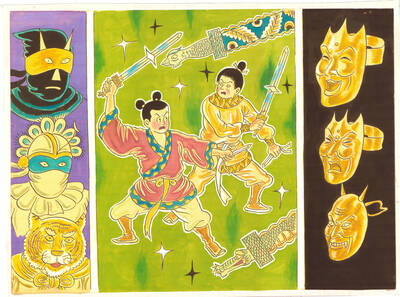
April 22 to April 28 The true identity of the mastermind behind the Demon Gang (魔鬼黨) was undoubtedly on the minds of countless schoolchildren in late 1958. In the days leading up to the big reveal, more than 10,000 guesses were sent to Ta Hwa Publishing Co (大華文化社) for a chance to win prizes. The smash success of the comic series Great Battle Against the Demon Gang (大戰魔鬼黨) came as a surprise to author Yeh Hung-chia (葉宏甲), who had long given up on his dream after being jailed for 10 months in 1947 over political cartoons. Protagonist

A fossil jawbone found by a British girl and her father on a beach in Somerset, England belongs to a gigantic marine reptile dating to 202 million years ago that appears to have been among the largest animals ever on Earth. Researchers said on Wednesday the bone, called a surangular, was from a type of ocean-going reptile called an ichthyosaur. Based on its dimensions compared to the same bone in closely related ichthyosaurs, the researchers estimated that the Triassic Period creature, which they named Ichthyotitan severnensis, was between 22-26 meters long. That would make it perhaps the largest-known marine reptile and would


 RSS
RSS