


“Mommy, I think I have some camel meat stuck in my teeth.” Now there’s something I don’t hear my eight-year-old daughter say every day. But then, we weren’t on an everyday kind of American family vacation.
My husband, Scott, my three children and I were in Oman, a place so remote that some of my friends had to look it up on their globes. Though we didn’t know it at the time, this Middle Eastern gem bordering Saudi Arabia has been named by many travel guides as a major hot spot for next year.
Last month, we spent nine days month in this exotic state on the Arabian sea, dividing our time between Muscat, the capital, and Salalah, a port city in the far south bordered by some of the most beautiful beaches I’ve ever seen.
The eating of camel meat came smack in the middle, when we opted to break away from our five-star luxury hotel and trek out into the remote Empty Quarter — the world’s largest sand desert — for a night of camping with a Bedouin guide.
Although I would have been perfectly content to lie by the pool, my husband had convinced me that a dunes-filled desert tour was a once-in-a-lifetime experience, certainly one not to be missed by our children.
So off we went in our SUV on a four-hour journey from Salalah into the abyss, a ride that started on a smooth highway and ended on a trackless desert sandscape that rapidly alternated between ascending and descending.
On the way, our guide took great delight in pointing out every gnarled frankincense tree we came across — and we came across a lot. Oman takes enormous pride in its frankincense, and the scent of the tree’s resin is ubiquitous in homes, shops and hotels throughout the country.
After coming to grips with the reality that fine grains of sand were going to get everywhere, I had to admit that there was something spectacular about watching the sunset in a sand dune swath covering 647,500km² of southern Arabia.
As we lay on our raised cots that night, out in the open, more than one glass of good scotch under a sky blazing with stars made me forget the white mice and black beetles scurrying across the sand.
Indeed, after an alfresco dinner of camel meat, chicken, rice, and garlic-touched fresh vegetables cooked by a handful of Bedouin men, the Arabian night cast a spell over me. And so did the rest of the holiday, filled with camels, beachcombing, world-class scuba diving and meals of mouth-watering tuna steaks and hummus.
Oman was an isolated, inward-looking nation until the 1970s, when the current leader, Sultan Qaboos bin Said, deposed his father in a bloodless coup and embarked on a lightning-fast investment and rebuilding scheme designed to bring the country into the 20th century. Today Oman is a peaceful country that hasn’t been afflicted with the same kind of turmoil so prevalent in other parts of the Middle East. Forty years ago, there were only 9.5km of paved road in this Kansas-sized country. Today there are thousands of kilometers of freeways, as well as road signs in English as well as Arabic.
There also are some top-notch luxury hotels and restaurants.
In Muscat we stayed at the massive Shangri-La’s Barr Al Jissah Resort, which boasts three hotels encompassing 638 rooms and nearly 20 different restaurants. Due to Islam-based rules, no alcohol is served most days from 3pm to 6pm, or before 2pm on Fridays. Yet Heineken beer can be found in the hotel rooms’ mini-fridges.
Although parts of the country are strangely Western — there’s a Dairy Queen in the Muscat airport — this is still very much a Middle Eastern country, one that perfectly blends old and new.
Away from the hotels, many women still cover themselves in long black robes. And men still wear the long, flowing tunics known as dishdashas, as well as the intricately embroidered skull cap called a kumma.
Besides Oman’s vast desert and plush hotels, why would one make the seven-hour plane ride from London — or much longer journey from New York? One major draw is the largely untouched 1,600km of coastline. In Oman, you can still find wide stretches of gorgeous sand, overrun with shells but with not a single sunbather.
Another attraction is Muscat itself, with its mosques, palaces, and historic harbor district dominated by a pair of 16th-century fortresses, Mirani and Jalali. One afternoon we visited the city’s colorful Muttrah souk and enjoyed getting lost in the winding alleyways that pass stalls hawking spices, crafts, scarves, silverware, and other souvenirs, all under a canopied roof of palm fronds.
From our Shangri-La hotel just outside Muscat, we also were able to arrange half-day snorkeling journeys on which the children were able to swim alongside huge sea turtles. There are more than 100 dive sites around Muscat alone, and even non-divers can enjoy close encounters with fish, turtles, dolphins and whale sharks.
But even better were the beaches around Salalah, a 90-minute plane ride from Muscat. Here we stayed at the lovely Crowne Plaza Hotel surrounded by some of the most pristine coastline in the world, a coastline that is especially alluring during the months of October through April.
What we liked best about Oman was that there are no glass skyscrapers of 21st-century commerce to mar the skyline as there are in Dubai, Oman’s flashy tourist-filled neighbor. There are simply jagged bluffs, old-fashioned food markets, hospitable people, and camels and goats grazing by the sides of roads.
We left the country armed with Christmas presents for friends, as well as hopes that Oman will retain its traditional, low-key flavor. We also arrived home with sand still in our suitcases.
But after such a great vacation, who cares?
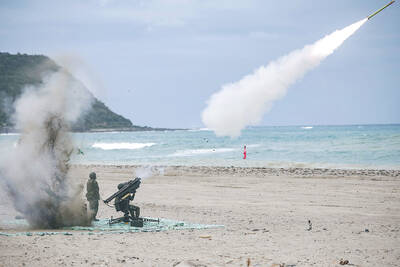
In late October of 1873 the government of Japan decided against sending a military expedition to Korea to force that nation to open trade relations. Across the government supporters of the expedition resigned immediately. The spectacle of revolt by disaffected samurai began to loom over Japanese politics. In January of 1874 disaffected samurai attacked a senior minister in Tokyo. A month later, a group of pro-Korea expedition and anti-foreign elements from Saga prefecture in Kyushu revolted, driven in part by high food prices stemming from poor harvests. Their leader, according to Edward Drea’s classic Japan’s Imperial Army, was a samurai
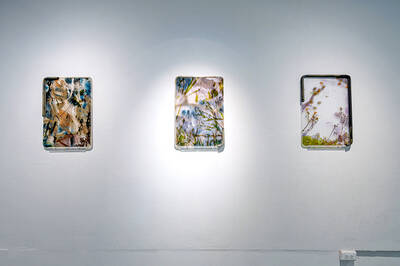
Located down a sideroad in old Wanhua District (萬華區), Waley Art (水谷藝術) has an established reputation for curating some of the more provocative indie art exhibitions in Taipei. And this month is no exception. Beyond the innocuous facade of a shophouse, the full three stories of the gallery space (including the basement) have been taken over by photographs, installation videos and abstract images courtesy of two creatives who hail from the opposite ends of the earth, Taiwan’s Hsu Yi-ting (許懿婷) and Germany’s Benjamin Janzen. “In 2019, I had an art residency in Europe,” Hsu says. “I met Benjamin in the lobby
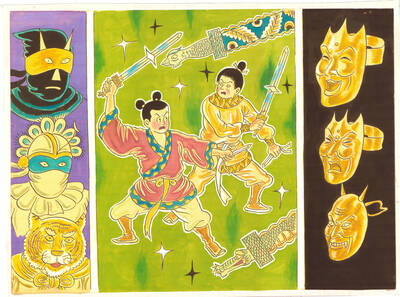
April 22 to April 28 The true identity of the mastermind behind the Demon Gang (魔鬼黨) was undoubtedly on the minds of countless schoolchildren in late 1958. In the days leading up to the big reveal, more than 10,000 guesses were sent to Ta Hwa Publishing Co (大華文化社) for a chance to win prizes. The smash success of the comic series Great Battle Against the Demon Gang (大戰魔鬼黨) came as a surprise to author Yeh Hung-chia (葉宏甲), who had long given up on his dream after being jailed for 10 months in 1947 over political cartoons. Protagonist

The following three paragraphs are just some of what the local Chinese-language press is reporting on breathlessly and following every twist and turn with the eagerness of a soap opera fan. For many English-language readers, it probably comes across as incomprehensibly opaque, so bear with me briefly dear reader: To the surprise of many, former pop singer and Democratic Progressive Party (DPP) ex-lawmaker Yu Tien (余天) of the Taiwan Normal Country Promotion Association (TNCPA) at the last minute dropped out of the running for committee chair of the DPP’s New Taipei City chapter, paving the way for DPP legislator Su


 RSS
RSS