


I used to be drawn to a small noodle shop in Shida because it was wallpapered with different stylizations of the Chinese character for book (書). Although no explanation of the styles was offered, I enjoyed contemplating the different types of calligraphy over a bowl of wonton noodles (餛飩麵).
The current exhibit at the National Museum of History, A Drop in the Ocean: Modern Contemporary Chinese Calligraphy and Painting Exhibition (滄海一粟—近現代書畫展), could have been an excellent opportunity to educate the public about the long and revered Chinese traditions of ink painting and calligraphy, which are said to date back at least two millennia. What has been presented instead is an exhibition that is barely more edifying than the wallpaper in that now-closed noodle shop.
Apart from a brief four-paragraph introduction, there are no explanations — in Chinese or any other language — as to the exhibit’s purpose. Although a title and artist are given for each work, the medium is not listed, and there are no dates or other clues as to why these works should be worthy of viewing, aside from hackneyed appeal to cliches such as “the meaning of life” and “cultivating one’s emotions and feelings.”
Consequently, viewers are left to figure out for themselves the meaning, context and tradition of each of the more than 300 ink paintings and calligraphic works that have been handsomely hung in glass cases throughout most of the museum’s second floor. The title of the exhibit is also misleading because fully two-thirds of the works on display were created before the “modern contemporary” period.
Part of what makes an object worthy of being placed in a museum is the tradition within which it exists. The genius of Chu Teh-chun’s (朱德群) abstract expressionist paintings, for example, only makes sense in the context of his evolution as an artist in a particular place and time. (An excellent retrospective of Chu’s work is currently on display as a special exhibit on the museum’s first floor. For details on that show, see the review on Page 15 of last Wednesday’s Taipei Times.)
It is difficult to believe that the curator or the two collectors who lent the works on display didn’t know the precise dates of the scrolls and paintings, which presumably were appraised before being hung. And since the artists’ names are given, the curator or museum could have at least provided the dates of the artists’ lives.
Chinese calligraphy has five essential styles, which are sometimes used in combination, and the museum could have taken advantage of some of the works on display to reveal the evolving and changing nature of calligraphy, the manner in which is was taught and why it was so important to the literati throughout Chinese history. The same applies to the ink paintings. Unfortunately, Wikipedia gives better descriptions of both traditions (“East Asian script styles” and “Chinese ink painting,” respectively) than this exhibit does.
I visited the exhibit three times and spoke with museumgoers of different ages to gain a sense of what they were or were not seeing. A younger university-educated woman showed tremendous patience with my incessant questioning because she often couldn’t answer even the most basic questions: What dynasty did this painter live in? What does that classical poem mean and was it written by the calligrapher? An older gentleman preferred to lead me to the ink paintings and scrolls he had some familiarity with, but, aside from noting that the artist was well-known, he often couldn’t answer the question: What makes the works worthy of being hung? Most visitors, meanwhile, walked briskly through the calligraphy sections and only paused briefly to look at the ink paintings.
In other words, Taiwanese visitors, especially the majority who stopped studying calligraphy after high school, are going to be nearly as confounded as to what they are seeing as this reviewer.
According to the exhibition literature, “Chinese calligraphy and painting is an activity contributing to one’s peace of mind and inner tranquility.” The arrangement of this exhibit, however, creates confusion and annoyance, raising more questions than it answers. Another gem from the four-paragraph introduction: “So many pieces … make us wonder what they contain and imply.” Exactly.
Rather than edify the public, the exhibit’s purpose, it would seem, is to advertise the “modesty” (this from the first paragraph of the introduction) of the two collectors who allowed the museum to show their collections.
“Finally, it is also hoped that, in the future, more collectors will be willing to show their collections so that audiences can have more opportunities to look at and understand ancient masterpieces,” the exhibit’s literature states. Hopefully, the next such exhibit will provide more information on the works on display, so that those who are not curators, art experts or collectors can understand why they are looking at the scrolls and paintings in front of them.
CORRECTION:
Last Wednesday the ticket price for the Chu Teh-chun 88 Retrospective (朱德群88回顧展) at the National Museum of History was incorrectly listed as NT$30. The ticket price is NT$150; concession tickets are NT$100. The Taipei Times regrets the error.
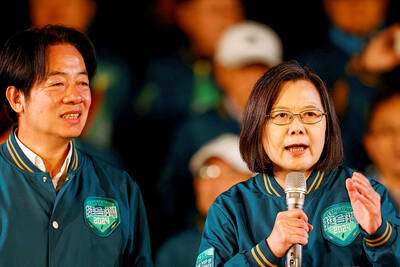
Last week Joseph Nye, the well-known China scholar, wrote on the Australian Strategic Policy Institute’s website about how war over Taiwan might be averted. He noted that years ago he was on a team that met with then-president Chen Shui-bian (陳水扁), “whose previous ‘unofficial’ visit to the US had caused a crisis in which China fired missiles into the sea and the US deployed carriers off the coast of Taiwan.” Yes, that’s right, mighty Chen caused that crisis all by himself. Neither the US nor the People’s Republic of China (PRC) exercised any agency. Nye then nostalgically invoked the comical specter
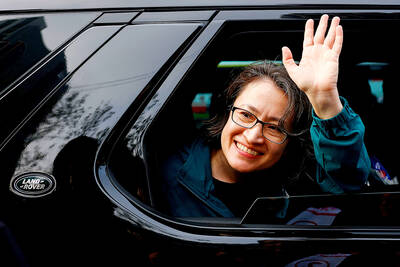
Relations between Taiwan and the Czech Republic have flourished in recent years. However, not everyone is pleased about the growing friendship between the two countries. Last month, an incident involving a Chinese diplomat tailing the car of vice president-elect Hsiao Bi-khim (蕭美琴) in Prague, drew public attention to the People’s Republic of China’s (PRC) operations to undermine Taiwan overseas. The trip was not Hsiao’s first visit to the Central European country. It was meant to be low-key, a chance to meet with local academics and politicians, until her police escort noticed a car was tailing her through the Czech capital. The
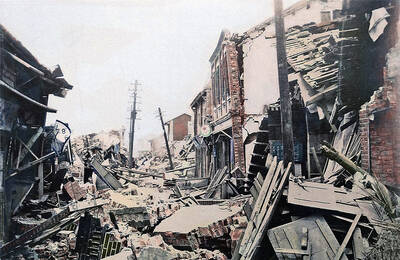
April 15 to April 21 Yang Kui (楊逵) was horrified as he drove past trucks, oxcarts and trolleys loaded with coffins on his way to Tuntzechiao (屯子腳), which he heard had been completely destroyed. The friend he came to check on was safe, but most residents were suffering in the town hit the hardest by the 7.1-magnitude Hsinchu-Taichung Earthquake on April 21, 1935. It remains the deadliest in Taiwan’s recorded history, claiming around 3,300 lives and injuring nearly 12,000. The disaster completely flattened roughly 18,000 houses and damaged countless more. The social activist and

Over the course of former President Ma Ying-jeou’s (馬英九) 11-day trip to China that included a meeting with Chinese Communist Party (CCP) leader Xi Jinping (習近平) a surprising number of people commented that the former president was now “irrelevant.” Upon reflection, it became apparent that these comments were coming from pro-Taiwan, pan-green supporters and they were expressing what they hoped was the case, rather than the reality. Ma’s ideology is so pro-China (read: deep blue) and controversial that many in his own Chinese Nationalist Party (KMT) hope he retires quickly, or at least refrains from speaking on some subjects. Regardless


 RSS
RSS