


The Sotheby’s auction house kicked off its annual art sale in New York this week against the backdrop of a gloomy economy that had some observers wondering whether there were any deep-pocketed buyers left to snap up paintings for tens of millions of US dollars.
Well, there are. And they’re breaking records.
Some of the most famous artworks of the past century were up for sale, including Edgar Degas’ Dancer in Repose and Kazimir Malevich’s Suprematist Composition (from 1916).
The Degas sold on Monday night for just over US$37 million, an all-time high for the artist, whose previous best was US$28 million for the same piece in 1999, a Sotheby’s spokeswoman said. The work’s presale estimate was US$40 million.
The Malevich work sold on Monday for just over US$60 million, in line with its presale estimate. The sale price set a record for the artist and for any Russian artwork sold at auction, Sotheby’s said.
The previous record for Malevich was US$17 million for another Suprematist Composition (from 1919 to 1920) in 2000; the previous Russian record was US$20.9 million for Wassily Kandinsky’s Fugue in 1990.
And Edvard Munch’s Vampire, a brooding painting of a woman with cascading auburn hair, set a new record for the Norwegian artist, US$38.2 million, Sotheby’s said. The previous record was US$30.8 million for Girls on a Bridge, set last year.
The buyers’ identities weren’t immediately disclosed.
Among those who reportedly are selling pieces from their art collections are Kathy Fuld, the wife of Richard Fuld Jr, the former chief executive officer of Lehman Brothers who has been vilified for his company’s role in the global financial meltdown.
The high-end art market had stumbled in recent months as the hedge fund traders, financiers and Russian, European and Middle Eastern buyers who helped prop up the art market in recent years fell victims to the financial crisis.
Sagging prices at last month’s London auctions suggested that the financial meltdown had finally ended the art market boom, which has seen a series of price records shattered over the last few years.
Christie’s and Sotheby’s contemporary art sales generated at least a third less money than predicted, and many items were unsold.
The auction houses’ New York sales are considered an important test of how price levels have changed since the summer and of how buyers will respond to the top-selling works, said Ian Peck, CEO of the art finance firm Art Capital Group.
The last such sales, in May, generated more than US$500 million between the two houses.
Last week, Sotheby’s withdrew Pablo Picasso’s Arlequin, one of the star lots at its Monday sale, for private reasons.
The move was “a sign that auction houses and buyers fear the risk of a downturn in prices is too great to ignore,’’ Peck said.
That fear also was evident in an online auction last week when a 1717 Stradivari cello reached a record bid of US$1.35 million but failed to reach its estimated value of US$1.48 million to US$1.97 million or its reserve, according to Tarisio, an auctioneer of fine stringed instruments and bows. The reserve is the lowest undisclosed price the consignor agrees to sell a work.
Sotheby’s and Christie’s said on Monday they were cautiously optimistic about the outcome of the Impressionist and modern art sales this week and postwar and contemporary art sales next week.
“The result will speak to market expectations,’’ said Guy Bennett, international co-head of Impressionist and modern art at Christie’s. “It won’t just be about one sale. The market is far deeper and broader than that. I think we found the right balance in terms of price points and also the quality of the things we’re offering.’’
The Fulds reportedly are selling a group of abstract and minimalist drawings at Christie’s on Wednesday of next week. The highlight of the 16 Master Drawings of American Post War Art from a Private Collection is a 1951 Willem de Kooning drawing of a nude called Woman, estimated at US$4 million.
Another important indicator in the art auction market is the number of guarantees by the auction houses. A guarantee is the undisclosed sum sellers are promised regardless of whether the work sells or not.
To offset risk that some works would not sell in the current financial climate, Sotheby’s has cut guarantees from $458.5 million last year to US$306.1 million this year.
Christie’s has guaranteed six out of 85 works in its Impressionist and modern art sale today, compared to the spring, when it guaranteed 16 out of 58 works from the same period.
“The things that we have chosen to guarantee this season we feel very comfortable with, we feel we made the right decision and we’ll see how the market reacts,’’ said Bennett.
To hedge against risk, Sotheby’s had lined up a buyer for Malevich’s Suprematist Composition who had placed an irrevocable bid on the abstract painting. If the painting went higher than the agreed-on price, which wasn’t disclosed, then the bidder with the irrevocable bid would be compensated according to prior arrangements.
The painting was recently returned to the artist’s descendants following a court battle and after residing for many years in the Stedelijk Museum in Amsterdam.
Despite the troubles in the market, as recently as last month the glimmer of the art market’s strength was evident when works by Damien Hirst sold for US$200 million at Sotheby’s in London.
Sotheby’s CEO William Ruprecht, in an interview last month, said “there’s no question’’ that some buyers are not willing to pay as much as before. “But there’s also no question that there’s an awful lot of interest in important works of art,’’ he said.
Peck said the “worst situation in the upcoming auctions would be for people to lose confidence in art as an asset or its perceived liquidity.’’
Among the other works coming up this week and next are Untitled (Boxer), a 1982 Jean-Michel Basquiat painting owned by Lars Ulrich of heavy-metal band Metallica. Christie’s expects it to fetch more than US$12 million at next Wednesday’s sale but feels it could surpass the current Basquiat record, US$14.6 million.

Last week Joseph Nye, the well-known China scholar, wrote on the Australian Strategic Policy Institute’s website about how war over Taiwan might be averted. He noted that years ago he was on a team that met with then-president Chen Shui-bian (陳水扁), “whose previous ‘unofficial’ visit to the US had caused a crisis in which China fired missiles into the sea and the US deployed carriers off the coast of Taiwan.” Yes, that’s right, mighty Chen caused that crisis all by himself. Neither the US nor the People’s Republic of China (PRC) exercised any agency. Nye then nostalgically invoked the comical specter

Relations between Taiwan and the Czech Republic have flourished in recent years. However, not everyone is pleased about the growing friendship between the two countries. Last month, an incident involving a Chinese diplomat tailing the car of vice president-elect Hsiao Bi-khim (蕭美琴) in Prague, drew public attention to the People’s Republic of China’s (PRC) operations to undermine Taiwan overseas. The trip was not Hsiao’s first visit to the Central European country. It was meant to be low-key, a chance to meet with local academics and politicians, until her police escort noticed a car was tailing her through the Czech capital. The
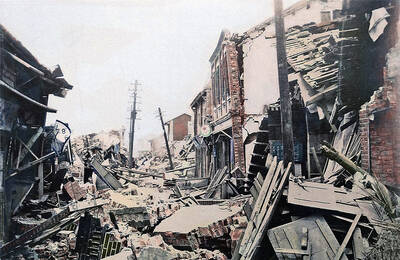
April 15 to April 21 Yang Kui (楊逵) was horrified as he drove past trucks, oxcarts and trolleys loaded with coffins on his way to Tuntzechiao (屯子腳), which he heard had been completely destroyed. The friend he came to check on was safe, but most residents were suffering in the town hit the hardest by the 7.1-magnitude Hsinchu-Taichung Earthquake on April 21, 1935. It remains the deadliest in Taiwan’s recorded history, claiming around 3,300 lives and injuring nearly 12,000. The disaster completely flattened roughly 18,000 houses and damaged countless more. The social activist and

Over the course of former President Ma Ying-jeou’s (馬英九) 11-day trip to China that included a meeting with Chinese Communist Party (CCP) leader Xi Jinping (習近平) a surprising number of people commented that the former president was now “irrelevant.” Upon reflection, it became apparent that these comments were coming from pro-Taiwan, pan-green supporters and they were expressing what they hoped was the case, rather than the reality. Ma’s ideology is so pro-China (read: deep blue) and controversial that many in his own Chinese Nationalist Party (KMT) hope he retires quickly, or at least refrains from speaking on some subjects. Regardless


 RSS
RSS