


Long before Barista Coffee or Starbucks arrived on these shores, Taiwan was home to a burgeoning cafe culture. But unlike the American-inspired franchise coffee shops that have sprung up across the country’s urban landscapes over the past decade, these earlier bohemian hangouts blended a Japanese-style tea shop atmosphere with a European vibe.
Early Taiwanese Coffee Culture (早期咖啡文化), located on the second floor of the National Museum of History, explores this coffee culture in an informative and well-designed, though small, exhibition.
The exhibition investigates two themes: the island’s coffee cultivation since the 19th century, and the coffee house culture that developed during the Japanese occupation period.
The museum does an adequate job of recreating the atmosphere of those days — from the lounge-style bars to the costumes of the servers — and even built a replica of a 1920s coffee shop.
The exhibit’s large collection of objects from the period, such as gramophones, phonograms, radios, as well as antique furniture and appliances, helps transport viewers back to a time when coffee shops were places to unwind and listen to the latest jazz, watch a silent movie or discuss art.
The black-and-white photos hung throughout the exhibit reveal a marked difference with Taiwan’s contemporary coffee shops. Here you won’t find crowds of university students spending hours at tables — either sleeping or studying — but well-heeled artists and intellectuals.
Other images show the servers in these haunts — far removed from the modern baristas who press buttons to brew coffee — and who were called jyogyuu (女給), a kind of geisha-cum-waitress. These images show “servers” sitting and chatting with clients.
The museum does a journeyman’s job bringing to life those glory days by placing the museumgoer right in the middle of the action. The exhibit also reveals the idiosyncrasies of each coffee shop, where owners would create an ambiance with a unique choice of furniture, art and services, which contrasts the uniform look of today’s coffee shops.
The section about Taiwan’s coffee cultivation is limited, just like the industry itself. It does, however, point out where coffee is grown and explain the bean-growing process.
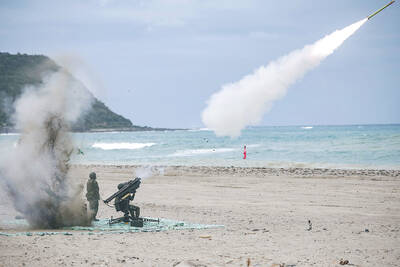
In late October of 1873 the government of Japan decided against sending a military expedition to Korea to force that nation to open trade relations. Across the government supporters of the expedition resigned immediately. The spectacle of revolt by disaffected samurai began to loom over Japanese politics. In January of 1874 disaffected samurai attacked a senior minister in Tokyo. A month later, a group of pro-Korea expedition and anti-foreign elements from Saga prefecture in Kyushu revolted, driven in part by high food prices stemming from poor harvests. Their leader, according to Edward Drea’s classic Japan’s Imperial Army, was a samurai
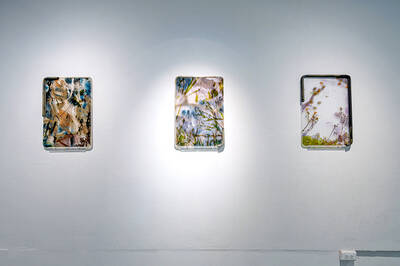
Located down a sideroad in old Wanhua District (萬華區), Waley Art (水谷藝術) has an established reputation for curating some of the more provocative indie art exhibitions in Taipei. And this month is no exception. Beyond the innocuous facade of a shophouse, the full three stories of the gallery space (including the basement) have been taken over by photographs, installation videos and abstract images courtesy of two creatives who hail from the opposite ends of the earth, Taiwan’s Hsu Yi-ting (許懿婷) and Germany’s Benjamin Janzen. “In 2019, I had an art residency in Europe,” Hsu says. “I met Benjamin in the lobby
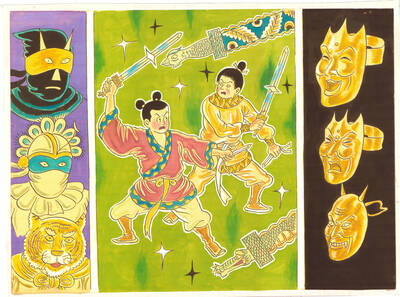
April 22 to April 28 The true identity of the mastermind behind the Demon Gang (魔鬼黨) was undoubtedly on the minds of countless schoolchildren in late 1958. In the days leading up to the big reveal, more than 10,000 guesses were sent to Ta Hwa Publishing Co (大華文化社) for a chance to win prizes. The smash success of the comic series Great Battle Against the Demon Gang (大戰魔鬼黨) came as a surprise to author Yeh Hung-chia (葉宏甲), who had long given up on his dream after being jailed for 10 months in 1947 over political cartoons. Protagonist

Peter Brighton was amazed when he found the giant jackfruit. He had been watching it grow on his farm in far north Queensland, and when it came time to pick it from the tree, it was so heavy it needed two people to do the job. “I was surprised when we cut it off and felt how heavy it was,” he says. “I grabbed it and my wife cut it — couldn’t do it by myself, it took two of us.” Weighing in at 45 kilograms, it is the heaviest jackfruit that Brighton has ever grown on his tropical fruit farm, located


 RSS
RSS