


Inthe current lean economic times, the performing arts have been struggling to fill auditoriums, so it is very gratifying to report that the most recent new production by the Tang Mei Yun Taiwanese Opera Company (唐美雲歌仔戲團), Lost Butterfly (蝶谷殘夢), managed to sell all its tickets for four performances a week before the show opened yesterday at the National Theater in Taipei. This is all the more amazing as this production is an experimental cooperation with the National Taiwan Symphony Orchestra (NTSO, 國立台灣交響樂團), which is providing a Western classical music score to the gezai opera (歌仔戲).
Fusions of Chinese opera with Western classical music orchestration are all the rage these days, but they have been something of a hit-and-miss affair, arguably reaching a nadir with the fantastically ambitious The Firmiana Rain (梧桐雨) in October last year. Lost Butterfly is less ambitious, with a clear point of departure within the traditions of gezai opera. The use of a small number of Western orchestral instruments to enrich the sound of Chinese opera is not new, but this is the first time that Tang Mei Yun has cooperated with a full Western orchestra, which performs in addition to the traditional Chinese string and percussion ensemble.
Chinese opera is notable for its relatively small musical ensemble, with clapper boards marking the beat and a string instrument sketching in a melody, which is filled out and articulated by the singer. The presence of the NTSO means that the music — an original score written by composer Chung Yiu-Kwong (鍾耀光), currently the director of the Taipei Chinese Orchestra (台北市立國樂團), and Liu Wen-liang (劉文亮), a specialist in theater music — shares the limelight with the singers, rather than playing a purely auxiliary role. The effect, as when French horns come in to lend their resonance to the expression of deep emotions, or when trombones and kettle drums bring complex and melodramatic revelations to a resounding and climatic denouement, has a cinematic quality that is not unappealing; in a more naturalistic style of performance, it might have been bombastic, but responding to the high emotions and stylization of gezai, the Romanticism of the score works rather well.
Within the rich texture of the orchestra score, the traditional ensemble occasionally emerges, sometimes in the strains of traditional instruments such as the erhu (二胡), sketching in the basic melodic line, or the taps of the clapper that give emphasis to the movements of the performers. At a rehearsal on Monday, there were clearly still some hiccups in establishing the rapport between musicians and performers (one of the crucial differences between Chinese and Western opera is that in the former, the musicians watch the performers and take their cue from them, whereas in Western opera, the singers follow the music), but overall, the solid grounding in the conventions of gezai meant that things could not go too far off the rails.
Tang Mei-yun (唐美雲), who takes the leading male role, is a powerful presence on stage, but more than that, has also taken an important role in pushing operatic conventions. In one scene, she goes so far as to partly undress one of her leading ladies with the clear intention of taking her to bed. This sort of thing is as far outside the conventions of gezai staging as the orchestra music that is part of Lost Butterfly, and Tang underlined these new developments by saying: “I would not do this with an established opera, but this is an entirely new opera.”
Tang’s reputation for putting on solid performances that don’t tax audiences in too many ways at once has clearly paid off, ensuring that she retains the support of traditional fans while appealing to younger audiences with her bolder ways of telling a story. Her success seems to indicate that reports of the death of traditional opera have been greatly exaggerated.

Last week Joseph Nye, the well-known China scholar, wrote on the Australian Strategic Policy Institute’s website about how war over Taiwan might be averted. He noted that years ago he was on a team that met with then-president Chen Shui-bian (陳水扁), “whose previous ‘unofficial’ visit to the US had caused a crisis in which China fired missiles into the sea and the US deployed carriers off the coast of Taiwan.” Yes, that’s right, mighty Chen caused that crisis all by himself. Neither the US nor the People’s Republic of China (PRC) exercised any agency. Nye then nostalgically invoked the comical specter

Relations between Taiwan and the Czech Republic have flourished in recent years. However, not everyone is pleased about the growing friendship between the two countries. Last month, an incident involving a Chinese diplomat tailing the car of vice president-elect Hsiao Bi-khim (蕭美琴) in Prague, drew public attention to the People’s Republic of China’s (PRC) operations to undermine Taiwan overseas. The trip was not Hsiao’s first visit to the Central European country. It was meant to be low-key, a chance to meet with local academics and politicians, until her police escort noticed a car was tailing her through the Czech capital. The
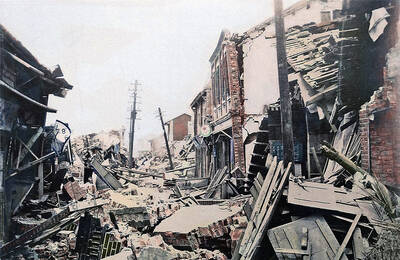
April 15 to April 21 Yang Kui (楊逵) was horrified as he drove past trucks, oxcarts and trolleys loaded with coffins on his way to Tuntzechiao (屯子腳), which he heard had been completely destroyed. The friend he came to check on was safe, but most residents were suffering in the town hit the hardest by the 7.1-magnitude Hsinchu-Taichung Earthquake on April 21, 1935. It remains the deadliest in Taiwan’s recorded history, claiming around 3,300 lives and injuring nearly 12,000. The disaster completely flattened roughly 18,000 houses and damaged countless more. The social activist and

Over the course of former President Ma Ying-jeou’s (馬英九) 11-day trip to China that included a meeting with Chinese Communist Party (CCP) leader Xi Jinping (習近平) a surprising number of people commented that the former president was now “irrelevant.” Upon reflection, it became apparent that these comments were coming from pro-Taiwan, pan-green supporters and they were expressing what they hoped was the case, rather than the reality. Ma’s ideology is so pro-China (read: deep blue) and controversial that many in his own Chinese Nationalist Party (KMT) hope he retires quickly, or at least refrains from speaking on some subjects. Regardless


 RSS
RSS