


This is the standard “treatment” for mentally ill people who have been coming to the Mia Ali sanctuary in eastern Afghanistan for 300 years.
“Here, we don’t give medication or advice, there is no other treatment than belief in God,” says Mia Mohammed Naeem, one of the guardians of the shrine in Samar Khel village, 10km from the city of Jalalabad.
“It’s a spiritual treatment with the Koran and diet,” he says.
In a country destroyed by three decades of conflict, about 2 million people suffer mental illness, according to the World Health Organization. But in 2005 there were only 160 beds in the nation’s psychiatric facilities, it says. At the Mia Ali sanctuary the patients, presumed to be possessed by jinns (demons), are chained by the wrist to a tree or in a concrete room, under shelter or in the open, for 40 days. They are fed only bread and water and get no change of clothing. In a shack close by, Ghulam Haider, 45, crouches on the ground, tirelessly writing in Arabic the different names of God and verses of the Koran on pieces of paper.
“Some of these taweez [amulets] will be poured in a glass of water and then drunk. Others will be burned or used as a necklace. Every single word of the holy Koran is healing,” he says.
The taweez, not recognized by orthodox Islam, are used to treat mental sickness and are also sought after by the pilgrims who come to visit and pray at the tomb of Mia Ali Sayed, a Sufi sage from the 17th century. Among one family that has arrived is a woman in a burqa who holds a baby in her arms: everyone has come to pray for the child to not cry the whole night. Other visitors ask for headaches or stomach pains to stop.
“We don’t ask Mia Ali for a cure, we ask God. Mia Ali is only the way to God,” says Mia Mohammed Naeem.
As his name suggests, he is a descendant of the Sufi as are the roughly 50 people who maintain this sanctuary, each taking turns for a few days a month. In normal life, Mohammed Naeem is a driver. Only Asadullah, an old man of 85 whose fingers play with the keys to the locks on the chains of the current eight patients, works full-time at the site.
“My responsibility is to tie up the patients. During the night, I go to see how they are; I clean them. Some can be violent but they respect my white beard,” he says.
Behind him a rake-thin young man is tied up inside a concrete room. Bare-chested and emitting a strong smell, Wali arrived here from Kabul, 150km away, about 20 days ago.
“I drank whisky, I smoked hash … so my family brought me here,” he says with a dark look.
The keepers of the sanctuary have no doubt about the success of this method of treatment developed by Mia Ali himself.
“Most of the people get well after 40 days,” says Mohammed Naeem. He gestures to an electricity generator. “This was built for us by a patient who came here in a bad condition and, as a miracle, was cured,” he says, adding that patients come from all over Afghanistan and even neighboring Pakistan.
“Families pay US$100 for food and cleaning. We stay in contact with them by phone,” he says.
The sanctuary has no links with the psychiatric section of the public hospital in the city of Jalalabad, even though it is close by.
“Family members bring the people here after treatment in the hospital has failed,” says Jan Baz, a 22-year-old soldier who is also a member of the Mia family. The hospital has had a psychiatric section for 30 years but can no longer admit permanent patients, allowing people to stay for only three weeks even though many return.
“We have 20 beds but only 12 patients right now,” says the head of the mental ward, Ahmad Zahir Allahyar. “Our treatment uses both medication and psychotherapy. The doctors counsel the patients, they talk to them as friends. There are music programs, they can watch TV, play board games, study … to free them from depression.”
A few years ago, patients here would have been tied to their beds but this practice has been stopped, the doctors adds, as people in blue uniforms amble in the corridor.
“War is the main cause for developing this kind of disease — most of them have histories of losing members of their families,” Allahyar says. Many Afghans try to cope themselves and it’s only the chronically ill who need a hospital such as this one, he says.
One of them is Raza Khan, who is about 50 years old and has a beard that is more salt than pepper. He says he has been ill since the time of the 1979 to 1989 Soviet invasion when he was a mujahidin (holy fighter).
“I saw a lot of fighting. I wasn’t scared of the Russian tanks or artillery but I got tired, not sleeping well. I started beating my relatives,” he says. “I know I’m ill. Whenever I’m cured, I want to go back to my family.”
Next to him is 27-year-old Jamshir, a former refugee in Pakistan who returned to Afghanistan three years ago.
“I have no job, no money,” he says. “I have long-term malaria. I’m causing problems for my family. “Here I am given pills, medicine, and after that I feel ok. I want to get cured and to help rebuild my country.”
The center can admit no women — this would mean building a separate building although this is being considered. Asked about the Mia Ali sanctuary, hospital medical director Abdel Shakoor says that education will one day see such practices disappear.
“Day after day, our network to cover mental illness increases and the number of people who believe in the shrine decreases,” the doctor says.
“But it will take a lot of time to change the behavior of the people. It needs more education, social organization systems, community participation, to change the habits of people.”
But he is not optimistic about the chances of his own patients being cured.
“In 21 days, we can only put them out of danger, not cure them,” he says. “They are chronic patients, the treatment is so long.”

Last week Joseph Nye, the well-known China scholar, wrote on the Australian Strategic Policy Institute’s website about how war over Taiwan might be averted. He noted that years ago he was on a team that met with then-president Chen Shui-bian (陳水扁), “whose previous ‘unofficial’ visit to the US had caused a crisis in which China fired missiles into the sea and the US deployed carriers off the coast of Taiwan.” Yes, that’s right, mighty Chen caused that crisis all by himself. Neither the US nor the People’s Republic of China (PRC) exercised any agency. Nye then nostalgically invoked the comical specter

Relations between Taiwan and the Czech Republic have flourished in recent years. However, not everyone is pleased about the growing friendship between the two countries. Last month, an incident involving a Chinese diplomat tailing the car of vice president-elect Hsiao Bi-khim (蕭美琴) in Prague, drew public attention to the People’s Republic of China’s (PRC) operations to undermine Taiwan overseas. The trip was not Hsiao’s first visit to the Central European country. It was meant to be low-key, a chance to meet with local academics and politicians, until her police escort noticed a car was tailing her through the Czech capital. The
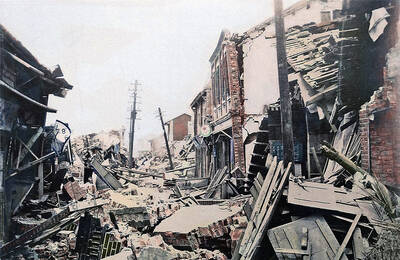
April 15 to April 21 Yang Kui (楊逵) was horrified as he drove past trucks, oxcarts and trolleys loaded with coffins on his way to Tuntzechiao (屯子腳), which he heard had been completely destroyed. The friend he came to check on was safe, but most residents were suffering in the town hit the hardest by the 7.1-magnitude Hsinchu-Taichung Earthquake on April 21, 1935. It remains the deadliest in Taiwan’s recorded history, claiming around 3,300 lives and injuring nearly 12,000. The disaster completely flattened roughly 18,000 houses and damaged countless more. The social activist and

Over the course of former President Ma Ying-jeou’s (馬英九) 11-day trip to China that included a meeting with Chinese Communist Party (CCP) leader Xi Jinping (習近平) a surprising number of people commented that the former president was now “irrelevant.” Upon reflection, it became apparent that these comments were coming from pro-Taiwan, pan-green supporters and they were expressing what they hoped was the case, rather than the reality. Ma’s ideology is so pro-China (read: deep blue) and controversial that many in his own Chinese Nationalist Party (KMT) hope he retires quickly, or at least refrains from speaking on some subjects. Regardless


 RSS
RSS